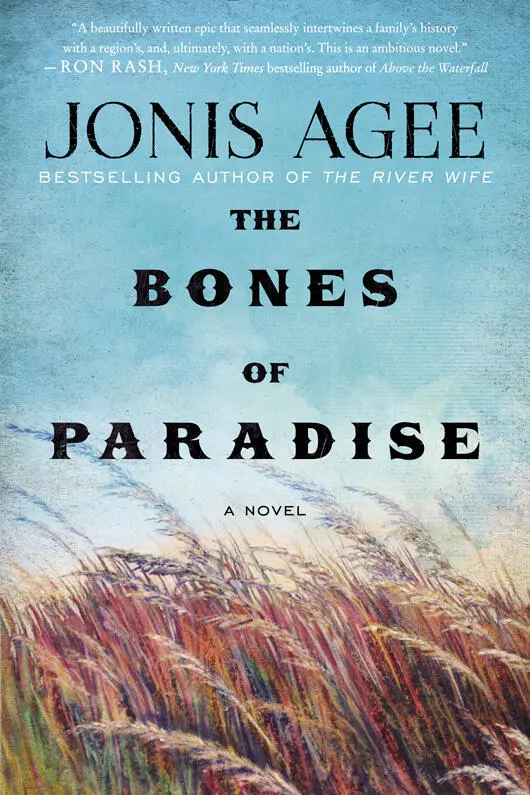
Jonis Agee - The Bones of Paradise
Здесь есть возможность читать онлайн «Jonis Agee - The Bones of Paradise» весь текст электронной книги совершенно бесплатно (целиком полную версию без сокращений). В некоторых случаях можно слушать аудио, скачать через торрент в формате fb2 и присутствует краткое содержание. Год выпуска: 2016, Издательство: William Morrow, Жанр: Современная проза, на английском языке. Описание произведения, (предисловие) а так же отзывы посетителей доступны на портале библиотеки ЛибКат.
- Название:The Bones of Paradise
- Автор:
- Издательство:William Morrow
- Жанр:
- Год:2016
- ISBN:нет данных
- Рейтинг книги:3 / 5. Голосов: 1
-
Избранное:Добавить в избранное
- Отзывы:
-
Ваша оценка:
The Bones of Paradise: краткое содержание, описание и аннотация
Предлагаем к чтению аннотацию, описание, краткое содержание или предисловие (зависит от того, что написал сам автор книги «The Bones of Paradise»). Если вы не нашли необходимую информацию о книге — напишите в комментариях, мы постараемся отыскать её.
returns with a multi-generational family saga, set in the unforgiving Nebraska Sandhills in the years following the massacre at Wounded Knee—an ambitious tale of history, vengeance, race, guilt, betrayal, family, and belonging, filled with a vivid cast of characters shaped by violence, love, and a desperate loyalty to the land. Ten years after the 7th Calvary massacred more than 200 Lakota men, women, and children at Wounded Knee, J. B. Bennett, a white rancher, and Star, a young Native American woman, are murdered in a remote meadow on J. B.’s land. The deaths bring together the scattered members of the Bennett family: his cunning and hard father, Drum; his estranged wife, Dulcinea; and his young sons, Cullen and Hayward. As the mystery of these twin deaths unfolds, the history of the dysfunctional Bennett’s and their damning secrets are revealed exposing the conflicted heart of a nation caught between past and future.
At the center of
are two remarkable women. Dulcinea, returned after bitter years of self-exile, yearns for redemption and the courage to mend her broken family and reclaim the land that is rightfully hers. Rose, scarred by the terrible slaughters that have decimated and dislocated her people, struggles to accept the death of her sister, Star, and refuses to rest until she is avenged.
A kaleidoscopic portrait of misfits, schemers, chancers, and dreamers, Jonis Agee’s bold new novel is a panorama of America at the dawn of a new century. A beautiful evocation of this magnificent, blood-soaked land—its sweeping prairies, seas of golden grass and sandy hills, all at the mercy of two unpredictable and terrifying forces, weather and lawlessness—and the durable men and women who dared to tame it. Intimate and epic,
is a remarkable achievement: a mystery, a tragedy, a romance, and an unflagging exploration of the beauty and brutality, tenderness and cruelty that defined the settling of the American west.
The Bones of Paradise — читать онлайн бесплатно полную книгу (весь текст) целиком
Ниже представлен текст книги, разбитый по страницам. Система сохранения места последней прочитанной страницы, позволяет с удобством читать онлайн бесплатно книгу «The Bones of Paradise», без необходимости каждый раз заново искать на чём Вы остановились. Поставьте закладку, и сможете в любой момент перейти на страницу, на которой закончили чтение.
Интервал:
Закладка:
He raised his cup and gulped the rest of the whiskey coffee in one long continuous swallow, slammed it on the table next to his chair, and pushed up, staggering slightly until he caught his balance on the porch rail. When he looked to see if anyone had noticed, Graver was walking up to his house.
“Boss?”
Higgs waved off the concern in the man’s eyes. He wanted to tell him to get the hell back to work, but couldn’t remember if he’d given him any work lately.
“That stallion’s going to pieces.”
Higgs stumbled inside where the reek of rotting food on crusted dishes piled on the table and in the sink nearly made his eyes water. Goddamn it. Goddamn it. That son of a bitch Bill. Vera’s note said only that she was going now and he shouldn’t follow. She wasn’t coming back. He believed her. He knew her to keep her word.
He opened the dresser drawer and pulled out the shirts she’d carefully folded, underwear, trousers, and carried them to the carpetbag he’d readied last week. He took the best horse he could find from the corral, figured he was owed, ignored Graver’s questioning expression, tied the bag to the saddle, mounted, and rode away without uttering another word to another person. To hell with the Bennetts, he was going to Kansas.
CHAPTER THIRTY-SEVEN
Graver was the only person who seemed to notice that the foreman just quit. The men idled around the bunkhouse drinking, playing cards, and fighting or riding off to town to raise a ruckus. Hayward was primed for it. Graver knew he should follow Higgs down the road, but the stallion had kicked the corral to pieces, his hooves cracking the poles repeatedly as nobody paid him any mind. Graver looked to the house to see if Dulcinea was aware of her horse’s actions, but there was nothing.
He sighed and pulled his hat lower on his forehead. He used a rope because he didn’t trust the stud, and waited for the horse’s natural curiosity to bring him around, hoping he’d read him right and that he wasn’t about to tear a chunk out of his shoulder. It wasn’t long before the horse was interested enough to follow him into the barn, where Graver brushed and saddled him with the same confident rhythm to hold the animal’s attention. He was about to lead him out and mount him when he was interrupted.
“What are you doing?” Hayward stood in the doorway, his hands hung over the twin set of pistols. Although Graver couldn’t see his face, he guessed it wore the rage that hid his grief.
“He needs to be ridden.”
“That’s my mother’s horse and no one else rides him.” Hayward stepped closer, his hands twitching nervously over the guns. If it weren’t so ridiculous, Graver would be tempted to give the boy a good thrashing. Instead he shrugged and slapped the stallion’s neck.
“Why don’t you saddle your father’s chestnut and we’ll take them both for a run. Not good for blooded animals to be penned up like this, and your ma’s still feeling poorly.” Graver pushed a hunk of mane over to the right side and rubbed the stud’s forehead while he straightened the forelock, watching the kid out of the corner of his eye as he circled him. Hayward’s face was a torment of emotions. Eyes red rimmed from crying, mouth jittery like it couldn’t decide whether to yell or pinch together in a sob. His skin was damp and greasy, like he’d drunk too much and it wasn’t sitting well. His hands trembled as they sought the gun belt with its extra holes punched to hold its heavy bulk on his narrow hips.
“Here, you hold him and I’ll ready the chestnut. Won’t take more than a minute or two. Just talk to him and pet on him like your mother does.” Graver held out the reins. The boy was like an orphan calf coaxed to the bucket for the first time. The stud sniffed him as he approached and stepped back with a nervous swish of his tail.
“You can ride him on the way back if he settles.” Graver placed the reins in the boy’s hand.
As he saddled the chestnut, Graver shook his head. “Damn waste.” He could feel the bitterness that had taken up permanent residence in his head since he lost his own family and witnessed the way these people tore each other to pieces. It made him mad. He stood for a moment, letting the horse settle as he watched Drum, who sat beside the grave as if it were a campfire. Half a dozen times he’d been tempted to march out to that cemetery and drag the old man to the house, force him to stand on his hind legs, and stop this nonsense. Now Frank Higgs was gone, things were getting worse. Wasn’t nobody doing a thing out here but sitting around. Even Rose kept to herself now that Dulcinea wouldn’t talk to her. One killing too many. Took the heart out of folks.
They rode out the back way, past the cemetery, hoping to get a rise out of the old man, and up into the hills beyond using the cattle trail. Graver glanced over his shoulder at the boy, who posted the chestnut’s high trot with little effort, his long legs relaxed at its sides. Slowing the stallion to a walk, Graver waited for Hayward to ride up beside him, the stallion ready to shy and bolt. He rubbed its withers and crooned until the horse let out a long series of snorts and dropped his head, still chewing the bit like he could break the metal in two.
“Doing good with that chestnut.” The boy’s face reddened and he straightened his back without looking at Graver. “We’ll have to use these two every day.”
Hayward brushed a big green horsefly off the chestnut’s neck, swatted it when it tried to circle back. “Cullen wanted to ride him.” He nodded at the stallion. “Planned to sneak him out and run away.” He shook his head, his mouth jittery again. “It was too late, though, we weren’t kids anymore.” He pulled down his hat and touched the horse with his spurs. When he leapt ahead, the stud fought to follow until Graver let him loose. The stallion was too big and out of shape to put in much of a run. He’d never catch the lighter cow ponies or the leaner horses like the lawyer rode or the chestnut that was at least a quarter mile ahead, but the sheer power of his mass thrilled nonetheless.
When they came through the valley and stopped at the windmill and tank, the horses’ sides heaved. “Best water the stud down slow,” Graver said as he dismounted. “Cow horse like the chestnut has the smarts to take care of itself, but this horse probably had someone watching out for it every day of its life.”
Graver could feel Hayward study him, imitating his movements, so he put extra deliberation into each gesture. While the horses watered, he gazed around. This was where he’d been shot four months ago after he’d found the girl and J. B. Bennett murdered. He was surprised Hayward didn’t remark on it.
“Come on over here.” Graver led the stud away from the tank toward the ground that still bore the rumpled disturbance of a grave reopened. The pale sand gave underfoot as they trod its edges and sat on the firmer grass.
When the shadow of a huge bird coasted overhead, cutting across the sun-bleached valley, then swam back again, giving a high-pitched scream, Graver and Hayward shaded their eyes and looked up.
“Golden eagle,” Hayward whispered, and the bird screamed again, a commanding, almost angry cry that should have alerted any prey, but didn’t. Then another joined, and another, and they swung in huge spiraling circles above the men, riding the drafts of air rising out of the valley before they rose higher and higher, almost into the sun itself, and disappeared.
“Never seen that before,” Graver said.
Hayward turned shy, pulled a piece of grass and followed an ant with the end until it climbed on, then he flung it away and lay on his back. “Saw one up on the reservation a while ago when Cullen and me were there.” Graver strained to hear him, the boy spoke so softly. “That’s where the trouble all started.”
Читать дальшеИнтервал:
Закладка:
Похожие книги на «The Bones of Paradise»
Представляем Вашему вниманию похожие книги на «The Bones of Paradise» списком для выбора. Мы отобрали схожую по названию и смыслу литературу в надежде предоставить читателям больше вариантов отыскать новые, интересные, ещё непрочитанные произведения.







Обсуждение, отзывы о книге «The Bones of Paradise» и просто собственные мнения читателей. Оставьте ваши комментарии, напишите, что Вы думаете о произведении, его смысле или главных героях. Укажите что конкретно понравилось, а что нет, и почему Вы так считаете.