Jonis Agee - The Bones of Paradise
Здесь есть возможность читать онлайн «Jonis Agee - The Bones of Paradise» весь текст электронной книги совершенно бесплатно (целиком полную версию без сокращений). В некоторых случаях можно слушать аудио, скачать через торрент в формате fb2 и присутствует краткое содержание. Год выпуска: 2016, Издательство: William Morrow, Жанр: Современная проза, на английском языке. Описание произведения, (предисловие) а так же отзывы посетителей доступны на портале библиотеки ЛибКат.
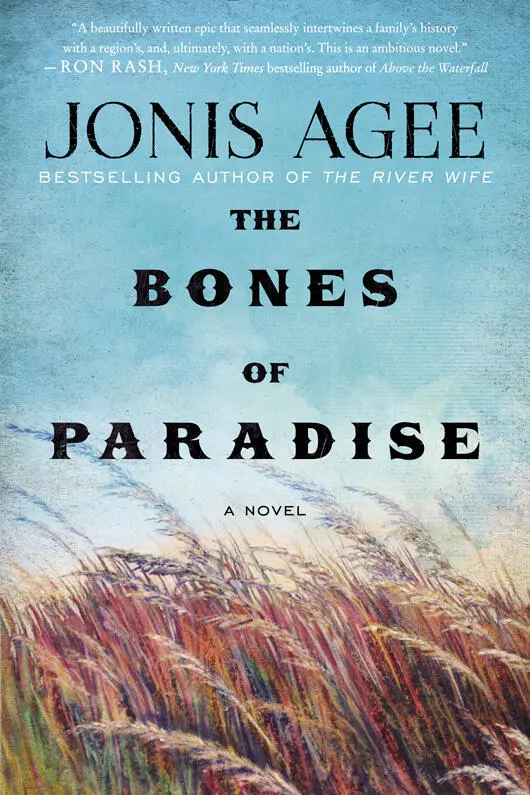
- Название:The Bones of Paradise
- Автор:
- Издательство:William Morrow
- Жанр:
- Год:2016
- ISBN:нет данных
- Рейтинг книги:3 / 5. Голосов: 1
-
Избранное:Добавить в избранное
- Отзывы:
-
Ваша оценка:
The Bones of Paradise: краткое содержание, описание и аннотация
Предлагаем к чтению аннотацию, описание, краткое содержание или предисловие (зависит от того, что написал сам автор книги «The Bones of Paradise»). Если вы не нашли необходимую информацию о книге — напишите в комментариях, мы постараемся отыскать её.
returns with a multi-generational family saga, set in the unforgiving Nebraska Sandhills in the years following the massacre at Wounded Knee—an ambitious tale of history, vengeance, race, guilt, betrayal, family, and belonging, filled with a vivid cast of characters shaped by violence, love, and a desperate loyalty to the land. Ten years after the 7th Calvary massacred more than 200 Lakota men, women, and children at Wounded Knee, J. B. Bennett, a white rancher, and Star, a young Native American woman, are murdered in a remote meadow on J. B.’s land. The deaths bring together the scattered members of the Bennett family: his cunning and hard father, Drum; his estranged wife, Dulcinea; and his young sons, Cullen and Hayward. As the mystery of these twin deaths unfolds, the history of the dysfunctional Bennett’s and their damning secrets are revealed exposing the conflicted heart of a nation caught between past and future.
At the center of
are two remarkable women. Dulcinea, returned after bitter years of self-exile, yearns for redemption and the courage to mend her broken family and reclaim the land that is rightfully hers. Rose, scarred by the terrible slaughters that have decimated and dislocated her people, struggles to accept the death of her sister, Star, and refuses to rest until she is avenged.
A kaleidoscopic portrait of misfits, schemers, chancers, and dreamers, Jonis Agee’s bold new novel is a panorama of America at the dawn of a new century. A beautiful evocation of this magnificent, blood-soaked land—its sweeping prairies, seas of golden grass and sandy hills, all at the mercy of two unpredictable and terrifying forces, weather and lawlessness—and the durable men and women who dared to tame it. Intimate and epic,
is a remarkable achievement: a mystery, a tragedy, a romance, and an unflagging exploration of the beauty and brutality, tenderness and cruelty that defined the settling of the American west.
The Bones of Paradise — читать онлайн бесплатно полную книгу (весь текст) целиком
Ниже представлен текст книги, разбитый по страницам. Система сохранения места последней прочитанной страницы, позволяет с удобством читать онлайн бесплатно книгу «The Bones of Paradise», без необходимости каждый раз заново искать на чём Вы остановились. Поставьте закладку, и сможете в любой момент перейти на страницу, на которой закончили чтение.
Интервал:
Закладка:
Chance was sent away to school at five when his father, a merchant ship captain, took his mother and sailed to the Orient. His father had already made a small fortune in ivory and spices, and embarked on a longer journey to secure jewels, gold, and wild animals for the rising market in exotic species. They left funds for their son’s schooling but failed to appear when the money ran out at age fourteen. Since leaving school, Chance lived by his wits, using his social polish and education wherever and whenever useful. For a time in his late teens, he clerked with a lawyer in New York City, until the man found him in bed with his wife. From there, he made his way into a circle of bankers always in need of a smart young man fast on his feet. He was twenty-two when he borrowed enough money from the bank to seek his fortune out West, without going through the formalities of signing papers. He was tired of the East anyway. The great fortunes to be made there were already taken and deposited in other people’s accounts.
He met the young earl at twenty-five in Chicago and truth be told, he was in despair for his poor luck. He had tried commodities trading, but it was a closed world and he was an Easterner. He was actually considering work on a steamboat on the Great Lakes when he met the earl one night in a Gold Coast saloon. With his outlandish clothes and English accent, the earl was about to be spirited away and mugged when Chance greeted him with a hug like an old friend, and whispered the danger in his ear. He threw his arm over the young earl’s shoulder and led him out the door into a horse cab.
It took three times around the lakeshore and park for the earl to spill his story and Chance to convince him that he needed a guide, a person who would protect and lead him through the wonders of the American West—Chance had never been farther west than Chicago, but he’d read a great deal. With the earl, Chance’s life began an important new chapter that should have continued back to England, where he would remain a lifelong friend supported in the manner his parents had dreamed about.
Chance opened the paper, refolded it, and used the edge of his palm to sharpen its creases. He sipped the cold coffee, raised his finger, and pointed at the cup when the waiter arrived. The hopeful expression on his face slid away as he left for the silver pot.
What he had not foreseen, and what still troubled him, were the vagaries of the earl’s taste—there was no other way to put it. His capacity for sexual adventure, nay, sexual experience, grew into a monstrous appetite for the strange, forbidden, and violent until it culminated ten years ago at the massacre known as Wounded Knee. It was as if all his vices were ingredients in a stew so vile the memory still turned Chance’s stomach. Yes, they drank to the point of delirium in those days, a fever in the brain that burned away the edge of morality. Nothing was too outlandish. Chance lost himself, lost sight of who he was, what he wanted. The vanity of the old world became an acid on his soul.
“We can do whatever we want,” the young earl said with a flourish of his hand—and he did. When Chance remembered the acts he participated in or simply watched, he felt beyond shame, he felt damned.
He felt frustrated, too, because he only wanted to make his way in the world, as the promoters advised: GO WEST! He imagined himself with a fortune in gold or land. He imagined his parents miraculously returned, praising him for becoming so prosperous. That’s all he wanted in life. Was it too much? He was willing to work. He’d proven that, damn it.
When the waiter returned, he gestured toward the empty cream pitcher. The man brought a fresh one and set it down heavily so it slopped over and he had to wipe it with his fresh white apron.
Chance finally took mercy on him and said, “A few more minutes.”
He would finish this damn business and be gone from this place. It was that girl, Star, who caused all the trouble. He was relieved the earl didn’t discover her the night they killed her mother, Lord, that would have been a grisly scene—still, he tried to talk to her, to buy back the necklace, the last token of his mother and father, tried to use reason and deny his participation, but she would have none of it. He could not stop her. Maybe he should have told her how he took revenge on the earl, killed him and left his body to be eaten by wild animals, the bones scattered across the reservation the last time they went up there. But she saw the pouch and knew what it was. He saved it as a reminder of how vile he could be. He would never cross that line again, ever. She wouldn’t listen to reason, though. He was only a relic hunter, a tradesman, the way her people were, he said. The whole world was a marketplace, and they were doing what people for thousands of years had done, trading goods. But she looked at him and drew her skinning blade. He had to stop her.
It was no use. He tried to be a good man. He was usually a nice man, polite and good-natured. But maybe he wasn’t a good man after all. Maybe a person had to do good after he made his fortune, as Carnegie urged. He didn’t know whether Star had told her sister about him, or if Rose found the necklace and knew it would lead to the killer. Honestly, he was tired of killing. The earl shot every living creature he came across. On days when big game was scarce he shot prairie dogs, rabbits, birds, cattle, and wild horses. For a while he employed a photographer to accompany them and capture the triumphant earl with his kill: rows and rows of snow geese left to rot after the picture was taken, five antelope also left because their horns were too small, and a dozen wild burros and horses trapped in a box canyon and slaughtered for joy. The man deserved to die. Chance did the world a service that day. He nodded to himself.
If he could explain that to Rose, maybe she would understand. He knew it was wishful on his part. He had a fortune to be made here, and he could not allow a youthful misdeed to stand in the way. He was sorry. He was very sorry. Civilized people understood how it was in battle. The soldiers were awarded medals for the massacre. Why was he any different? The tension in his neck and shoulders relaxed. This was how he could explain himself. He was helping the army that day. And later, he was a relic and antiquities dealer—nothing illegal. He was a fair and just man. He was even a moral man in some circumstances. He definitely wasn’t any worse than most.
That being said, he drank the last of his coffee, stood, put on his hat, brushed the crumbs from the front of his waistcoat, and left the hotel dining room. With a new energy in his step, he tipped his hat at the couple outside the hotel and went directly to his law office to draw up new papers for Mrs. Bennett to sign. And by Jesus, she would sign this time. Fortune smiles on those who force her hand.
CHAPTER THIRTY-NINE
The cowboys argued beneath her bedroom window and the day was gray. Clouds massed on the horizon and pushed toward the ranch like an invading Old Testament army bringing submission and doom while the hands argued like sparrows, back and forth, building the nest of disagreement into which they would eventually settle.
Dulcinea went downstairs and pushed open the door, startling the men, who jumped to their feet. She clutched the shawl she carried as a chill worked its way down from her scalp and drenched her in cold as if she were caught in the rain.
Irish Jim’s intense blue eyes with their bright glitter like semiprecious jewels took her in, then relaxed. “Just passin’ the time, ma’am.”
She looked at Larabee, second to Higgs.
“Nobody give us orders,” he said and belatedly remembered to remove his hat, and the others snatched theirs off, too.
Читать дальшеИнтервал:
Закладка:
Похожие книги на «The Bones of Paradise»
Представляем Вашему вниманию похожие книги на «The Bones of Paradise» списком для выбора. Мы отобрали схожую по названию и смыслу литературу в надежде предоставить читателям больше вариантов отыскать новые, интересные, ещё непрочитанные произведения.





Обсуждение, отзывы о книге «The Bones of Paradise» и просто собственные мнения читателей. Оставьте ваши комментарии, напишите, что Вы думаете о произведении, его смысле или главных героях. Укажите что конкретно понравилось, а что нет, и почему Вы так считаете.