Jonis Agee - The Bones of Paradise
Здесь есть возможность читать онлайн «Jonis Agee - The Bones of Paradise» весь текст электронной книги совершенно бесплатно (целиком полную версию без сокращений). В некоторых случаях можно слушать аудио, скачать через торрент в формате fb2 и присутствует краткое содержание. Год выпуска: 2016, Издательство: William Morrow, Жанр: Современная проза, на английском языке. Описание произведения, (предисловие) а так же отзывы посетителей доступны на портале библиотеки ЛибКат.
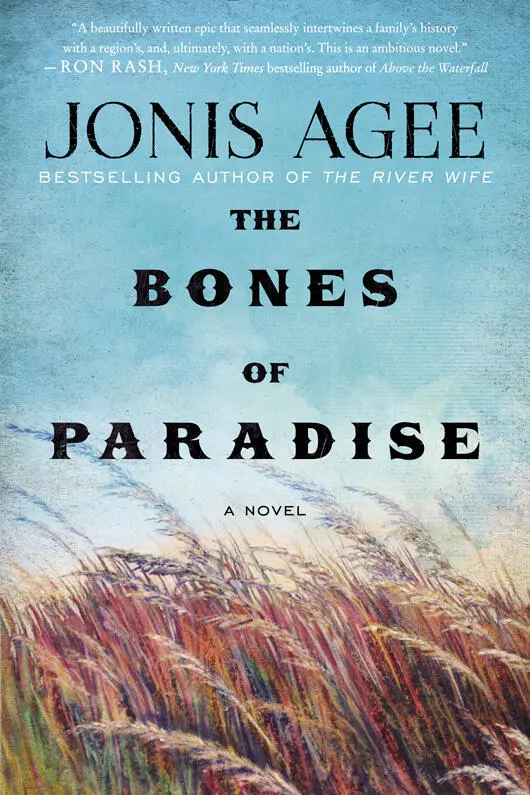
- Название:The Bones of Paradise
- Автор:
- Издательство:William Morrow
- Жанр:
- Год:2016
- ISBN:нет данных
- Рейтинг книги:3 / 5. Голосов: 1
-
Избранное:Добавить в избранное
- Отзывы:
-
Ваша оценка:
The Bones of Paradise: краткое содержание, описание и аннотация
Предлагаем к чтению аннотацию, описание, краткое содержание или предисловие (зависит от того, что написал сам автор книги «The Bones of Paradise»). Если вы не нашли необходимую информацию о книге — напишите в комментариях, мы постараемся отыскать её.
returns with a multi-generational family saga, set in the unforgiving Nebraska Sandhills in the years following the massacre at Wounded Knee—an ambitious tale of history, vengeance, race, guilt, betrayal, family, and belonging, filled with a vivid cast of characters shaped by violence, love, and a desperate loyalty to the land. Ten years after the 7th Calvary massacred more than 200 Lakota men, women, and children at Wounded Knee, J. B. Bennett, a white rancher, and Star, a young Native American woman, are murdered in a remote meadow on J. B.’s land. The deaths bring together the scattered members of the Bennett family: his cunning and hard father, Drum; his estranged wife, Dulcinea; and his young sons, Cullen and Hayward. As the mystery of these twin deaths unfolds, the history of the dysfunctional Bennett’s and their damning secrets are revealed exposing the conflicted heart of a nation caught between past and future.
At the center of
are two remarkable women. Dulcinea, returned after bitter years of self-exile, yearns for redemption and the courage to mend her broken family and reclaim the land that is rightfully hers. Rose, scarred by the terrible slaughters that have decimated and dislocated her people, struggles to accept the death of her sister, Star, and refuses to rest until she is avenged.
A kaleidoscopic portrait of misfits, schemers, chancers, and dreamers, Jonis Agee’s bold new novel is a panorama of America at the dawn of a new century. A beautiful evocation of this magnificent, blood-soaked land—its sweeping prairies, seas of golden grass and sandy hills, all at the mercy of two unpredictable and terrifying forces, weather and lawlessness—and the durable men and women who dared to tame it. Intimate and epic,
is a remarkable achievement: a mystery, a tragedy, a romance, and an unflagging exploration of the beauty and brutality, tenderness and cruelty that defined the settling of the American west.
The Bones of Paradise — читать онлайн бесплатно полную книгу (весь текст) целиком
Ниже представлен текст книги, разбитый по страницам. Система сохранения места последней прочитанной страницы, позволяет с удобством читать онлайн бесплатно книгу «The Bones of Paradise», без необходимости каждый раз заново искать на чём Вы остановились. Поставьте закладку, и сможете в любой момент перейти на страницу, на которой закончили чтение.
Интервал:
Закладка:
Higgs burst through the door, looked wildly around the kitchen and parlor. “Where is she? She’s here, isn’t she? You hiding her?” He spun and Graver, who followed, grabbed his arm to stop him. “She’s not here!” His words almost an accusation. The two women looked at each other. Vera was gone.
“I’ll go and look for her,” Graver said. “Should I take anyone?”
“The Indian,” Higgs said. Then his shoulders slumped and he remembered his hat, pulled it off his head, and held it in his hands as if he stood beside a gravesite. Dulcinea was about to offer him coffee and breakfast, half out of her chair when Rose put a hand on her arm to stop her.
“She’s gone. Black Bill, too. They run off together,” Rose said. Higgs ran a trembling hand up his forehead and the bald dome of his head.
“She hasn’t been herself, I could see that, I knew she was unhappy.” He glanced at the women at the table as if suddenly aware they listened. Without another word, he set his hat on his head, turned, and left.
“Do you think this has anything to do with . . .” Dulcinea asked.
Rose thought for a moment, then shook her head. “Vera loved your husband like a brother.”
“Why did she leave, then?”
Rose looked out the window and didn’t answer.
Chance came down the stairs carrying his bag. He tipped his hat at Dulcinea and ignored Rose. His handsome face appeared hollow this morning with dark circles around his eyes as if he had not slept. A pallor like dusty fog clung to his skin. He had shaved, badly, nicking his chin and missing the dark stubble patches on his throat.
“Did you know about this business with the Eastmans?” Dulcinea asked, her voice harsh.
He gazed at her, rolled his lower lip under his teeth, looked at Rose, and then shook his head. “Last night’s the first I heard of it.”
“How can that be? You told me you were looking at my land, you must have someone who’s paying you.”
Rose wanted to add that he was too busy living off the fat of the land and pretending to prospect to do much work for anybody, but stopped herself.
“I haven’t been in my office much of late. Miss Eastman arrived while I was out of town.” He raised his brow. “Maybe Cullen can provide the information you seek.” Rose could tell he was a person unused to questioning, especially from a female.
Dulcinea squared her shoulders. “Do we have a conflict of interest?” She poured herself more coffee without offering him any.
He looked startled, shook his head quickly, and tried to hide the anger in his eyes. “No, I’m working to gain clear title to the ranch for you. I told you I was looking for oil and gas. This new business with the Eastmans—are you wanting me to represent you in that, too?”
She paused, sipped her coffee without taking her eyes off him. “How can it be clear title if the rights are subverted? What led Cullen to imagine he could sell those, I wonder?”
He held up a hand, set down his bag, and stepped toward the table. “Mind if I sit and have a cup of coffee with you?”
She hesitated before giving a quick nod. Rose stood, took a dirty cup from the pile in the sink, placed it before him, and let him pour his own. He lifted a hand to reach for the sugar, glanced at Dulcinea, then picked up the bowl. He looked around for a spoon, gave up, poured it in, and stirred with his finger. His eyes searched the table for the cream pitcher, but Rose had already put it away and made no move to retrieve it.
He drank from the cup, grimaced, and set it down. “In the matter of—”
Dulcinea jumped up. “Oh, stop it! I’ll go to town today and contact my people in Chicago to discover the meaning of all this. I don’t know who you think you’re dealing with, Mr. Chance, but I am not the fool you have been taking me for!”
She gathered her skirts and marched to the stairs, where she stopped and turned again, saying, “Good day, sir.” And then flew up the stairs to change into her riding costume.
Rose wondered how she could escape the lawyer, who always found an excuse to linger at the ranch. In some ways he reminded her of Crockett from the telegraph office. Lily skipped in and tugged on her skirt. Behind her three kittens followed, tails stiff as tiny lodge poles as they crossed the porch into the house to tumble at the child’s feet. When Rose knelt to pet them, Lily whispered, “Mama, Mr. Higgs says his wife is gone, and Black Bill’s with her. Mr. Higgs is so upset he wants to hurt someone, he says. Mr. Graver says don’t act too quick, he’ll find them.” Lily gazed into her eyes, and her chin quivered. Rose gathered her in her arms and rocked her, crooning. She might be small, but she had to live among people who were not her own, and must learn vigilance, and how to guard herself by finding the secrets they carried. She felt the lawyer’s eyes follow her every move.
“I’m leaving then.” Chance stepped onto the porch. Rose kept her eyes on his tall black boots, their heels and soles worn to the thickness of a cottonwood leaf. He pulled a small leather pouch from his pocket and shook it. The sound of jingling coins caught Lily’s attention. He loosened the drawstring and let a coin slip into his palm, then held it up to catch the light. Lily started to reach for it, but Rose drew her hand down with a shake of her head. The lawyer shrugged and slid the coin back in the pouch. With a tip of his hat, he left. Rose watched him all the way to his horse, already tied at the gate by one of the hands, who must have felt as she did about the man who never went home.
She held Lily on her lap as she nuzzled the gray kitten against her cheek, and was reminded of her sister. They were separated when Star was four years old by the priests who took Rose away to train as a servant at the mission school, but she had always kept Star close in her thoughts, especially after their mother was killed. She rarely thought about their father, who drank until he died on the road to Rosebud one winter night and wasn’t found until spring melted the snow, revealing him on his back, one arm flung out in sleep, the other clutching the whiskey bottle he favored. His face gnawed some, the rest of him untouched, too old and sinewy, too pickled, people laughed, maybe he was onto something there. Ever know a drunk to get a mosquito bite?
As was the nature of her people, it was a good joke that grew until it was said that he’d died a happy death, smiling. Since his nose and cheeks were gnawed off, Rose didn’t know how they could say that. She was still at school, almost trained, the whites said, enough for a dumb one, though what good it would do to write and read English and do sums when she would be scrubbing floors, washing dishes, and calling white people mister and missus, she couldn’t say. They wouldn’t let her go home for the funeral. Then her mother insisted she take the first job offered with the telegraph man because of the upheaval on the reservation.
After their mother was killed, Star was taken in by their aunt to live with her white husband and sprawling family on their rundown ranch. The white man was an indifferent rancher and left all the work to her cousins and other distant relatives, who knew enough to keep horses and cattle from starving and freezing, even if they couldn’t hang on to their allotment of land. At least people wanted Star. After Rose left Crockett and the telegraph office, she fled to Pine Ridge with Dulcinea and stayed with those same relatives until she met Jerome Some Horses, who was already a man with a vision and a horse and a shack, where he lived with his grandmother.
Last spring, as they made their way north, through Babylon for a few supplies, and out to the Buffalo Grounds to set up summer camp, they met her mother’s cousin, Byron. He shared a beer with Some Horses, and Rose gave him a bowl of rabbit stew, a poor meal, but it was a hard winter and the animals wore only thick coats over their bones. A few days before, Byron was drinking in town with the white man, Conway, married to her aunt, when Conway complained that Star was worse than useless, as he put it, and to top it all off, she’d run away. He suspected she’d gone to Rapid City or even as far as Omaha to lift her skirts and earn her keep. Byron hit the man and was promptly beaten, then thrown in jail, but the sheriff released him two days later when a white boy charged with murdering his grandmother refused to share a cell with an Indian. Byron’s long, pox-scarred face was still bruised and lumpy from the beating as he gummed the thin stew and swallowed.
Читать дальшеИнтервал:
Закладка:
Похожие книги на «The Bones of Paradise»
Представляем Вашему вниманию похожие книги на «The Bones of Paradise» списком для выбора. Мы отобрали схожую по названию и смыслу литературу в надежде предоставить читателям больше вариантов отыскать новые, интересные, ещё непрочитанные произведения.




Обсуждение, отзывы о книге «The Bones of Paradise» и просто собственные мнения читателей. Оставьте ваши комментарии, напишите, что Вы думаете о произведении, его смысле или главных героях. Укажите что конкретно понравилось, а что нет, и почему Вы так считаете.