Jonis Agee - The Bones of Paradise
Здесь есть возможность читать онлайн «Jonis Agee - The Bones of Paradise» весь текст электронной книги совершенно бесплатно (целиком полную версию без сокращений). В некоторых случаях можно слушать аудио, скачать через торрент в формате fb2 и присутствует краткое содержание. Год выпуска: 2016, Издательство: William Morrow, Жанр: Современная проза, на английском языке. Описание произведения, (предисловие) а так же отзывы посетителей доступны на портале библиотеки ЛибКат.
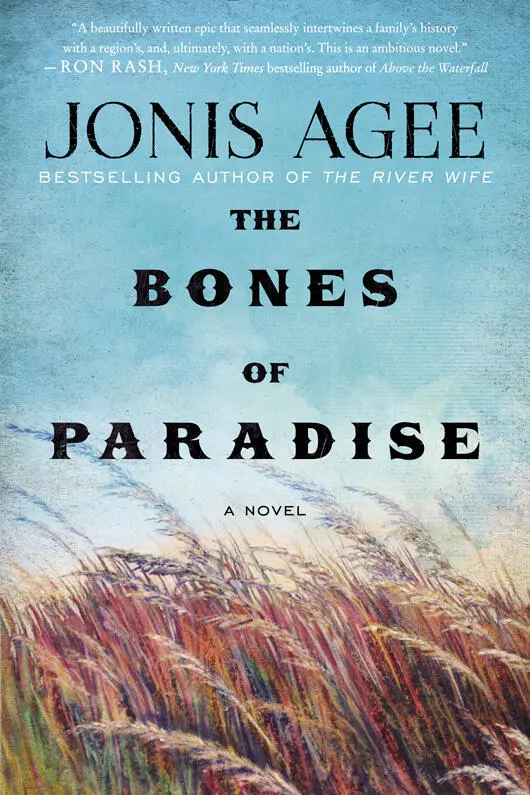
- Название:The Bones of Paradise
- Автор:
- Издательство:William Morrow
- Жанр:
- Год:2016
- ISBN:нет данных
- Рейтинг книги:3 / 5. Голосов: 1
-
Избранное:Добавить в избранное
- Отзывы:
-
Ваша оценка:
The Bones of Paradise: краткое содержание, описание и аннотация
Предлагаем к чтению аннотацию, описание, краткое содержание или предисловие (зависит от того, что написал сам автор книги «The Bones of Paradise»). Если вы не нашли необходимую информацию о книге — напишите в комментариях, мы постараемся отыскать её.
returns with a multi-generational family saga, set in the unforgiving Nebraska Sandhills in the years following the massacre at Wounded Knee—an ambitious tale of history, vengeance, race, guilt, betrayal, family, and belonging, filled with a vivid cast of characters shaped by violence, love, and a desperate loyalty to the land. Ten years after the 7th Calvary massacred more than 200 Lakota men, women, and children at Wounded Knee, J. B. Bennett, a white rancher, and Star, a young Native American woman, are murdered in a remote meadow on J. B.’s land. The deaths bring together the scattered members of the Bennett family: his cunning and hard father, Drum; his estranged wife, Dulcinea; and his young sons, Cullen and Hayward. As the mystery of these twin deaths unfolds, the history of the dysfunctional Bennett’s and their damning secrets are revealed exposing the conflicted heart of a nation caught between past and future.
At the center of
are two remarkable women. Dulcinea, returned after bitter years of self-exile, yearns for redemption and the courage to mend her broken family and reclaim the land that is rightfully hers. Rose, scarred by the terrible slaughters that have decimated and dislocated her people, struggles to accept the death of her sister, Star, and refuses to rest until she is avenged.
A kaleidoscopic portrait of misfits, schemers, chancers, and dreamers, Jonis Agee’s bold new novel is a panorama of America at the dawn of a new century. A beautiful evocation of this magnificent, blood-soaked land—its sweeping prairies, seas of golden grass and sandy hills, all at the mercy of two unpredictable and terrifying forces, weather and lawlessness—and the durable men and women who dared to tame it. Intimate and epic,
is a remarkable achievement: a mystery, a tragedy, a romance, and an unflagging exploration of the beauty and brutality, tenderness and cruelty that defined the settling of the American west.
The Bones of Paradise — читать онлайн бесплатно полную книгу (весь текст) целиком
Ниже представлен текст книги, разбитый по страницам. Система сохранения места последней прочитанной страницы, позволяет с удобством читать онлайн бесплатно книгу «The Bones of Paradise», без необходимости каждый раз заново искать на чём Вы остановились. Поставьте закладку, и сможете в любой момент перейти на страницу, на которой закончили чтение.
Интервал:
Закладка:
On the last morning of his life, J.B. rode out to retrieve his son from his father, deep in memory. He remembered that Dulcinea had waited until after breakfast that final May morning ten years ago, when the hands had ridden out to collect the cattle for spring branding. It was a day like today. As soon as the last hand mumbled thanks for the breakfast and with hat clutched against chest backed his way through the door and carefully closed it, she stood and walked with a determined step, shoulders back, chin high, and stopped in front of the big Union Pacific calendar he kept on the wall above the baker’s table and pie safe, despite her objections. He liked the western themes. This month a lone cowboy rode hell-bent for leather across the sagebrush after a wild-eyed longhorn. J.B. never tired of that picture, even though it was already mid-May and he’d faced it every morning and evening. Later he would wonder that he never thought to ask why she’d written a small x in each day for the past two weeks. On May 15, she drew a slash across the whole box rather than the small, discreet x. He’d always been a little slow on the uptake, Drum assured him later that day when he rode in for the cow sorting since both their herds ran together each winter. After Dulcinea left, he spent money he didn’t have to build a fence between his land and Drum’s, but the cattle still broke through on occasion. Too little too late.
“Looks like she was wishing it was your throat she slashed rather than that little ole paper. What did you do to that girl, J.B.?” Drum’s mouth had widened into a grin when he’d heard. J.B. remembered her preoccupied air, how she ignored Hayward as he tried to lift another ladle of syrup onto his pancakes, succeeding in dribbling it across the table and dropping the large wooden spoon on the floor without any of it landing on his plate. The child had looked fearfully at his mother, his lower lip quivering, and J.B. had picked up the spoon and wiped down the table without a word. Dulcinea stood watching them, a thoughtful expression on her face, arms folded, then she turned and walked swiftly to the stairs, lifting her skirt as she hurried up almost soundlessly. J.B. thought he’d seen tears in her eyes.
She came down wearing a long ivory linen duster over one of the two traveling dresses she had brought with her all those years earlier.
He slammed down his coffee cup, pushed the chair away so hard it fell backward to the floor, and strode across the room to grab her arm.
“What is this?” He knew it was the wrong tone, the wrong words, because her eyes flared then flattened and her mouth settled into a grim line. He dropped his hand.
Hayward began his peculiar sobbing-hiccupping that was much too babyish for a five-year-old boy, his father would later assure him.
“Go outside, son,” J.B. told him, but he sat quietly, stubbornly at the table, kicking the legs of his chair and scowling at his mother.
Dulcinea took a deep breath, squared her shoulders, swiped at the corner of her eye with the edge of her gloved hand, and peered around J.B. “Come here, Hayward, come to Mama.”
The boy picked up his fork then purposely dropped it on the plate to produce the clanging sound the adults hated, but which he seemed to understand he would not be reprimanded for in this moment of crisis. Satisfied, he ran his forefinger once more through the syrup and melted butter smeared on his plate. She had made his favorite breakfast—donkey pancakes, including the bacon pack-saddle that he’d gobbled first.
“Son,” J.B. said.
“Leave him alone.” She adjusted the black-plumed hat on her head, draping the veil across her forehead so it could be pulled down and tied in back.
“Hayward, go outside. Tell Jorge I said you could have your new horse.” J.B. hoped she would hear what he suggested, that he meant to give their five-year-old his own horse, despite her objections, that she daren’t leave, but she only looked over her shoulder at the stairs behind her.
“I’m ready to go,” she called and immediately the sound of a large, heavy object thumped down the uncarpeted steps. J.B. counted each one, four to the landing, ten to the bottom.
“Who is that?” he asked.
Hayward bounced off his chair and ran to the door, pulled it open, and clambered down the three steps to the stone walk, his miniature cowboy boots clopping loudly. Her steamer trunk landed with a thud at the bottom of the stairs, and one of the men, Stubs, who later went to work for Drum, followed.
J.B. looked at Dulcinea, her expression grim, while her hands busied themselves with a large floral brocade satchel stuffed with necessities for a long journey. After rummaging for a moment, she extricated an ivory envelope he recognized as her stationery from before they were married. She handed him the envelope but stopped his hand when he moved to open the unsealed flap.
“You’re leaving then,” he finally managed to say. He could hear the jingling harness and creaking wood as the wagon pulled up outside the gate.
He knew better than to ask how long she’d be gone, just as he had known better than to ask if she was staying when she arrived ten years ago. He felt something small inside him, a shard of resentment that wanted revenge, and fought to keep it silent until she was halfway to the gate.
“Nobody’s going to water the lilacs,” he called to her.
She brushed it off with a wave of her hand over her shoulder. She wasn’t even going to look at him?
“Or those mulberries, nobody’s going to . . .”
She spun and marched right up to him, the expression on her face so fierce he took half a step back before he caught himself. Staring at him, eyes filled with tears, she clasped the back of his head and pulled his mouth to hers, kissed him so deep and long he began to hope, until she released him. Did she think that would keep him until she returned? He wiped his mouth with the back of his hand, worked to keep the anger out of his voice when he told her that she shouldn’t leave; though it hurt him to beg, he came as close as he could, pulling her into his arms, smelling her sweet iris perfume, willing himself to remember their first night together under the coarse wool blanket with another folded for a pillow on the ground beneath the stars.
“I’ll bring Hayward to visit,” J.B. said. Hope jumped in her eyes before she caught herself, smoothed the front of her duster and tugged on the black kid gloves that snugged her fingers too tightly now, her hands nearly ruined by the harsh weather, rough land, and hard chores. She’d have to cut her wedding ring off someday, he thought with a pang.
She shook her head.
“Do you have enough money for the trip?” He half turned toward the house. “I can—”
“You go get Cullen from your father and I’ll come back,” she said.
She shifted her gaze to the man beside her on the wagon bench. “Mr. Stubs?”
When he didn’t move, she lifted the whip from its holder and cracked it over the horses’ backs. Lunging forward, they swept against J.B. and pushed him backward.
“You’ll never see Hayward again,” he yelled as the wagon left the barnyard. He couldn’t fetch Cullen and his defeat slumped his shoulders as he watched the ball of dust churn down the road, until finally they were a mere speck disappearing over the last hill on the horizon.
Hayward rode happily around the corral on his new spotted horse, which trotted three steps for every ten it walked to keep the swaying rider on its back. J.B. watched his boy and felt both pride and sadness swell in his chest, and soon another feeling, one that made him spin on his heel and hurry inside the house, run up the stairs two at a time, and yank open the door to their bedroom, where he discovered that she’d left her perfume bottles, the silver-backed brush, comb, and mirror set he’d given her, and the glass jars of creams and powders he was helpless to understand, sitting on top of the clumsy dressing table he’d made for her. Cottonwood. He brushed the dented surface with the edge of his hand. Wood so soft it bore the impression of everything she’d ever set down too hard. Had she been so angry? He’d waxed the wood to bring out the soft yellow hue, but over the years it had darkened along certain grains, and small dark spots dotted the surface like tears. Had she wept here? Suddenly, he knew with a force that punched the breath out of his chest that if she wept, it had not been for him, anyone but her husband, who had given his eldest son to his father. Cullen, this was all about Cullen.
Читать дальшеИнтервал:
Закладка:
Похожие книги на «The Bones of Paradise»
Представляем Вашему вниманию похожие книги на «The Bones of Paradise» списком для выбора. Мы отобрали схожую по названию и смыслу литературу в надежде предоставить читателям больше вариантов отыскать новые, интересные, ещё непрочитанные произведения.




Обсуждение, отзывы о книге «The Bones of Paradise» и просто собственные мнения читателей. Оставьте ваши комментарии, напишите, что Вы думаете о произведении, его смысле или главных героях. Укажите что конкретно понравилось, а что нет, и почему Вы так считаете.