Jonis Agee - The Bones of Paradise
Здесь есть возможность читать онлайн «Jonis Agee - The Bones of Paradise» весь текст электронной книги совершенно бесплатно (целиком полную версию без сокращений). В некоторых случаях можно слушать аудио, скачать через торрент в формате fb2 и присутствует краткое содержание. Год выпуска: 2016, Издательство: William Morrow, Жанр: Современная проза, на английском языке. Описание произведения, (предисловие) а так же отзывы посетителей доступны на портале библиотеки ЛибКат.
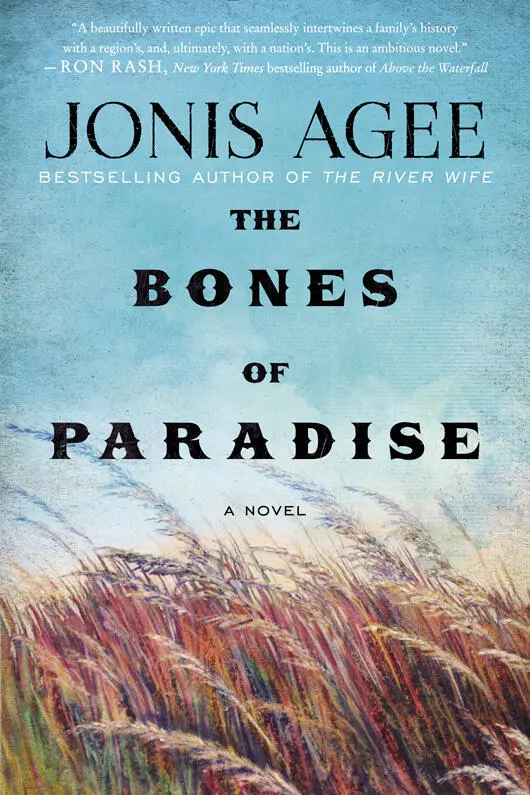
- Название:The Bones of Paradise
- Автор:
- Издательство:William Morrow
- Жанр:
- Год:2016
- ISBN:нет данных
- Рейтинг книги:3 / 5. Голосов: 1
-
Избранное:Добавить в избранное
- Отзывы:
-
Ваша оценка:
The Bones of Paradise: краткое содержание, описание и аннотация
Предлагаем к чтению аннотацию, описание, краткое содержание или предисловие (зависит от того, что написал сам автор книги «The Bones of Paradise»). Если вы не нашли необходимую информацию о книге — напишите в комментариях, мы постараемся отыскать её.
returns with a multi-generational family saga, set in the unforgiving Nebraska Sandhills in the years following the massacre at Wounded Knee—an ambitious tale of history, vengeance, race, guilt, betrayal, family, and belonging, filled with a vivid cast of characters shaped by violence, love, and a desperate loyalty to the land. Ten years after the 7th Calvary massacred more than 200 Lakota men, women, and children at Wounded Knee, J. B. Bennett, a white rancher, and Star, a young Native American woman, are murdered in a remote meadow on J. B.’s land. The deaths bring together the scattered members of the Bennett family: his cunning and hard father, Drum; his estranged wife, Dulcinea; and his young sons, Cullen and Hayward. As the mystery of these twin deaths unfolds, the history of the dysfunctional Bennett’s and their damning secrets are revealed exposing the conflicted heart of a nation caught between past and future.
At the center of
are two remarkable women. Dulcinea, returned after bitter years of self-exile, yearns for redemption and the courage to mend her broken family and reclaim the land that is rightfully hers. Rose, scarred by the terrible slaughters that have decimated and dislocated her people, struggles to accept the death of her sister, Star, and refuses to rest until she is avenged.
A kaleidoscopic portrait of misfits, schemers, chancers, and dreamers, Jonis Agee’s bold new novel is a panorama of America at the dawn of a new century. A beautiful evocation of this magnificent, blood-soaked land—its sweeping prairies, seas of golden grass and sandy hills, all at the mercy of two unpredictable and terrifying forces, weather and lawlessness—and the durable men and women who dared to tame it. Intimate and epic,
is a remarkable achievement: a mystery, a tragedy, a romance, and an unflagging exploration of the beauty and brutality, tenderness and cruelty that defined the settling of the American west.
The Bones of Paradise — читать онлайн бесплатно полную книгу (весь текст) целиком
Ниже представлен текст книги, разбитый по страницам. Система сохранения места последней прочитанной страницы, позволяет с удобством читать онлайн бесплатно книгу «The Bones of Paradise», без необходимости каждый раз заново искать на чём Вы остановились. Поставьте закладку, и сможете в любой момент перейти на страницу, на которой закончили чтение.
Интервал:
Закладка:
“Needed to clean them out,” he said. “Look at you—” He took a drink. “Inbreeding. No morals to speak of. Can’t be taught.” He finished his glass. “Best Indian I ever knew. Can’t talk and not too lazy. I’ll keep it!” He whooped with laughter and slapped the table with both hands. He gazed at her, and there was a shift in his eyes. Despite her efforts to stay ugly, dirty, to keep temptation from his mind, he took out a small tortoiseshell comb and cleaned the food from his mustache as he did nightly, winked at her, and demanded to know what she was stealing.
Then he swiftly wrapped his arms around her so tightly she could barely breathe and pushed her backward onto the bed, landing on top of her. She couldn’t reach her knife or gun while his hands groped and his body pushed the air from her lungs. He had to roll off to unfasten his pants and she was able to slip on top, grab the pillow, and press it over his face, leaning with her entire weight. Much of his fight had been spent getting her on the bed, and his limbs were heavy with drink. She fought off his clawing hands and bucking torso by hooking her feet and hands to the sides of the bed. When the scratching sound of his breath beneath the pillow quit, and his body shuddered, and then softened again, she lifted it. She had meant to put him to sleep, but was angry and now his hands lay carelessly at his sides, a shred of meat nested in his mustache.
She left him there and went to the front office, determined to find anything that would offer clues or names of the men who’d killed her mother and massacred her people. She found Bennett files listed by individuals and ranches. Drum Bennett wrote short, blunt orders for land and cattle deals, which made him richer over the years, but J. B. Bennett’s were coded like Dulcinea’s. Some she sent to him from Rushville, but others came from Gordon, Chadron, Cody, Valentine, Ainsworth, towns that sat above the Sand Hills. Hers was a restless spirit, Rose had already concluded, and she did not bother to decipher the code. She did wonder why they thought it necessary to hide their messages. And why Crockett kept them. She never found a message to or from a Lakota.
In the bottom drawer, tucked behind the other files, and without a name, she found the pictures. Photographs and newspaper drawings from before and after the massacre, some dated back ten years. A picture of Rose with the other children at the school. She stared at the photo from the Ghost Dance village for a long time until she began to hear their voices chanting, her mother’s, see the dogs circling, whining, tails down, looking for food when there was little to eat, the picture said, yet the people built fires and cooked big kettles of stew from commodity meat, wild rabbits and birds, roots and vegetables to keep the dancers going. She rubbed her thumb across the image of the bodies frozen in a ravine, arms reaching out, legs still running in the mass grave. Photos of soldiers lying with guns at the ready and onlookers behind them. She pounded that picture with her fist. Didn’t they realize, didn’t they know what would happen? The priests told the dancers to go home. Jesus is coming! The Savior is coming, the dancers insisted while the soldiers cleaned and loaded their guns, and the cannons were rolled to the top of the ridge for a better field of fire on children playing games, dancers, old and crippled ones watching. So few escaped. She searched the images for her mother and sister but didn’t find them. Finally she tucked the photographs and drawings into the large envelope with the newspaper clippings, stood, took one last look around, and poured lamp oil on the floor. She touched a burning candle to the oil and it smoldered so long she wondered if there was some white witchcraft at work, but when she opened the door, the fire swooshed alive.
When they found Crockett’s body, the sheriff said it was a mishap caused by too much drink, and no one remembered the stupid mute Indian girl who used to work for him.
Rose went to Dulcinea that night and the two of them rode up to Pine Ridge Reservation for the first time since the massacre the winter before.
CHAPTER THIRTEEN
J.B. was always on his way to Dulcinea. First, that fine April afternoon in 1880, as he walked along the Lake Michigan shore in Chicago, marveling at the water that extended past the horizon, flat instead of hilly like home. Although he would never see the ocean, he decided it must be like this, no way for the eye to comprehend the vastness before it. He half expected to see steamships bound for Europe and the Far East, and was momentarily confused by the freighter that appeared to crawl sluggishly along the line where water met sky. Then he saw a young woman, half dragged by a pair of small white curly-haired dogs who leapt and ran, straining to swim at the water’s edge, jumping on passersby and snapping at the toy balls she threw ahead of them.
He admired her grace and beauty, but most of all her patience handling the dogs. She was unafraid of appearing relaxed and awkward when they tangled her in their leashes or muddied her long skirt with their paws. When the fatter of the two managed to slip off his collar and wade in fearlessly, the waves up to his ears, she threw back her head and laughed, then followed to retrieve him and give the other dog a good soaking, too. J.B. looked up and down the beach. She was the only woman in the water. It was too cool for swimming. He’d been warned the lake stayed cold until midsummer, but she didn’t seem to mind. The dark line of the water wet her gray dress past the long bodice to her small waist. It must have weighed on her, yet she still moved with grace. Once she’d secured the collar around the dog, he bounded out of the water, bouncing up and down with his paws waving in the air as J.B. approached.
Fortunately, the little rascal slipped out of his collar again and headed straight into J.B.’s arms, licking his face as if they were old friends. J.B. never forgot that dog, and felt as brokenhearted as Dulcinea when he finally passed.
“My dogs won’t bite,” she called with a smile.
“Might get licked to death.” He laughed and stood with the dog in his arms.
“You’re getting wet,” she said, her own long gray sleeves dripping.
“J. B. Bennett,” he said. “Nebraska Sand Hills. Cattle. That’s what I grow, I mean raise, cattle.” Stop, he warned himself, hush now. He grinned foolishly.
“Dulcinea Woodstone,” she said with a tilt of her head as if to get a better view of him. “Three blocks away. Play with dogs, read books, attend boring parties, theatrical and musical performances. What are the Sand Hills?” It was her humor that capped it for him.
They saw each other every day after that, as long as possible until her parents began to worry, then he’d gone home for a month, only to return and ask for her hand in marriage. She’d been waiting, packed, her trousseau consisting not of dresses and furs, but of specially ordered ranch clothing as she called it. The only outfitting he had to do in Omaha when they stopped on the train out to North Platte was to buy her a pair of cowboy boots and a real cowboy hat. He didn’t care if she wore a coronation crown and a ball gown, but she insisted that she be ready for her part in their western adventure. Years later he wondered how their life had changed so easily, from this to that, and from that to this: He’d spent the last ten years tracking her to some rooming house or hotel in a town above or below the hills, or a few times to a tent she pitched far from their house. He never knew when she’d summon him for another argument, never knew if he could leave work to meet her. Last time, she told him he must bring both their sons if he expected them to be together again. He’d held off as long as he could, intending to wait until after branding and culling, then woke and decided today was the day he’d ride to his father’s ranch and retrieve their eldest son. It was Drum who’d taught him to always do the hardest work first thing in the morning.
Читать дальшеИнтервал:
Закладка:
Похожие книги на «The Bones of Paradise»
Представляем Вашему вниманию похожие книги на «The Bones of Paradise» списком для выбора. Мы отобрали схожую по названию и смыслу литературу в надежде предоставить читателям больше вариантов отыскать новые, интересные, ещё непрочитанные произведения.







Обсуждение, отзывы о книге «The Bones of Paradise» и просто собственные мнения читателей. Оставьте ваши комментарии, напишите, что Вы думаете о произведении, его смысле или главных героях. Укажите что конкретно понравилось, а что нет, и почему Вы так считаете.