Carmen Boullosa - Cleopatra Dismounts
Здесь есть возможность читать онлайн «Carmen Boullosa - Cleopatra Dismounts» весь текст электронной книги совершенно бесплатно (целиком полную версию без сокращений). В некоторых случаях можно слушать аудио, скачать через торрент в формате fb2 и присутствует краткое содержание. Год выпуска: 2004, Издательство: Grove Press, Жанр: Современная проза, на английском языке. Описание произведения, (предисловие) а так же отзывы посетителей доступны на портале библиотеки ЛибКат.
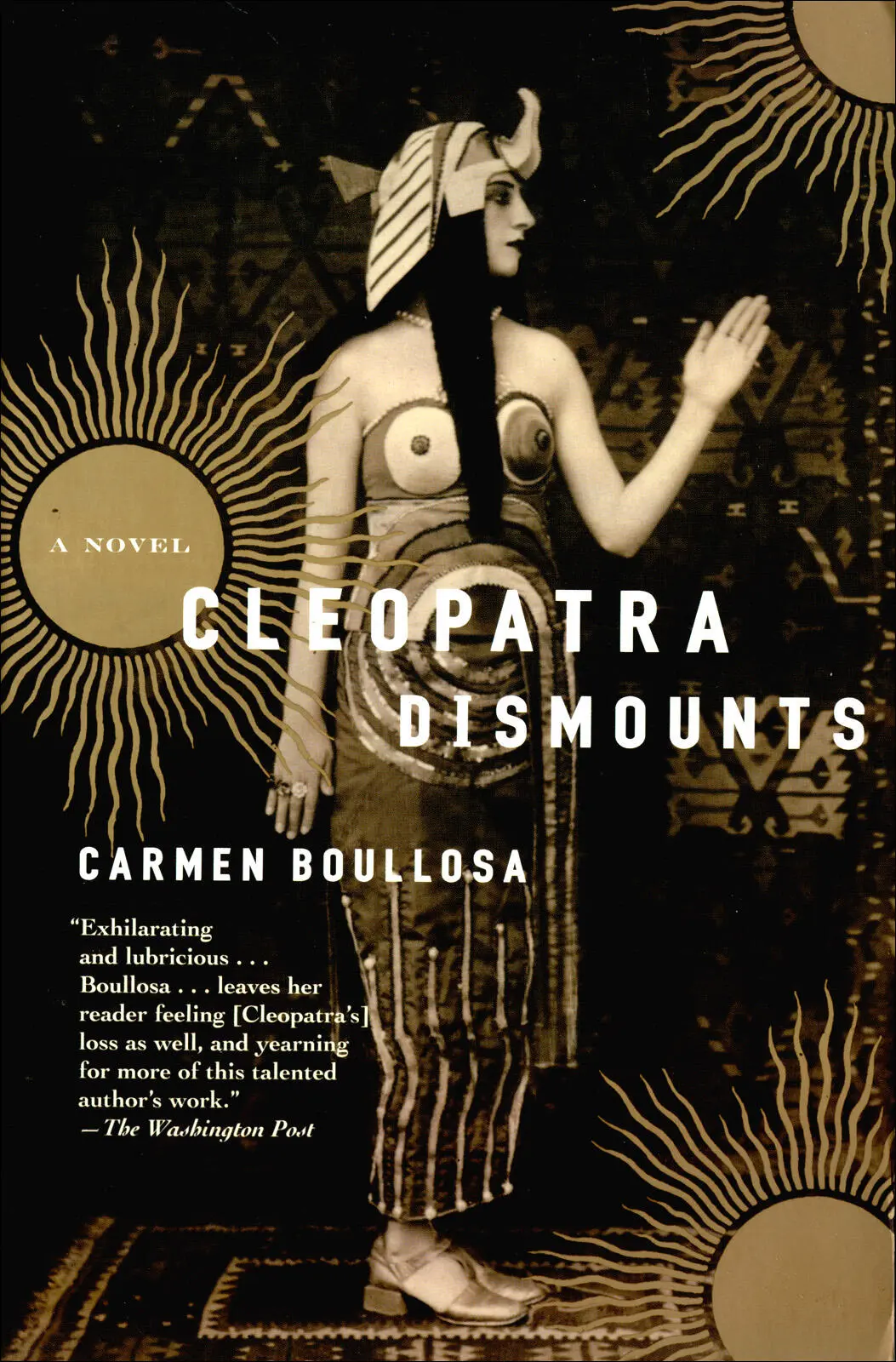
- Название:Cleopatra Dismounts
- Автор:
- Издательство:Grove Press
- Жанр:
- Год:2004
- ISBN:нет данных
- Рейтинг книги:3 / 5. Голосов: 1
-
Избранное:Добавить в избранное
- Отзывы:
-
Ваша оценка:
Cleopatra Dismounts: краткое содержание, описание и аннотация
Предлагаем к чтению аннотацию, описание, краткое содержание или предисловие (зависит от того, что написал сам автор книги «Cleopatra Dismounts»). Если вы не нашли необходимую информацию о книге — напишите в комментариях, мы постараемся отыскать её.
Through the intervention of Cleopatra's scribe and informer Diomedes, Boullosa creates two deliriously wild other lives for the young monarch — a girl escaping the intrigues of royal society to disguise herself and take up residence with a band of pirates; and the young queen who is carried across the sea on the back of a magical bull, to live among the Amazons.
Magical, multifaceted, and rippling with luminous imagination, Cleopatra Dismounts is a work that recalls Jeanette Winterson’s Sexing the Cherry and confirms Carmen Boullosa as an important international voice.
Cleopatra Dismounts — читать онлайн бесплатно полную книгу (весь текст) целиком
Ниже представлен текст книги, разбитый по страницам. Система сохранения места последней прочитанной страницы, позволяет с удобством читать онлайн бесплатно книгу «Cleopatra Dismounts», без необходимости каждый раз заново искать на чём Вы остановились. Поставьте закладку, и сможете в любой момент перейти на страницу, на которой закончили чтение.
Интервал:
Закладка:
“Well,” put in another poet, “the walls of Ascalon are something to be reckoned with. It is magnificently fortified. Its garrison consists of a cohort of infantry and a squadron of cavalry. It is not a bad refuge.”
“Thank you for your opinions, but to stick to the point, why would I choose to come to the land of the Amazons in order to restore order in Alexandria? Nobody has the right to act as he pleases, unless everything is organized in the best interests of improvement. I have two questions: Can I really ally myself with the Amazons? And what would I get out of that alliance?”
Instead of answering my questions, an aged poet, full of wrinkles, with hair as red as fire, put a question to the others. “Pardon my ignorance, but where is Ascalon?”
“Five hundred and twenty stadia from Jerusalem, which is all too short a distance, if you realize how much hatred the Jews have for its inhabitants,” Castor replied.
“It’s a lovely city. They’ve recently built an aqueduct from Laodice in the direction of the sea. The baths there are famous. There are springs and colonnades, admirable for both their architecture and their proportions.”
“Yes, it is lovely,” said Acusilaus. “But an alliance with these ferocious women warriors is better for Cleopatra.”
“They’re a bunch of bandits,” said Philo. “A roving band of female thugs who survive on what they can steal.”
“It’s also true,” said Acusilaus, “that theirs is a city without ovens. Fire is kindled here only to illuminate the night with torches or to make a bonfire to spur on tales and intimacies. They’re probably the only human beings who do not use fire for cooking or melting metals. It serves them only to flutter around, like moths.”
“That’s just silly talk,” said another. “They were the first people to use iron, and that’s why initially they won all their battles.”
“True, true, but that was centuries ago. Nowadays. .”
“Their camps have no buildings, no tents even,” said Philo. “They sleep out in the open. For a temple they have a big black rock to which they offer worship. Do you call this—” he pointed to the sky and the four cardinal points where there was no sign of a building, “a city?”
“It’s a city for Amazons. This is the way they live. They dress without proper clothing and they live without walls and roofs.”
“What about you?” I asked.
Acusilaus was the one to answer. “We live on the other side of the hill. Craftsmen from nearby towns have cobbled together something rustic for us. We pass our time there.”
“We have some palaces,” Philo made clear. “Anybody who wants treasures or sculptures has them. If Acusilaus wants his palace austere, that’s his choice.”
“Yes. Right enough.”
“The rest,” added another who until then had not opened his mouth, “stand on pillars of Tenarus marble, for they quarry it in the Peloponnese. They have coffered ceilings of ivory between gilded beams, and as for our fruit trees, they are a match for those of Phaeacia.”
“Why did you come here, you poets?” I asked. “For inspiration, I bet!”
The poets laughed.
“We didn’t ’come,’ Cleopatra, any more than you did. We were brought here, snatched away. We are the booty of the Amazons—”
Somebody interrupted this remark from Philo: “Nobody leaves Egypt out of choice. I am Peteosochus, also known as Peteuris, son of Selebous Persa from Epigonus. Did I need to leave Egypt to find inspiration?”
“Well, I for one would have come here for inspiration,” said Acusilaus, “if I’d been young and I could have come freely, not being driven into exile. I’d have been interested in knowing how these women lived. Do you know, Your Majesty, that they supply their needs from plunder? The ribbon that they wear across their breasts, the quiver, the bow, the arrows, the golden shields in the shape of half-moons, their silver axes, their bread and olives — they got it all by violence. And why are their possessions so different? Because there’s more than one town that will buy off their attacks by fabricating for them special objects designed to please them. Since they love poetry and music, they kidnap musicians and poets, musical instruments and rolls of paper. They picked us for our advanced years, as you can see. They believe that the older the poet, the better his poetry. Unlike certain rulers who have turned against some of us, the Amazons don’t request us to write poems in their praise.”
“They hate laudatory verses,” asserted another. I hadn’t seen him until then and as if he read my mind, he added, “I’m Tegogolo, Queen of Kings, it’s a pleasure to hear your voice and an even greater one to converse with you.”
“They hate any verses written to get favors,” said another old man, who had had the nerve to sit on the edge of my litter. “For them, we write the poems we want to write.”
“We really say what we mean,” said a third.
“And do you really want government by women?” I asked. “Do you really hate the institution of marriage?”
All except Philo said yes.
“Among themselves, Cleopatra, there is no stealing and plundering. They don’t hit each other, they don’t disobey orders, they live in exemplary harmony. Of course, there’s no question of adultery. Not one of them is capable of a vile or shameful action.”
“But they don’t bother about trade or agriculture,” said Philo.
Acusilaus said, “Cleopatra, the maat, as you Egyptians call harmony, justice, order, truth, the ideal condition of the universe that only a good monarch can bestow — the maat is a real possibility for the Amazons.”
“I think you’ve gone blind, Acusilaus,” said my companion on the litter, in a resigned voice. “They don’t know anything but war. And even that, in the Roman style. They have no hoplites, no code of honor. Their war consists of — how can I describe it — trickery and deceit.”
Here, everybody chimed in, one remark overlaying another:
“There’s no word for their kind of warfare.”
“It’s a war of women.”
“Obviously it’s a war of women. They learned to fight like that when they fought against Heracles. It took eight of them to die fighting one man, for them to work out their special type of warfare.”
“They are anti-hoplites. They use only light weapons. They act by night. They use cunning. Their shields are shaped like half-moons. They can’t use them in military formations.”
“Nobody can beat them in combat, except the hero.”
“Pisiannassa used a shield made of wicker.”
“How can you believe such nonsense? What good is a wicker shield?”
“Of course not. That’s one of Estoa’s lies.”
“No bigger lie than those of bad artists who paint them in checkered breeches and boots!”
“Heracles was wearing the skin of a lion and it made him invulnerable. As a reminder, they wear a ribbon on their chests and use it to invoke the protection of the gods.”
“His came from a lion, theirs from a viper.”
“They’re both wild animals.”
“And those panther cloaks, why do they wear those?”
“Eight of them fought against Heracles, one after the other.”
“Marpe was the seventh to die, Asteria the sixth.”
“Aello was the first to attack him and the first to die.”
“Deianeira was his fifth victim, fighting in single combat against the invincible hero.”
“Eriobea was the fourth.”
“Alcipe was number nine, and the last Amazon to die in single combat. After her, they attacked him as a group.”
“But even several at a time could not defeat the man in the lion skin. Eurybe, Celaneo, and Phoebe, shoulder to shoulder with their shields, had been unbeaten in battle till they encountered him. He killed them, all three with one swipe of his sword.”
Читать дальшеИнтервал:
Закладка:
Похожие книги на «Cleopatra Dismounts»
Представляем Вашему вниманию похожие книги на «Cleopatra Dismounts» списком для выбора. Мы отобрали схожую по названию и смыслу литературу в надежде предоставить читателям больше вариантов отыскать новые, интересные, ещё непрочитанные произведения.






Обсуждение, отзывы о книге «Cleopatra Dismounts» и просто собственные мнения читателей. Оставьте ваши комментарии, напишите, что Вы думаете о произведении, его смысле или главных героях. Укажите что конкретно понравилось, а что нет, и почему Вы так считаете.