Carmen Boullosa - Cleopatra Dismounts
Здесь есть возможность читать онлайн «Carmen Boullosa - Cleopatra Dismounts» весь текст электронной книги совершенно бесплатно (целиком полную версию без сокращений). В некоторых случаях можно слушать аудио, скачать через торрент в формате fb2 и присутствует краткое содержание. Год выпуска: 2004, Издательство: Grove Press, Жанр: Современная проза, на английском языке. Описание произведения, (предисловие) а так же отзывы посетителей доступны на портале библиотеки ЛибКат.
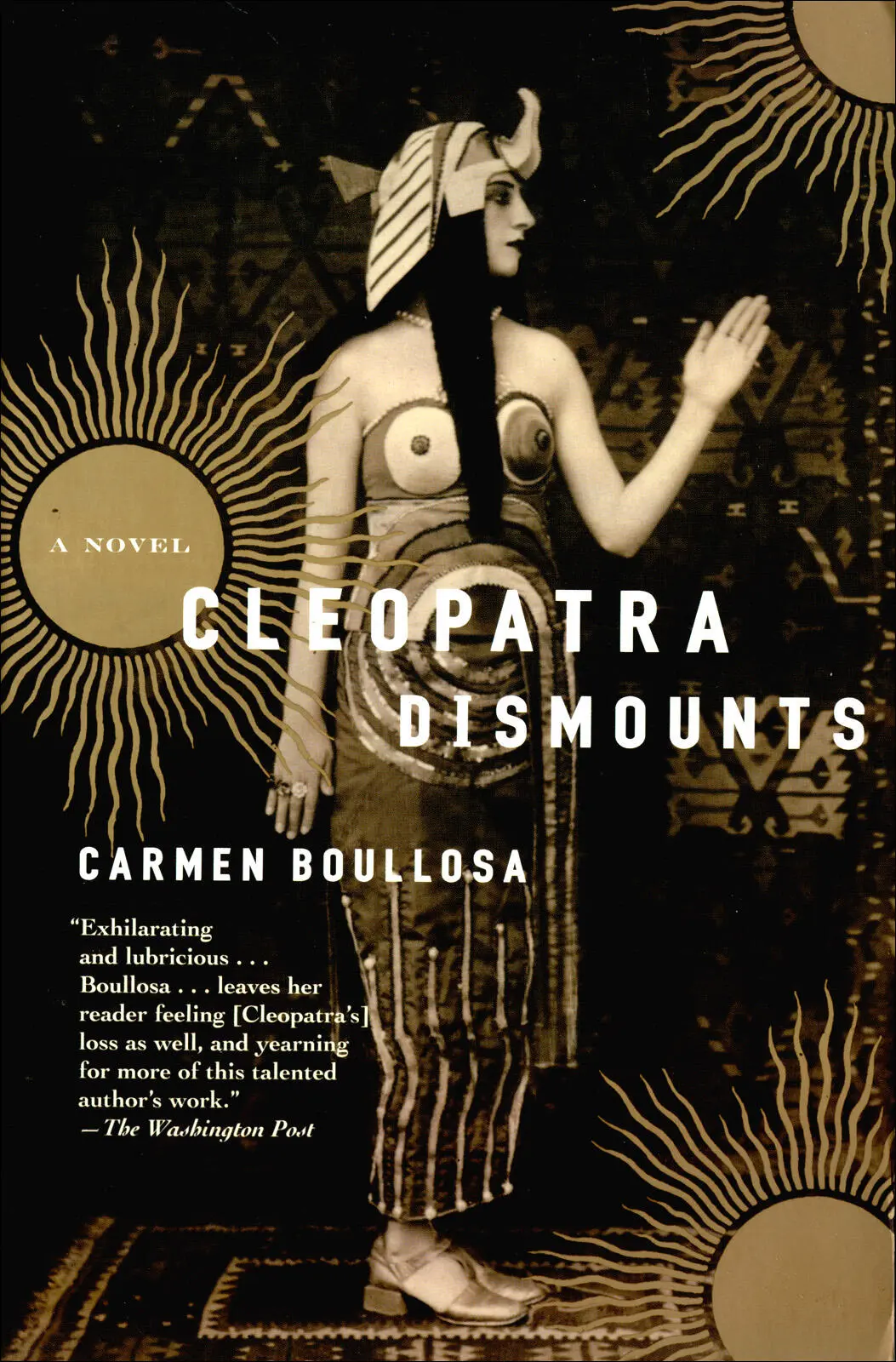
- Название:Cleopatra Dismounts
- Автор:
- Издательство:Grove Press
- Жанр:
- Год:2004
- ISBN:нет данных
- Рейтинг книги:3 / 5. Голосов: 1
-
Избранное:Добавить в избранное
- Отзывы:
-
Ваша оценка:
Cleopatra Dismounts: краткое содержание, описание и аннотация
Предлагаем к чтению аннотацию, описание, краткое содержание или предисловие (зависит от того, что написал сам автор книги «Cleopatra Dismounts»). Если вы не нашли необходимую информацию о книге — напишите в комментариях, мы постараемся отыскать её.
Through the intervention of Cleopatra's scribe and informer Diomedes, Boullosa creates two deliriously wild other lives for the young monarch — a girl escaping the intrigues of royal society to disguise herself and take up residence with a band of pirates; and the young queen who is carried across the sea on the back of a magical bull, to live among the Amazons.
Magical, multifaceted, and rippling with luminous imagination, Cleopatra Dismounts is a work that recalls Jeanette Winterson’s Sexing the Cherry and confirms Carmen Boullosa as an important international voice.
Cleopatra Dismounts — читать онлайн бесплатно полную книгу (весь текст) целиком
Ниже представлен текст книги, разбитый по страницам. Система сохранения места последней прочитанной страницы, позволяет с удобством читать онлайн бесплатно книгу «Cleopatra Dismounts», без необходимости каждый раз заново искать на чём Вы остановились. Поставьте закладку, и сможете в любой момент перейти на страницу, на которой закончили чтение.
Интервал:
Закладка:
The elders had worked their way through the Amazons and their horses in order to hear the queen from close at hand. On hearing the mention of the weakling brother, they interrupted in chorus: “Down with the filthy institution of marriage! Let women take charge of governing!”
Behind the shouts of the men, an Amazon was shrieking, “Death before a husband’s bed!”
“A quotation from Aeschylus,” I muttered to myself, recognizing the famous phrase. I was upset and put out. “What a petty thing is human will,” I continued. “Instead of giving me as an ally the garrison commanded by the Jew of Pelusium and Ascalon, the gods have brought me here to seal an alliance with these creatures, the last thing I wanted. . I’m finished. This is ridiculous, totally absurd!” I regretted removing my cloak as a sign of friendship.
The old men stopped chanting their slogans and the queen went on. “Cleopatra will return to Egypt, to queen it over kings. Her subjects will be the Medes, the Hyrcanians, who feed their dead to the dogs, the Syrians, Assyrians, Cappadocians, Phrygians, Lydians, Carians, Phoenicians, Babylonians, Bactrians, Indians, Cilicians, Scythians, Paphlagonians, Magadians, Cypriots, and her reign shall be free of terror. She will be adored like a goddess, she will instill into the masses a desire to worship her, they will call her ’generous of heart,’ and her glory will exceed that of the son of Cambyses. Her subjects will include Pasagardians, Mara-phians, Maspians, Germans, Pantialians, and Derusians, as well as nomads, the Daians, Mardians, Dropicans, and Sargacians — all the tribes of Persia! Her subjects will be Gauls, Spaniards, Jews, and all the kingdoms that look on the Mediterranean and the great Ocean. Thus speaks Hippolyta the Third, Queen of the Amazons, in welcome of Cleopatra the Seventh, declaring herself and her troops the foremost of her loyal subjects.”
After the enumeration of possible future subjects, I felt safer and more comfortable, now that government by women and the hatred for marriage had been left behind. As soon as the queen stopped talking, the musicians started up, producing a merry chaos on their instruments, filling the air with sounds like the voices of eunuchs. The queen bade me good-bye with a gesture, and off she went, followed by the rest of the Amazons. I lifted my cloak off the ground, shook it clean, and put it back on.
Once fully dressed, I turned away from the sea and the sloping beach. At first I had assumed because of the presence of the Amazons that I had landed in Themiskira at the mouth of the River Thermidon. Now, with a chance to look around, I saw it was the Isle of Evening, in the swamp of Tritonis, for the place was exactly as the poets describe it. To one side there was an abundance of fruit trees, uncountable flocks of goats and sheep, and magnificent dogs. Between them and the river extended a plain as far as the sea. There two gigantic palm trees, like two pillars, flanked an enormous black stone. I was soon to learn that this was the Temple of Demeter. The sun still remained fixed to the horizon, motionless, and I realized that on this island sunset was everlasting.
As I already told you, by my side a powerful river debouched into the sea, protecting the Amazons from any flank attacks. Their land defense was a range of irregular escarpments, partly bare of vegetation, where the flat top was crowned by dense woodland. I soon discovered that on the far side of the range were sheer cliffs but right then I felt it was a weak point. Between the range, which the evening sun was staining blue, and the sea was a stretch of level land, free from undergrowth, and on it stood the gigantic palms and the black stone, the one feature that dominated all others. On the other side, the fruit trees, the herds of livestock and the mangers of the horses, marked off by bales of fodder, along with stakes and stones that functioned as corrals, acted as a complicated defensive wall for what I may call the nest of the Amazons.
The impression the place gave me was a disturbing one. Though the fruit trees and the livestock evoked a sense of peace, the absence of buildings, the force of the river, the ceaseless crashing of the waves, the movement of the mounted army like so many ants in the distance — if there were three hundred Amazons, there had to be two or three times that number of horses — all spoke of restless motion. Though the range of hills was not far from the sea, the open plain in the middle and the proximity of the sea created a sense of broad, generous space. The home of the Amazons was spacious, everything was in motion there. The island was the very opposite of a desert but it had something in common with one. I felt the desert on my skin, because it was still caked with salt, and the damp atmosphere did not dispel it. “When all is said and done,” I thought, “everything outside Alexandria is desert.” I added the words of the poet:
Alexandria is all of Earth.
All Earth is Alexandria.
The great city came back into my mind, its columned arcades, the temple of Serapis, the innumerable streets crisscrossing. . I had to get back there as fast as possible.
While I was surveying the place and sighing for my city, the elders had readied themselves to serve me. Some of them came carrying a triclinium that they set down on the sand. They placed me in it, cloak and all. Others brought over trays of fresh figs and nuts, olives, pomegranates, cheeses, bread, and dried fish from Lake Mareotis, brought here perhaps by land, perhaps by sea. They resettled the crown on my disheveled locks and served me wine. They placed a garland of wheat ears on me. The hundreds of Amazons paid us no attention, absorbed by I-don’t-know-what. The queen had disappeared from sight.
The gathering now consisted of the old men and me. I thought I recognized, under all the wrinkles, Philo, the Roman poet who frequented the palace of Pompey. I was almost certain that the first one I had identified was Acusilaus but not being wholly certain, I addressed him as “poet.”
To my astonishment, all the old men answered my call.
“Acusilaus?” I asked and he nodded. “You’re all poets?”
They nodded their heads, all except one, who came close and said in sorry voice, “I am a false poet. I am Castor, the historian. I married the daughter of King Deiotarus, whom Cicero defended. My father-in-law killed my wife and planned to assassinate me too. I escaped by leaving in my marriage bed a substitute for me. In return for my life, I offered him a night of love with my darling wife. Since I fled from my city, I have been writing verses. But I am no poet.”
“Yes, you are a poet, Castor,” another old man assured him warmly.
“No, I’m not. I sold my life in order to save it, Your Majesty. I can’t be a poet. I am what remains when all of Castor has gone. I am. .”
Another poet put his arms round his shoulders and Castor fell quiet in his grief.
“You recognized me,” Acusilaus said, interrupting the awkward moment, “though the last time you saw me you were a child.”
“And are you Philo?” I asked the other.
Philo nodded.
“What brings you here, Cleopatra?” Acusilaus asked.
“I was brought here over the seas. But not by my own choice. I was with my entourage at the gates of Pelusium when a god in the shape of a bull seduced me. My plan is to go to Ascalon. There men await me to form an army and to restore me to my throne. Surely my people are already on their way. It is suicide to remain in Pelusium without gathering reinforcements.”
“The god did not err, Cleopatra. The truth is that the Amazons do not have inspectors of public works or guardians of the State’s treasures. There are no officials charged with maintaining food supplies, no collectors of taxes, no garbage-disposal staff. There is no court. There are no nobles. There is just the queen with her warriors.”
Читать дальшеИнтервал:
Закладка:
Похожие книги на «Cleopatra Dismounts»
Представляем Вашему вниманию похожие книги на «Cleopatra Dismounts» списком для выбора. Мы отобрали схожую по названию и смыслу литературу в надежде предоставить читателям больше вариантов отыскать новые, интересные, ещё непрочитанные произведения.





Обсуждение, отзывы о книге «Cleopatra Dismounts» и просто собственные мнения читателей. Оставьте ваши комментарии, напишите, что Вы думаете о произведении, его смысле или главных героях. Укажите что конкретно понравилось, а что нет, и почему Вы так считаете.