Affinity Konar - Mischling
Здесь есть возможность читать онлайн «Affinity Konar - Mischling» весь текст электронной книги совершенно бесплатно (целиком полную версию без сокращений). В некоторых случаях можно слушать аудио, скачать через торрент в формате fb2 и присутствует краткое содержание. Год выпуска: 2016, Издательство: Lee Boudreaux Books, Жанр: Современная проза, на английском языке. Описание произведения, (предисловие) а так же отзывы посетителей доступны на портале библиотеки ЛибКат.
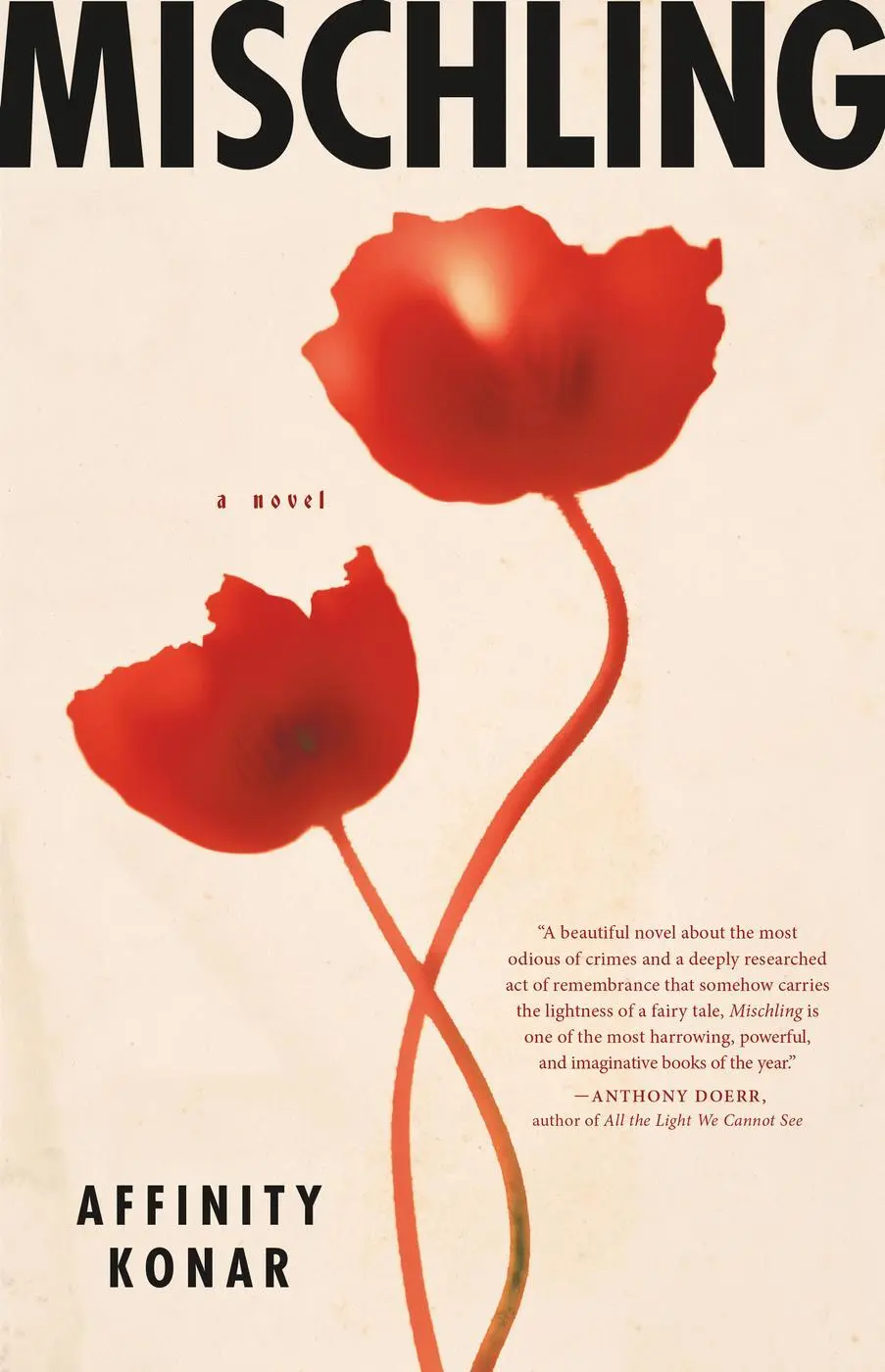
- Название:Mischling
- Автор:
- Издательство:Lee Boudreaux Books
- Жанр:
- Год:2016
- ISBN:нет данных
- Рейтинг книги:5 / 5. Голосов: 1
-
Избранное:Добавить в избранное
- Отзывы:
-
Ваша оценка:
Mischling: краткое содержание, описание и аннотация
Предлагаем к чтению аннотацию, описание, краткое содержание или предисловие (зависит от того, что написал сам автор книги «Mischling»). Если вы не нашли необходимую информацию о книге — напишите в комментариях, мы постараемся отыскать её.
Stasha must care for: the funny, the future, the bad.
It's 1944 when the twin sisters arrive at Auschwitz with their mother and grandfather. In their benighted new world, Pearl and Stasha Zagorski take refuge in their identical natures, comforting themselves with the private language and shared games of their childhood.
As part of the experimental population of twins known as Mengele's Zoo, the girls experience privileges and horrors unknown to others, and they find themselves changed, stripped of the personalities they once shared, their identities altered by the burdens of guilt and pain.
That winter, at a concert orchestrated by Mengele, Pearl disappears. Stasha grieves for her twin, but clings to the possibility that Pearl remains alive. When the camp is liberated by the Red Army, she and her companion Feliks-a boy bent on vengeance for his own lost twin-travel through Poland's devastation. Undeterred by injury, starvation, or the chaos around them, motivated by equal parts danger and hope, they encounter hostile villagers, Jewish resistance fighters, and fellow refugees, their quest enabled by the notion that Mengele may be captured and brought to justice within the ruins of the Warsaw Zoo. As the young survivors discover what has become of the world, they must try to imagine a future within it.
A superbly crafted story, told in a voice as exquisite as it is boundlessly original,
defies every expectation, traversing one of the darkest moments in human history to show us the way toward ethereal beauty, moral reckoning, and soaring hope.
Mischling — читать онлайн бесплатно полную книгу (весь текст) целиком
Ниже представлен текст книги, разбитый по страницам. Система сохранения места последней прочитанной страницы, позволяет с удобством читать онлайн бесплатно книгу «Mischling», без необходимости каждый раз заново искать на чём Вы остановились. Поставьте закладку, и сможете в любой момент перейти на страницу, на которой закончили чтение.
Интервал:
Закладка:
So we followed the woman up the stairs, through the parlor, and into the kitchen, where a dour teenager, her limbs spotty with bruises, glared at Miri as if she believed her to be an old enemy. With a mocking bow, she pulled out a chair for my guardian.
“Away with you, Eugenia!” our hostess ordered, bewildered by this display, and the girl fled to join a trio lounging on the stairs, but not before casting a final look of disgust at Miri.
In the sweetly perfumed kitchen, Gabriella’s softness increased; she lifted me from the wheelbarrow and onto a chair as if she performed this task every day of her life. Then she placed the note on the kitchen table and smoothed it lovingly with her hand, as if doing so achieved some proximity not just to the names, but to their owners.
“I left the note for my nieces,” she said. “I do not expect their mother to be alive. She was lame, like your girl. I know that the cripples did not last.”
Miri asked the woman if she had been at Auschwitz.
“I was in hiding here,” Gabriella said. “This place — it was not my choice. I used to be a dressmaker. But who needs pretty dresses in war? What I know of Auschwitz I learned from my girls. Two of them came here from…the Puff, I think they called it.”
Miri glanced at the girls on the stairs, the frills of their pastel underthings lending them the look of half-dressed parakeets. I knew she searched for Ibi. She did not find her.
“I have heard that twins were precious at Auschwitz. From Eugenia.” She indicated the bruised teenager, whose sulkiness had yet to abate. “She insisted there could be hope if one was a twin. I assumed my nieces to be dead even as I left that note. But now you come here with their names in your hand — and you would not bring bad news?”
I thought Miri’s silence strange. It seemed simple enough to reveal herself as the guardian of Auschwitz’s twins, a caretaker who was losing pieces of herself to the stress of keeping them whole. But she said nothing. I took this as a chance to act on her behalf. And so, with an adult tone borrowed from my caretaker, I asked Gabriella her nieces’ names.
“Esfir and Nina,” the woman said, her voice wistful. Again, she caressed the note.
Esfir and Nina — these names brought back the memory of my first night in the Zoo. I thought of them dragging a dead girl from our bunk and stealing her clothes.
“Resourceful girls,” Miri said carefully. “I was their doctor.”
Gabriella was beautiful in this renewal of her hope. Her eyes shone; her cheeks pinked.
“Where are they now? Can I see them?” Her gaze darted about the house, taking in all that would have to change to make this place into environs befitting the two refugees.
Before Miri could say a word, Eugenia began to speak.
“A doctor in Auschwitz was not a doctor at all,” she declared angrily. “Ask her who she answered to. Ask her what she did.”
Bewildered by this outburst, Gabriella looked at Miri, whose eyes were needlessly lit with shame. Gabriella reached out her hand and tried to take the doctor’s in it, as if the touch might prompt better news. Miri responded to this gesture with a start. Her tears were soundless, and they slid from eye to lips without the accompaniment of any expression at all. But in number, these tears — I have never seen them matched. One followed the other; they multiplied themselves; they became innumerable. I wondered how I might defend Miri.
And then the words presented themselves to me. At the time, they seemed to arise from a sweet nowhere, some place within me that I didn’t know I had. I told Gabriella that I’d known her nieces too. They were good girls, kind girls, and their last act had been a brave one of which any auntie could be proud. I said that no sooner had the girls found themselves in the Zoo than they began to plot as to how to thwart the death-doctor. These plans consumed them down to the second. Always, they were sly, sidling up to him like little foxes and applying thick layers of flattery to his willing ego. They pretended to like what he liked, to think what he thought, and when they had him alone in a vulnerable moment, isolated within the confines of a car, they grasped the hilts of their bread knives, which were secreted in their pockets, and even though this plan proved unsuccessful, they had been more alive than anyone in that moment, and their plots to kill the doctor — however naive, however foolish — were the stuff of legend. Every day, I said, I thought of them. I thought of them with such an intensity that they often merged into a single person and I thought of this person as if she were my own heart.
Gabriella kissed the top of my head and held me tight; her embrace was such that I knew, in our closeness, that she imagined me into the girls she had lost. Her touch carried heartbreak, but her voice held only resolve.
“You have made life livable,” she whispered. I thought her grip might never ease, but she suddenly released me, and she walked across the room and then back, as if proving to herself that she could continue, and then an idea must have seized her because she darted to a closet by the entry. Out of it tumbled all manner of things: scarves, umbrellas, hats, even the tuft of a toupee. She sifted through this pile, reached to the back of the closet, and, triumphant, she presented to me what no one else in Krakow could.
“Left by a soldier,” she said. “A shrimp of a boy, and so ill — he is not coming back. Better for you to have these than some drunken lout!”
Though old, these crutches made me new. They made a version of me that could walk. Or at least, one that could do more than stumble. I could sidle a crutch forward and swing my feet before me, and even within a few steps, I saw the potential of what I might do. That I might remain broken, but I could be swift and broken, adaptable and broken, able and broken.
With these crutches at my sides, I could take better care of Miri.
As we left that place, Miri asked me where I’d summoned such a story, about plots and vengeance and dreaming this most impossible dream of Mengele’s death, and I told her that it was something imprinted within me, and while I couldn’t locate its origin, I knew it to be real, or half-real, or at least the warmth that ran through me — so intense that it cast a shadow I could pretend into family — felt realer than anything.
“Remember that,” she advised me. And so, it was official: this became my first true memory of my sister, the twin that I’d once had.
On our final morning I woke to the sun peering through the cracks in the boarded windows, tossing its ribbons over the rows of sleeping children on the floor, all of us cocooned in blankets and rags. Sophia lay on my left, snoring mightily, her arms flung over my chest. My crutches were on my right, and seeing them, I remembered: I could go anywhere by myself, and take Miri with me.
But on that day, they would try to turn me over to the Red Cross.
As soon as I opened my eyes, I saw the preparations for our parting. Miri and Twins’ Father, they were huddled on the kitchen floor, a pile of our many shoes between them. Miri was stuffing the holes with paper, and Twins’ Father was binding them with twine. Shoe after shoe they mended in silence, and with hands that shook, both unsteadied by the nearing good-bye. I saw Miri glance at the packs stationed by the door, one for Peter, another for Twins’ Father. She studied them as if she was trying to gather courage to speak, and then she addressed Twins’ Father, her face downturned, her eyes still low.
“You never questioned my actions, Zvi. Why was this? The others — I would hear stories about myself, what I had done. And the stories, they follow me, even now.”
She sealed the shoe’s injury shut, tied the twine in a final knot.
Читать дальшеИнтервал:
Закладка:
Похожие книги на «Mischling»
Представляем Вашему вниманию похожие книги на «Mischling» списком для выбора. Мы отобрали схожую по названию и смыслу литературу в надежде предоставить читателям больше вариантов отыскать новые, интересные, ещё непрочитанные произведения.










Обсуждение, отзывы о книге «Mischling» и просто собственные мнения читателей. Оставьте ваши комментарии, напишите, что Вы думаете о произведении, его смысле или главных героях. Укажите что конкретно понравилось, а что нет, и почему Вы так считаете.