Alan Moore - Jerusalem
Здесь есть возможность читать онлайн «Alan Moore - Jerusalem» весь текст электронной книги совершенно бесплатно (целиком полную версию без сокращений). В некоторых случаях можно слушать аудио, скачать через торрент в формате fb2 и присутствует краткое содержание. Год выпуска: 2016, Издательство: Liveright Publishing Corporation, Жанр: Современная проза, на английском языке. Описание произведения, (предисловие) а так же отзывы посетителей доступны на портале библиотеки ЛибКат.
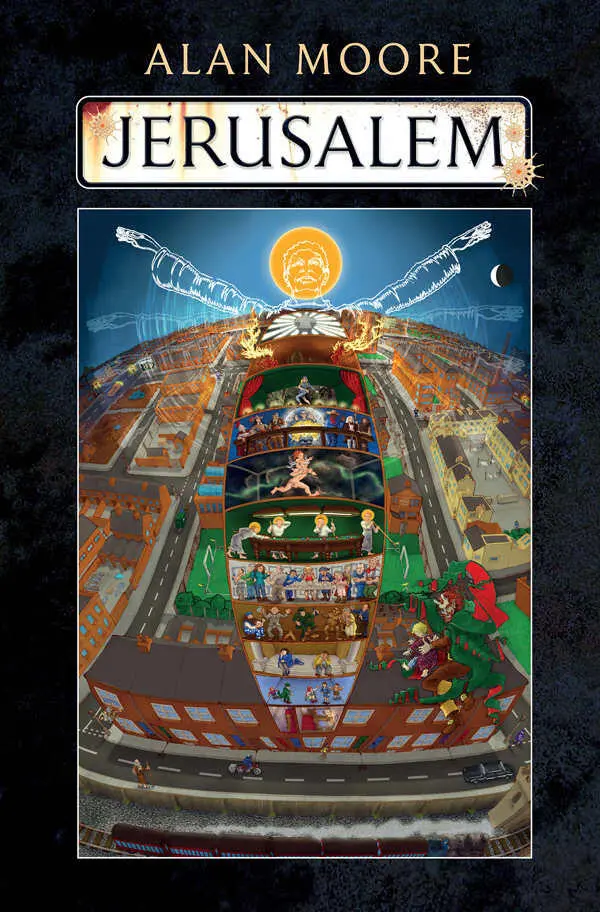
- Название:Jerusalem
- Автор:
- Издательство:Liveright Publishing Corporation
- Жанр:
- Год:2016
- ISBN:нет данных
- Рейтинг книги:4 / 5. Голосов: 1
-
Избранное:Добавить в избранное
- Отзывы:
-
Ваша оценка:
Jerusalem: краткое содержание, описание и аннотация
Предлагаем к чтению аннотацию, описание, краткое содержание или предисловие (зависит от того, что написал сам автор книги «Jerusalem»). Если вы не нашли необходимую информацию о книге — напишите в комментариях, мы постараемся отыскать её.
Disappeared lanes yield their own voices, built from lost words and forgotten dialect, to speak their broken legends and recount their startling genealogies, family histories of shame and madness and the marvellous. There is a conversation in the thunderstruck dome of St. Paul’s cathedral, childbirth on the cobblestones of Lambeth Walk, an estranged couple sitting all night on the cold steps of a Gothic church-front, and an infant choking on a cough drop for eleven chapters. An art exhibition is in preparation, and above the world a naked old man and a beautiful dead baby race along the Attics of the Breath towards the heat death of the universe.
An opulent mythology for those without a pot to piss in, through the labyrinthine streets and pages of Jerusalem tread ghosts that sing of wealth and poverty; of Africa, and hymns, and our threadbare millennium. They discuss English as a visionary language from John Bunyan to James Joyce, hold forth on the illusion of mortality post-Einstein, and insist upon the meanest slum as Blake’s eternal holy city. Fierce in its imagining and stupefying in its scope, this is the tale of everything, told from a vanished gutter.
Jerusalem — читать онлайн бесплатно полную книгу (весь текст) целиком
Ниже представлен текст книги, разбитый по страницам. Система сохранения места последней прочитанной страницы, позволяет с удобством читать онлайн бесплатно книгу «Jerusalem», без необходимости каждый раз заново искать на чём Вы остановились. Поставьте закладку, и сможете в любой момент перейти на страницу, на которой закончили чтение.
Интервал:
Закладка:
He sipped his bitter and, taking advantage of the sunlight falling through the window that he sat beneath, removed A Northamptonshire Garland from his satchel and began to read. The first piece his eyes fell on was “The Angler’s Song”, a work by William Basse, seventeenth-century pastoral poet with disputed although likely origins here in the town.
As inward love breeds outward talk,
The hound some praise, and some the hawk,
Some, better pleased with private sport,
Use tennis, some a mistress court:
But these delights I neither wish,
Nor envy, while I freely fish.
Ben liked the poem, though he’d never really done much fishing since his first youthful attempts, which had involved the accidental hooking of another child during the back-swing when he’d cast off. He recalled the blood, the screams, and worst of all his total inability to keep from giggling inappropriately with shame during the subsequent first aid. That had been it for Benedict and fishing, pretty much, though he approved of it as an idea. Along with fauns and shepherdesses it was part of his Arcadian mythology, the angler drowsing by the stream, the riverine crawl of the afternoon, but like the shepherdesses it was something he’d had little practical experience of.
On reflection, that was probably why Ben had let “Atlantis” go unfinished all those years ago, the sense that it was inauthentic, that he had been barking up the wrong tree. When he’d started it, he’d been a schoolboy from a dark house down in Freeschool Street, deploring all the grimy factory yards the way that he thought John Clare would have done; lamenting the bucolic idyll that, in his imagination, the contemporary mean streets of the Boroughs had displaced. Only when those slate rooftops and tree-punctured chimney breasts had been themselves removed had come belated recognition that the narrow lanes were the endangered habitat he should have been commemorating. Bottle-caps, not bluebells. He’d thrown out his central metaphor, the droning, drowning hedgerows of a continent that he’d reported lost but in all truth had never really owned, and written “Clearance Area” instead. After the neighbourhood as Benedict had known it was no more, at last he’d found a voice that had been genuine and of the Boroughs. Looking back, he thought that later poem had been more about the bulldozed flats of his own disillusion than the demolition site his district had become, although perhaps the two were ultimately the same thing.
He lit a cigarette, noting that this left six still rattling loose in the depleted pack, and flipped on through the alphabetically arranged compendium, skipping past Clare this time to light on the inarguably authentic Boroughs voice of Philip Doddridge. Though the piece was called “Christ’s Message” and based on a passage from the Book of Luke it was essentially the text of Doddridge’s most celebrated hymn: “Hark the glad sound! The Saviour comes!/ The Saviour promised long!” Benedict liked the exclamation marks, which seemed to couch the second coming as a gravel-throated trailer for a movie sequel. In his heart, Ben couldn’t say that he was confident concerning Christianity … the ton-up accident that took his sister back when he’d been ten put paid to that … but he could still hear and respect the strong Boroughs inflection in Doddridge’s verses, his concern for the impoverished and wretched no doubt sharpened by his time at Castle Hill. “He comes the broken heart to bind, The bleeding soul to cure,/ And with the treasures of his grace T’ enrich the humble poor.”
He’d drink to that. Lifting his glass he noticed that its ebbing tide-line foam was at half-mast. Just four sips left. Oh well. That was enough. He’d make it last. He wouldn’t have another one in here, despite the seventeen-odd pounds he still had left. He thumbed his way on through the book until he reached the Fanes of Apethorpe: Mildmay Fane, the second Earl of Westmorland, and his descendant Julian. He’d only really settled on the pair through being taken with the names ‘Mildmay’ and ‘Apethorpe’, but soon found himself immersed in Julian’s description of the family pile, as admired by Northampton fan John Betjeman. “The moss-grey mansion of my father stands/ Park’d in an English pasturage as fair/ As any that the grass-green isle can show./ Above it rise deep-wooded lawns; below/ A brook runs riot thro’ the pleasant lands …” The brook went babbling on as he sipped dry his pint and bought another without thinking.
Suddenly it was ten minutes after three and he was half a mile away, emerging out of Lutterworth Road onto Billing Road, just down from what had once been the Boy’s Grammar School. What was he doing here? He had the vaguest memory of standing in the toilets at the Crown & Cushion, of a ghostly moment staring at his own face in the mirror bolted up above the washbasin, but for the life of him could not remember leaving the pub premises, much less the fairish walk he’d evidently taken down here from the Wellingborough Road. Perhaps he’d wanted to head back to the town centre but had chosen this admittedly more scenic route? Chosen was probably too strong a word. Ben’s path through life was governed not so much by choice as by the powerful undertow of his own whimsy, which would on occasion wash him up to unexpected beachheads like this present one.
Across the street and some way off upon his left was the red brick front of the former grammar school, set back from the main road by flat lawns and a gravel forecourt where a naked flagpole stood, no ensign showing which side the establishment was on. Benedict understood the reticence. These days, targets were what schools aimed at, not what they aspired to be. Stretching away behind the calm façade and the aloof gaze of the tall white windows there were classrooms, art rooms, physics blocks and playing fields, a spinney and a swimming pool, all trying to ignore the gallows shadow that league tables cast across them. Not that there was any cause here for immediate concern. Though relegated from a snooty grammar to a red-eared comprehensive in the middle 1970s, the place had used its dwindling aura and residual reputation as brand markers in the competition-focussed marketplace that teaching had become. Invoking the school’s previous elitist status and the ghost of poshness past would seem to have succeeded, making it a big hit with the choice-dazed well-off parent of today. Apparently, from what Ben heard, they even made a selling point of the monastic single-sex approach to education. Anyone applying for their son to be accepted had to first compose a modest essay stating why, precisely, at the most profound ideological and moral level, they believed their child would benefit from being tutored in an atmosphere of strict gender apartheid. What did they expect people to say? That what they hoped for little Giles was that at best he’d grow into somebody awkward and uncomprehending in all his relationships with women, while at worst he’d end up a gay serial murderer? Ah ha ha ha.
Benedict crossed the road and turned right, heading into town, putting the school behind him. He’d once been a pupil there and hadn’t liked it much. For one thing, having squandered his first decade on the planet in what his mam called “acting the goat”, he’d not passed his eleven-plus exams that first go-round. When all the clever kids like Alma went off to their grammars, Benedict attended Spencer School, on the now-feared Spencer estate, with all the divs and bruisers. He’d been every bit as smart as Alma and the rest, just not inclined to take things like examinations seriously. Once he’d been at Spencer for a year or two, however, his intelligence began to shine from the surrounding dross and only then had he been transferred to the grammar school.
Читать дальшеИнтервал:
Закладка:
Похожие книги на «Jerusalem»
Представляем Вашему вниманию похожие книги на «Jerusalem» списком для выбора. Мы отобрали схожую по названию и смыслу литературу в надежде предоставить читателям больше вариантов отыскать новые, интересные, ещё непрочитанные произведения.








Обсуждение, отзывы о книге «Jerusalem» и просто собственные мнения читателей. Оставьте ваши комментарии, напишите, что Вы думаете о произведении, его смысле или главных героях. Укажите что конкретно понравилось, а что нет, и почему Вы так считаете.