Alan Moore - Jerusalem
Здесь есть возможность читать онлайн «Alan Moore - Jerusalem» весь текст электронной книги совершенно бесплатно (целиком полную версию без сокращений). В некоторых случаях можно слушать аудио, скачать через торрент в формате fb2 и присутствует краткое содержание. Год выпуска: 2016, Издательство: Liveright Publishing Corporation, Жанр: Современная проза, на английском языке. Описание произведения, (предисловие) а так же отзывы посетителей доступны на портале библиотеки ЛибКат.
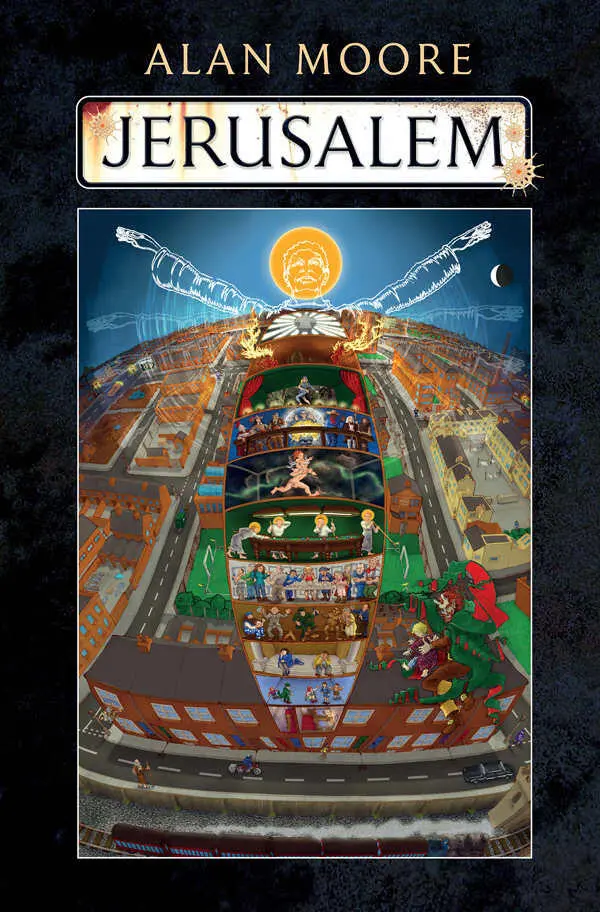
- Название:Jerusalem
- Автор:
- Издательство:Liveright Publishing Corporation
- Жанр:
- Год:2016
- ISBN:нет данных
- Рейтинг книги:4 / 5. Голосов: 1
-
Избранное:Добавить в избранное
- Отзывы:
-
Ваша оценка:
Jerusalem: краткое содержание, описание и аннотация
Предлагаем к чтению аннотацию, описание, краткое содержание или предисловие (зависит от того, что написал сам автор книги «Jerusalem»). Если вы не нашли необходимую информацию о книге — напишите в комментариях, мы постараемся отыскать её.
Disappeared lanes yield their own voices, built from lost words and forgotten dialect, to speak their broken legends and recount their startling genealogies, family histories of shame and madness and the marvellous. There is a conversation in the thunderstruck dome of St. Paul’s cathedral, childbirth on the cobblestones of Lambeth Walk, an estranged couple sitting all night on the cold steps of a Gothic church-front, and an infant choking on a cough drop for eleven chapters. An art exhibition is in preparation, and above the world a naked old man and a beautiful dead baby race along the Attics of the Breath towards the heat death of the universe.
An opulent mythology for those without a pot to piss in, through the labyrinthine streets and pages of Jerusalem tread ghosts that sing of wealth and poverty; of Africa, and hymns, and our threadbare millennium. They discuss English as a visionary language from John Bunyan to James Joyce, hold forth on the illusion of mortality post-Einstein, and insist upon the meanest slum as Blake’s eternal holy city. Fierce in its imagining and stupefying in its scope, this is the tale of everything, told from a vanished gutter.
Jerusalem — читать онлайн бесплатно полную книгу (весь текст) целиком
Ниже представлен текст книги, разбитый по страницам. Система сохранения места последней прочитанной страницы, позволяет с удобством читать онлайн бесплатно книгу «Jerusalem», без необходимости каждый раз заново искать на чём Вы остановились. Поставьте закладку, и сможете в любой момент перейти на страницу, на которой закончили чтение.
Интервал:
Закладка:
It was as all this was sinking in that there had been a terrible commotion in the nearby waters. The Nene Hag’s glutinous eyes had narrowed and contracted, squinting in surprise at this unwelcome interruption. The huge flattened head had turned, seeking the source of the disturbance, and then it had –
Marjorie bumped suddenly into the back of Reggie Bowler, who had stopped dead on the Ultraduct in front of her. The radiant flyover was evidently passing just above a central point in the web of entangled lunatic asylums, this being where Phyllis Painter had seen an abundance of mad-apples earlier, before she’d got mixed up with Michael Warren in the Attics of the Breath.
“All right, ’ere’s where I saw the Puck’s ’Ats. There wiz ’undreds of ’em, ’angin’ from the trees and from the gutterin’. If we jump dayn from where we are now, we can bag the lot of ’em.”
So saying, Phyllis clambered nimbly up onto the alabaster rail that edged the walkway, asking John to pass up Michael Warren so that Phyllis and the toddler could jump from the Ultraduct together, holding hands. The other children followed suit, and soon they were all plunging slowly through the ghost-seam’s treacle atmosphere towards the scrunched-up time and space below, grey after-pictures in a smear behind them marking their trajectories. The phantom ruffians fell towards the overlapping madhouse lawns like graceful and unhurried smoke grenades.
Marjorie landed in a crouch upon the shaved baize, with her staggered rain of multiple exposures in accompaniment. The piece of lawn she landed on appeared well tended and was therefore probably a displaced fragment of St. Andrew’s Hospital, rather than part of the more lowly nuthouse here at Berry Wood. Upon closer inspection she could even see the seams where neatly-manicured St. Andrew’s verges met with the more roughly-shorn grounds of St. Crispin’s or Abington Park: irregular trapeziums and wedges of dark or light grass fitted unevenly beside each other like a poorly manufactured jigsaw, different places crumpled up into a single landscape by the cave-in of the higher planes above. Tilting her head and looking up, Marjorie noticed that the sky itself appeared pasted together; distinct cloud types from diverse locations and from wildly varying altitudes clumsily juxtaposed, with only rough torn-paper lines dividing them. From some segments or slices of the heavens, it was drizzling.
As disorienting as the natural features of the view such as the grass and sky might be, the folded-in and mixed up buildings of the various institutions that surrounded them appeared much more peculiar. Stretches of ivy-covered limestone that were clearly part of the asylum-turned-museum in Abington fused jaggedly with pale and stately ship-like buildings from St. Andrew’s Hospital, metamorphosing ultimately to the faintly sinister brick edifices of St. Crispin’s. These bizarre, Victorian constructions were most prevalent amongst the mix of madhouses, no doubt because St. Crispin’s was the actual geographical position in the ghost-seam that these other places had become conflated with, both in the upper territories and the confused inmate dreams those higher realms were founded on.
The architecture of the institution here at Berry Wood had seemed perverse to Marjorie since she’d first learned the word “perverse”. It just seemed wrong, housing the mentally disturbed in an unsettling environment such as St. Crispin’s, where the high-windowed brick wings huddled together in a whispering conspiracy, peering suspiciously from under the steep brims of their slate hats, and where a spidery tower of no apparent purpose rose obscurely from the already oppressive skyline. Taken as a whole, St. Crispin’s Hospital had the demeanour of a strange Bavarian social experiment, left over from a bygone century. There was a gaol or workhouse flavour to its labyrinthine paths, its curfew hush, its isolation. Frankly, having fragments of St. Andrew’s or the Abington Park madhouse muddled up with it was rather an improvement.
The ghost-children were progressing cautiously across the variegated lawn towards a hodgepodge of asylum buildings dominated by the purposeless St. Crispin’s tower, a thing too slender to make any sense save as a crematorium chimney stack. One of the huddled structures near the turret’s base was a prefab extension of its native hospital, a single-storey unit where on previous visits Marjorie had stumbled upon various framed artworks executed by the inmates. In amongst the strangely captivating landscapes on display, the burning orange skies, the metal shrubs trimmed to a dangerous and spiky topiary, she’d been unsurprised to find painted depictions of the way the overlapping madhouses appeared when looked at from the ghost-seam, lumps of Abington Park or St. Andrew’s spliced in with St. Crispin’s as though by mistake. Even the sudden bursts of higher-space phenomena — like the cascading moiré pattern currently erupting from behind the spindly brick spire ahead of them — were reproduced upon some of the canvasses, a proof that living people in an extreme mental state could sometimes see the upper world and its inhabitants. She’d even found a crayon drawing of a figure that looked the dead spit of Phyllis Painter, with the rabbit skins hung in a rancid garland round her neck. It had been a distorted charcoal sketch that made the ghost gang’s leader look a lot more frightening than she was in real life or death.
Marjorie’s reverie was interrupted by a sudden loud, indignant outburst from the real Phyll Painter, the sheer vehemence of which made Marjorie think that the unknown mental patient’s portrait might have been more accurate than she’d at first supposed.
“Some bugger’s ’ad ’em! There wiz ’undreds of ’em earlier, and all these trees wiz nearly creakin’ wi’ the weight of ’em! If I find out who’s come and nicked our Bedlam Jennies before we could nick ’em then I’ll punch ’is bloody lights out, even if it’s the Third Borough!”
Everybody else, even her presumed younger brother Bill, seemed stunned by the near-blasphemy of Phyllis’s incendiary rant. Marjorie glanced towards the nearby trees and madhouse eaves. She noticed that while there were still enough Puck’s Hats growing upon them to provide a satisfying meal for the dead youngsters, there were nowhere near as many as Phyllis had led them to expect. Was their infuriated leader right? Was there some other well-informed and highly organised ghost-scavenger at work here, possibly a rival phantom gang attempting to encroach upon their territory? Marjorie hoped that this wouldn’t prove to be the case. She’d never previously heard tell of gang warfare in Mansoul, but she imagined that it could get luminously ugly. Wraith-brawls spilling over from the Mayorhold, urchins swinging dreams or memories of pickaxe handles, although how would they distinguish between differing gang colours in the monochrome arena of the ghost-seam? One side could wear black, perhaps; the other white, like violent, scruffy chess. Her wandering thoughts had got as far as revenge doorstep exorcisms when she realised that she wasn’t thinking about her real, present circumstances at all but was instead plotting a third book, presumably a follow-up to her forthcoming novel about Snowy Vernall and his beautiful granddaughter hiking through Eternity.
It was as Marjorie was forcing her unruly literary fancies back into their cage that tall John cried out suddenly.
“I can see one of the blighters! Look! He’s peeping from behind the tower!”
Marjorie turned in time to see a tiny fair-haired head bob back behind one corner of the edifice’s base. You could tell that it was that of a ghost-kid by how it left a grey stream of little heads evaporating in its wake. So, she’d been right. There was a rival gang of spectral ruffians who’d beaten them to the mad apples. There were poachers on their land! Surprised by her own sense of angry indignation, Marjorie joined with the other children as they stormed towards the tower, their half-a-dozen swelled into a shrieking Mongol horde by all the trailing doppelgangers.
Читать дальшеИнтервал:
Закладка:
Похожие книги на «Jerusalem»
Представляем Вашему вниманию похожие книги на «Jerusalem» списком для выбора. Мы отобрали схожую по названию и смыслу литературу в надежде предоставить читателям больше вариантов отыскать новые, интересные, ещё непрочитанные произведения.








Обсуждение, отзывы о книге «Jerusalem» и просто собственные мнения читателей. Оставьте ваши комментарии, напишите, что Вы думаете о произведении, его смысле или главных героях. Укажите что конкретно понравилось, а что нет, и почему Вы так считаете.