Alan Moore - Jerusalem
Здесь есть возможность читать онлайн «Alan Moore - Jerusalem» весь текст электронной книги совершенно бесплатно (целиком полную версию без сокращений). В некоторых случаях можно слушать аудио, скачать через торрент в формате fb2 и присутствует краткое содержание. Год выпуска: 2016, Издательство: Liveright Publishing Corporation, Жанр: Современная проза, на английском языке. Описание произведения, (предисловие) а так же отзывы посетителей доступны на портале библиотеки ЛибКат.
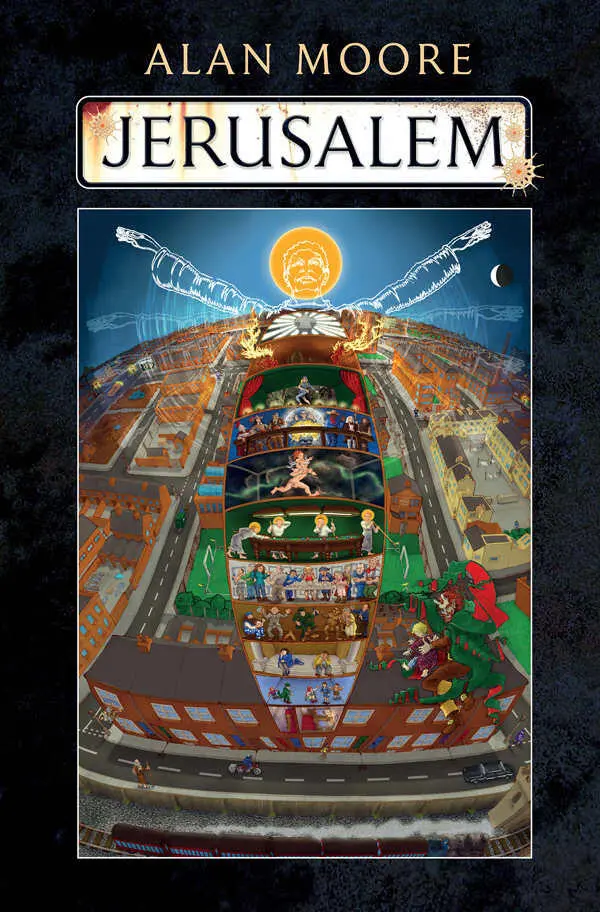
- Название:Jerusalem
- Автор:
- Издательство:Liveright Publishing Corporation
- Жанр:
- Год:2016
- ISBN:нет данных
- Рейтинг книги:4 / 5. Голосов: 1
-
Избранное:Добавить в избранное
- Отзывы:
-
Ваша оценка:
Jerusalem: краткое содержание, описание и аннотация
Предлагаем к чтению аннотацию, описание, краткое содержание или предисловие (зависит от того, что написал сам автор книги «Jerusalem»). Если вы не нашли необходимую информацию о книге — напишите в комментариях, мы постараемся отыскать её.
Disappeared lanes yield their own voices, built from lost words and forgotten dialect, to speak their broken legends and recount their startling genealogies, family histories of shame and madness and the marvellous. There is a conversation in the thunderstruck dome of St. Paul’s cathedral, childbirth on the cobblestones of Lambeth Walk, an estranged couple sitting all night on the cold steps of a Gothic church-front, and an infant choking on a cough drop for eleven chapters. An art exhibition is in preparation, and above the world a naked old man and a beautiful dead baby race along the Attics of the Breath towards the heat death of the universe.
An opulent mythology for those without a pot to piss in, through the labyrinthine streets and pages of Jerusalem tread ghosts that sing of wealth and poverty; of Africa, and hymns, and our threadbare millennium. They discuss English as a visionary language from John Bunyan to James Joyce, hold forth on the illusion of mortality post-Einstein, and insist upon the meanest slum as Blake’s eternal holy city. Fierce in its imagining and stupefying in its scope, this is the tale of everything, told from a vanished gutter.
Jerusalem — читать онлайн бесплатно полную книгу (весь текст) целиком
Ниже представлен текст книги, разбитый по страницам. Система сохранения места последней прочитанной страницы, позволяет с удобством читать онлайн бесплатно книгу «Jerusalem», без необходимости каждый раз заново искать на чём Вы остановились. Поставьте закладку, и сможете в любой момент перейти на страницу, на которой закончили чтение.
Интервал:
Закладка:
It clearly wasn’t an abundance of the customary phantasmagoria you found around Mansoul that had so taken the small boy aback: Spring Lane was very much as it had been in life when Phyllis had been living down here, only more so. There were hardly any dreamlike touches of the kind that typified the upper world, no cellar grids with blackened teeth instead of bars, no fur upon the paving slabs. Instead there was no more than the familiar incline, but on fire with itself and shimmering with identity, with its own foot-worn history, with all the lights it had been saturated by across the thousand years of its existence.
Spring Lane burned with a mythology of chipped slates, pale wash-water blue and flaking at the seam. The summer yellow glow of an impending dawn diffused, diluted in the million-gallon sky above the tannery that occupied this low end of the ancient gradient, across the narrow street from where Phyllis and Michael stood outside the alley-mouth. The tannery’s high walls of browning brick with rusted wire mesh over its high windows didn’t have the brutal aura that the building had down in the domain of the living. Rather it was softly iridescent with a sheen of fond remembrance — the cloisters of some mediaeval craft since disappeared — and had the homely perfume of manure and boiled sweets. Past the peeling wooden gates that lolled skew-whiff were yards where puddles stained a vivid tangerine harboured reflected chimney stacks, lamp black and wavering. Heaped leather shavings tinted with corrosive sapphire stood between the fire-opal pools, an azure down mounded into fantastic nests by thunderbirds to hatch their legendary fledglings. Rainspouts eaten through by time had diamond dribble beading on their chapped tin lips, and every splinter and subsided cobble sang with endless being.
Michael Warren stood entranced and Phyllis Painter stood beside him, sharing his enchantment, looking at the heart-caressing vista through his eyes. The district’s summer sounds were, in her ears, reduced to a rich stock. The lengthy intervals between the bumbling drones of distant motorcars, the twittering filigree of birdsong strung along the guttered eaves, the silver gurgle of a buried torrent echoing deep in the night-throat of a drain, all these were boiled down to a single susurrus, the hissing, tingling reverberation of a cymbal struck by a soft brush. The instant jingled in the breeze.
Uphill, the other four official members of the Dead Dead Gang were climbing through a tentative prismatic haze that seemed to fog — deliciously — each windowsill and curbstone in the slanted lane. Making hard work of it, their slogging forms looked every bit as marvellously typical as the scrubbed doorsteps they were trudging past, looked just as indispensable to the beguiling composition of the scene. Phyllis’s Bill and Reggie Bowler were the closest to the top, with Handsome John and Marjorie sharing a joke as they ascended past the entrance to Monk’s Pond Street, opening to their left on Spring Lane’s other side. Trading a glance in which they both acknowledged what a marvel this all was, Phyllis and Michael started dawdling up the perfect street after their comrades.
Fastening the wine-red dressing gown more tightly round his waist the little boy took big steps to keep up with Phyllis, staring all the time in wonderment at the long terrace reaching from the hill’s foot to its crown, the row of painted wooden doors almost uninterrupted on their right as they went up. At last he could contain his curiosity no longer.
“What are all these houses? Spring Lane wizzn’t like this when I wiz alive still.”
Placing one blue shoe before the other on the pink and weathered pavement as she struggled up the hillside, Phyllis glanced towards the homes that they were passing with a wistful look upon her fair-skinned face.
“Yer right, it wizzn’t, but it wiz when I wiz little. Most of these got knocked dayn right before the war, and then it wiz just wasteland for the kids to play on until it got turned to the school playing field. That little row of ’ouses where your house wiz, on St. Andrew’s Road, that’s all that’s left of a big block of ’ouses. They wiz all up Scarletwell Street and Spring Lane, all along Crispin Street up at the top, and there wiz whole streets in between what ain’t there now. Scarletwell Terrace, what we’ve just come ayt of, that wiz one, and a bit further up on this side of the lane there’s Spring Lane Terrace.”
Michael Warren was still listening, but he was letting his gaze wander to the road’s far side where now the entrance to Monk’s Pond Street opened up, running off north from Spring Lane’s east-west line. Phyllis reflected that this side-street would look vastly altered, too, from the small boy’s perspective. Closest to them, on the left-hand side as they looked down Monk’s Pond Street, stood the east wall of the tannery, which would be recognisable from Michael’s lifetime. Opposite and on the right, however, some two dozen well-kept doorsteps stretched away north to connect with Crane Hill and the bottom end of Grafton Street. Two dozen sprawling families, perhaps two hundred people in their proudly-maintained row, which would, by Michael Warren’s day, become a patch of rubble that the local children called ‘The Bricks’ or else be factory property fenced off by walls of corrugated tin. Only up here, in the magnetic fields of dream and memory, were the old homesteads manifest.
Along the thoroughfare’s far end upon its leftmost, western side there was the feature that had evidently captured the youngster’s attention. The expansive pond from which the street derived its name, dried up down in the timely world since the late sixteen-hundreds, glittered in the sourceless sunlight. Two or three unhurried figures in dun-coloured habits stood conversing by the waterside, one of them carrying a fishing pole.
“They’re monks,” Phyllis explained to Michael. “They’re monks who lived a long while back at Andrew’s Priory, which wiz up near where St. Andrew’s Church wiz now, that I got booted ayt of when me rabbit skins wiz causing such a stink. They’re Frenchies most of them, I think, and it wiz one of them who let the King’s troops in to ransack everything, eight ’undred year ago. Up ’ere that’s all forgiven, by and large, but mostly they don’t mingle wi’ the local ghosts and still keep to themselves. Or sometimes the more boozy ones will ’aunt a pub, just for the company. There’s several of the inns round ’ere ’ave got a ghostly monk in the back cellar or the snug, though I can only think of one by name and that’s Old Joe who floats araynd the Jolly Smokers on the Mayorhold. Old Joe’s not his real name, ’cause that would be something French, but it’s just what the people Daynstairs call him.”
Michael Warren looked at her, perplexed.
“Can people who are still aliveable see ghosts, then?”
Phyllis shrugged.
“Some of them can, but only if they’re a bit funny in the ’ead, like mystic people are, or people who’ve gone mad. People who drink a lot or who smoke opium or things like that, they can see ghosts as well. That’s why yer get more ’aunted pubs than any other sort of building, because dead folk like a place where there’s a chance someone wizzle be drunk enough to notice them. But even the few people what are able to see ghosts can only see them when they’re wandering abayt dayn in the ghost-seam.”
Monk’s Pond Street was vanishing behind them on their left as they continued up the fond and sparkling daydream of the hill. The tartan-shrouded toddler’s attention was now wholly fixed on Phyllis.
“What’s a ghost-seam?”
Phyllis couldn’t help herself from saying “Funny, till yer get to know ’im,” which was an old joke up in Mansoul and which the baffled infant clearly didn’t get. She answered him again, more seriously.
Читать дальшеИнтервал:
Закладка:
Похожие книги на «Jerusalem»
Представляем Вашему вниманию похожие книги на «Jerusalem» списком для выбора. Мы отобрали схожую по названию и смыслу литературу в надежде предоставить читателям больше вариантов отыскать новые, интересные, ещё непрочитанные произведения.









Обсуждение, отзывы о книге «Jerusalem» и просто собственные мнения читателей. Оставьте ваши комментарии, напишите, что Вы думаете о произведении, его смысле или главных героях. Укажите что конкретно понравилось, а что нет, и почему Вы так считаете.