Харуки Мураками - Killing Commendatore
Здесь есть возможность читать онлайн «Харуки Мураками - Killing Commendatore» весь текст электронной книги совершенно бесплатно (целиком полную версию без сокращений). В некоторых случаях можно слушать аудио, скачать через торрент в формате fb2 и присутствует краткое содержание. Город: New York, Год выпуска: 2018, ISBN: 2018, Издательство: Alfred A. Knopf, Жанр: Современная проза, на английском языке. Описание произведения, (предисловие) а так же отзывы посетителей доступны на портале библиотеки ЛибКат.
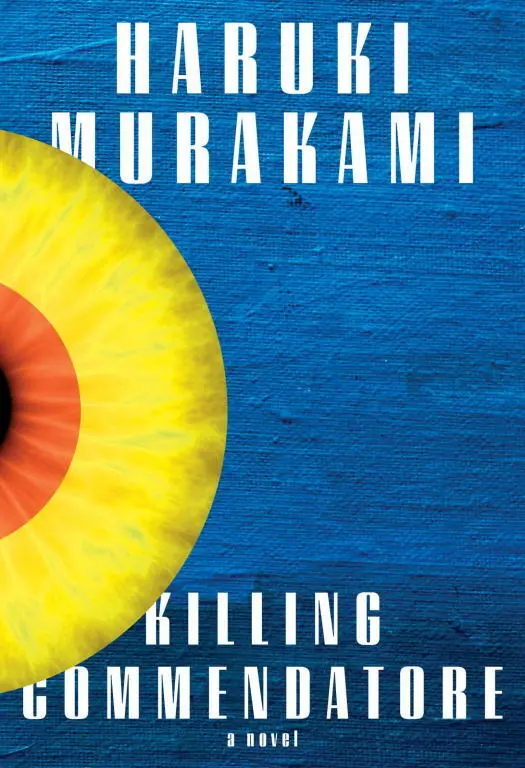
- Название:Killing Commendatore
- Автор:
- Издательство:Alfred A. Knopf
- Жанр:
- Год:2018
- Город:New York
- ISBN:978-0-5255-2005-4
- Рейтинг книги:5 / 5. Голосов: 1
-
Избранное:Добавить в избранное
- Отзывы:
-
Ваша оценка:
Killing Commendatore: краткое содержание, описание и аннотация
Предлагаем к чтению аннотацию, описание, краткое содержание или предисловие (зависит от того, что написал сам автор книги «Killing Commendatore»). Если вы не нашли необходимую информацию о книге — напишите в комментариях, мы постараемся отыскать её.
In Killing Commendatore, a thirty-something portrait painter in Tokyo is abandoned by his wife and finds himself holed up in the mountain home of a famous artist, Tomohiko Amada. When he discovers a previously unseen painting in the attic, he unintentionally opens a circle of mysterious circumstances. To close it, he must complete a journey that involves a mysterious ringing bell, a two-foot-high physical manifestation of an Idea, a dapper businessman who lives across the valley, a precocious thirteen-year-old girl, a Nazi assassination attempt during World War II in Vienna, a pit in the woods behind the artist’s home, and an underworld haunted by Double Metaphors.
A tour de force of love and loneliness, war and art—as well as a loving homage to The Great Gatsby—Killing Commendatore is a stunning work of imagination from one of our greatest writers.
Killing Commendatore — читать онлайн бесплатно полную книгу (весь текст) целиком
Ниже представлен текст книги, разбитый по страницам. Система сохранения места последней прочитанной страницы, позволяет с удобством читать онлайн бесплатно книгу «Killing Commendatore», без необходимости каждый раз заново искать на чём Вы остановились. Поставьте закладку, и сможете в любой момент перейти на страницу, на которой закончили чтение.
Интервал:
Закладка:
“We’ll be coming at three o’clock,” she said. “Mariye has said she’s willing. Well, she gave a small nod, is more accurate.”
I said I would expect them at three.
“Thank you so much,” she said. “I’m at my wit’s end. I don’t understand what’s going on, or what I should be doing.”
I wanted to tell her I felt the same way, but I didn’t. That’s not the response she was seeking.
“I’ll do what I can. I can’t be sure if it will work, but I’ll try my best,” I said. Then I hung up.
I stole a look around the room as I put down the receiver. On the off chance that the Commendatore might be in the vicinity. But he was nowhere to be seen. I missed him. The way he looked, and his odd way of speaking. But I would never lay eyes on him again. With my own hand, I had driven a knife through his tiny heart. The razor-sharp carving knife Masahiko had brought to my house. All for the purpose of rescuing Mariye from someplace. I had to find out where that someplace was.
59
UNTIL DEATH SEPARATED US
Before Mariye arrived, I took another look at her portrait, so close to done. I could picture exactly what it would look like if I ever finished it. Sad to say, though, I never would. There was no way around that. I had no good explanation for why I couldn’t complete the painting. No logical argument. Just the strong feeling that it had to be that way . The reason, I expected, would reveal itself in stages. What was clear now was that I was fighting a very dangerous opponent. I had to be on my toes every second.
I went out to the terrace, sat in a deck chair, and stared across the valley at Menshiki’s white mansion. Handsome, colorless Menshiki, he of the white hair. “We only talked for a moment at your door, but he seemed like an interesting guy,” Masahiko had said. “ A very interesting guy,” I had corrected him. At this stage of the game, though, I would have to say a very, very, very interesting guy.
A few minutes before three, the familiar blue Toyota Prius rolled up the slope and parked in its usual spot in front of my house. The engine stopped, the driver’s door opened, and Shoko Akikawa got out. Most elegantly, pivoting in her seat, knees tight together. A moment later, Mariye emerged from the passenger’s seat. Most reluctantly, her movements slow and sluggish. The morning clouds had sailed off somewhere, and the sky was the clear blue of early winter. The soft hair of the two women danced in the cold wind coming off the mountain. Mariye brushed the hair from her eyes in an impatient gesture.
Mariye was in a skirt, unusual for her. A wool skirt of navy blue, it reached her knees. Beneath was a pair of dark blue tights. Her white blouse was covered by a cashmere V-neck sweater. The sweater was a deep purple, the color of grapes. Her shoes were dark brown loafers. In that outfit, Mariye looked like a well-brought-up child from a well-off family, a healthy, pretty, utterly conventional girl. You could see nothing eccentric about her. Just that her chest was almost flat.
Shoko was wearing snug light-gray slacks. Gleaming black low-heeled shoes. A long white cardigan, fixed with a belt around her waist. Her breasts stood out proudly beneath the cardigan. She was carrying a black purse made of what looked like enamel. The sort women commonly carry, though their contents have always mystified me. Mariye appeared a bit at a loss with no pockets to plunge her hands into.
They were so different in age and stage of maturity, this young aunt and her niece, yet both were so lovely. I observed their approach through the parted curtains. When they walked side by side, the world brightened a little. As when Christmas and New Year’s arrive in tandem each year.
The doorbell chimed, and I went to open the door. Shoko greeted me politely, and I ushered them inside. Mariye said nothing. Her lips were set in a straight line, as if someone had stitched them together. She was a strong-willed girl. Once she made up her mind about something, she never backed down.
As before, I led them to the living room. Shoko launched into a string of apologies, but I cut her off. This was no time for social niceties.
“If you don’t mind, could you leave Mariye and me alone for a while?” I said, getting straight to the point. “I think that’s best. Please come back in about two hours. Would that be possible?”
“Oh, well, certainly,” the young aunt said. She seemed a little flustered. “If it’s all right with Mariye, then it’s all right with me.”
Mariye gave a slight nod. It was all right with her.
Shoko Akikawa consulted her small silver watch.
“Then I’ll come back at five o’clock. I’ll be waiting at home, so please call if you need anything.”
I told her we would.
Looking worried, Shoko paused uncertainly, clutching her black purse. Then she appeared to make up her mind, for she took a deep breath, smiled a bright smile, and left. There was the sound of the Prius’s engine starting (I couldn’t really hear it, but I assume it did), and the car disappeared down the slope. Mariye and I were left alone in the house.
The girl sat on the sofa and looked down at her lap, her lips still set in a stubborn line and her knees pressed together. Her pleated blouse was neatly ironed.
A deep silence followed. Finally, I spoke up.
“You don’t have to say a word,” I began. “You can stay quiet as long as you want. So try to relax. I’ll do the talking—all you have to do is listen. All right?”
Mariye raised her eyes and looked at me. But she didn’t speak. Nor did she nod or shake her head. She merely stared in my direction. Her face showed no emotion. I felt as if I were gazing at the full moon in winter. Perhaps she had made her heart like the moon for the time being. An icy mass of rock floating in the sky.
“First, I need your help with something,” I said. “Can you come with me?”
I rose and headed to the studio. A moment later she got up and followed. The room was chilly, so I lit the kerosene stove. When I pulled back the curtains, the mountainside was bright in the sun. Mariye’s portrait-in-progress was sitting on an easel, close to finished. She glanced at it but then quickly looked away, as if she had glimpsed something she shouldn’t have.
I crouched down, removed the cloth I had draped over Killing Commendatore , and hung the painting on the wall. I asked Mariye to sit on the stool to observe it more closely.
“You’ve seen this painting before, right?”
Mariye gave a small nod.
“It’s called Killing Commendatore . At least that’s what was written on its wrapping. It’s one of Tomohiko Amada’s most perfect works, though we don’t know exactly when he painted it. It’s beautifully composed and masterfully drawn. Each character is fully realized and utterly convincing.”
I paused for a moment, waiting for my words to sink in.
“Yet this painting was wrapped up and closeted away in the attic of this house,” I went on, “where no one would ever see it. When I stumbled upon it and brought it downstairs, it had been gathering dust for a very long time. Apart from the artist, you and I are probably the only people who have ever looked at it. Your aunt could have too on your first visit, but for some reason it didn’t catch her eye. I don’t know what made Tomohiko Amada hide it in the attic. It’s such a brilliant work, one of his true masterpieces, so why would he keep it from the world?”
Mariye didn’t respond. She sat on the stool, her eyes fixed on Killing Commendatore .
I continued. “As if on cue, weird things have happened one after another since I stumbled on this painting. First, Mr. Menshiki went out of his way to make my acquaintance.”
Читать дальшеИнтервал:
Закладка:
Похожие книги на «Killing Commendatore»
Представляем Вашему вниманию похожие книги на «Killing Commendatore» списком для выбора. Мы отобрали схожую по названию и смыслу литературу в надежде предоставить читателям больше вариантов отыскать новые, интересные, ещё непрочитанные произведения.






Обсуждение, отзывы о книге «Killing Commendatore» и просто собственные мнения читателей. Оставьте ваши комментарии, напишите, что Вы думаете о произведении, его смысле или главных героях. Укажите что конкретно понравилось, а что нет, и почему Вы так считаете.