Харуки Мураками - Killing Commendatore
Здесь есть возможность читать онлайн «Харуки Мураками - Killing Commendatore» весь текст электронной книги совершенно бесплатно (целиком полную версию без сокращений). В некоторых случаях можно слушать аудио, скачать через торрент в формате fb2 и присутствует краткое содержание. Город: New York, Год выпуска: 2018, ISBN: 2018, Издательство: Alfred A. Knopf, Жанр: Современная проза, на английском языке. Описание произведения, (предисловие) а так же отзывы посетителей доступны на портале библиотеки ЛибКат.
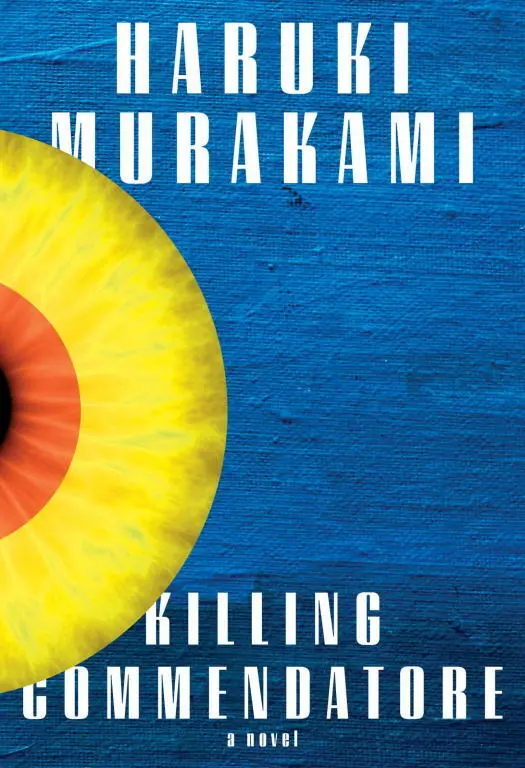
- Название:Killing Commendatore
- Автор:
- Издательство:Alfred A. Knopf
- Жанр:
- Год:2018
- Город:New York
- ISBN:978-0-5255-2005-4
- Рейтинг книги:5 / 5. Голосов: 1
-
Избранное:Добавить в избранное
- Отзывы:
-
Ваша оценка:
Killing Commendatore: краткое содержание, описание и аннотация
Предлагаем к чтению аннотацию, описание, краткое содержание или предисловие (зависит от того, что написал сам автор книги «Killing Commendatore»). Если вы не нашли необходимую информацию о книге — напишите в комментариях, мы постараемся отыскать её.
In Killing Commendatore, a thirty-something portrait painter in Tokyo is abandoned by his wife and finds himself holed up in the mountain home of a famous artist, Tomohiko Amada. When he discovers a previously unseen painting in the attic, he unintentionally opens a circle of mysterious circumstances. To close it, he must complete a journey that involves a mysterious ringing bell, a two-foot-high physical manifestation of an Idea, a dapper businessman who lives across the valley, a precocious thirteen-year-old girl, a Nazi assassination attempt during World War II in Vienna, a pit in the woods behind the artist’s home, and an underworld haunted by Double Metaphors.
A tour de force of love and loneliness, war and art—as well as a loving homage to The Great Gatsby—Killing Commendatore is a stunning work of imagination from one of our greatest writers.
Killing Commendatore — читать онлайн бесплатно полную книгу (весь текст) целиком
Ниже представлен текст книги, разбитый по страницам. Система сохранения места последней прочитанной страницы, позволяет с удобством читать онлайн бесплатно книгу «Killing Commendatore», без необходимости каждый раз заново искать на чём Вы остановились. Поставьте закладку, и сможете в любой момент перейти на страницу, на которой закончили чтение.
Интервал:
Закладка:
The faceless man nodded. “The day may come when you can draw my likeness,” he said. “If that day arrives, I will return the penguin to you.”
The faceless man strode to the end of the wooden jetty and stepped down into the small boat moored there. It was a rectangular vessel, shaped like a pastry box. Barely six feet long and narrow, and made of heavy wooden boards. I doubted it could carry many passengers at a time. There was a thick mast in the middle of the boat, at the top of which stood a metal ring about four inches in diameter. A sturdy rope was threaded through that ring. The rope stretched across the river to the far shore in a straight line—it barely sagged at all. It appeared that the boat ran back and forth along that rope, which kept it from being swept away by the swift current. The boat looked as if it had been in use for ages. It had no visible means of propulsion, or even a proper prow. It was just a shallow wooden box floating on the water.
I followed the faceless man into the boat and seated myself on the horizontal plank that ran from side to side. He leaned against the thick mast with his eyes closed, as if waiting for something. Neither of us spoke. After a few minutes, as if it had made up its own mind, the boat began its slow departure. I had no idea what was propelling us, but we were moving silently toward the far shore. There was no sound of an engine, nor of any other machinery. All I could hear was the steady slapping of water against the hull. We moved at roughly the pace of someone walking. Our boat was dashed from side to side by the current, but the sturdy rope prevented us from being washed downstream. It was just as the faceless man had said—no one could cross the river without a boat. He leaned calmly against the mast, unperturbed even when it felt like our craft might capsize.
“Will I be able to find Mariye Akikawa when we reach the other side?” I asked, when we were about halfway across.
“I am here to ferry you across the river,” the faceless man said. “To help you navigate the interstice between presence and absence. After that, it’s up to you—my job is done.”
Not long after, we hit the jetty on the far shore with a small bump. The faceless man’s posture, however, did not change. He leaned against the mast, as if confirming some sort of internal process. When that was done, he expelled a great, empty breath and stepped up onto the jetty. I followed him out of the boat. The jetty and the winch-like mechanism attached to it were the same as those on the opposite bank. So similar, in fact, it felt as if we had made a round-trip, and ended back where we started. That feeling disappeared, however, the moment I stepped onshore. For the ground on this side was normal earth, not solid rock.
“You must proceed alone from here,” the faceless man announced.
“But I don’t know which path to take. Or which direction to go.”
“Such things are inconsequential here,” came the rumble from the milky void. “You have drunk from the river, have you not? Now each of your actions will generate an equivalent response, in accordance with the principle of connectivity. Such is the place you have come to.”
With these words, the faceless man adjusted his wide-brimmed hat, turned on his heel, and walked back to his boat. Once he was aboard, it returned as it had come, following the rope to the other side. Slow and sure, like a well-trained animal. The faceless man and the boat were one as they vanished into the mist.
I decided to leave the jetty behind and walk downstream along the bank. I could have gone in any direction, but it seemed best to follow the river. That way, there was water to drink when I got thirsty. A short while later, I turned to look back at the jetty, but it was already cloaked in white mist. As though it had never existed.
The farther I walked, the wider the river became, and the gentler the current. There were no more whitecaps, and the sound of rushing water had practically disappeared. Why hadn’t they put the pier here, instead of where the flow was so swift? True, the distance would have been greater, but the crossing would have been so much easier where the water was calm. All the same, this world probably operated according to its own principles, its own way of thinking. Even greater danger might lurk beneath the placid surface.
I searched my pockets. Sure enough, the penguin was gone. That the protective charm had been lost (most likely for all eternity) was hardly reassuring. Perhaps I had made the wrong choice. Yet what other option did I have? I could only hope Mariye would be all right without it. At this point, hope was all I had.
I made my way along the riverbank, the flashlight from Tomohiko Amada’s bedside in one hand. I kept it turned off. This dusky world was not so dim as to require a light. I could see where I was walking, and for about twelve or fifteen feet ahead. The river flowed to my left, slow and silent. Once in a while, I could glimpse the far shore through the haze.
The farther on I pushed, the more the ground beneath my feet came to resemble a path. Not a well-defined path, yet something that fulfilled the function of a path. There were vague signs that people had passed this way before. Gradually, the path was leading me away from the river. At a certain point, I drew up short. Should I stick to the river? Or allow this presumed path to take me in another direction?
After some thought, I elected to follow the path and leave the river behind. I had a feeling it would lead me somewhere. Now each of your actions will generate an equivalent response, in accordance with the principle of connectivity , the ferryman had said. This path could well be an example. I decided to follow the plausible suggestion, if that’s what it was, that had been presented to me.
The farther I moved from the river, the more the path turned uphill. Eventually, I realized I could no longer hear the rush of water. The slope was easy and the path almost straight, so my steps fell into a steady rhythm. The mist was melting away, but the light remained pale and somewhat opaque. There was no way to tell what lay ahead. I kept my eyes on my feet, and my breathing regular and systematic.
How long had I been walking? I had lost all sense of time. All sense of direction, too. And the thoughts running through my head were distracting me. I had so much to figure out, yet my thoughts had become so terribly fragmented. When I tried to focus on one thought, a new thought would appear to gulp it down, and my mind would careen in the wrong direction. Each time, I lost track of what I had just been thinking about.
I was so distracted, in fact, that I almost bumped right into that . I tripped on something, and raised my eyes as I was regaining my balance. In that instant, the air around me was transformed—I could feel it on my skin. I snapped back to reality. An enormous black mass loomed directly ahead. My jaw dropped in surprise. What was it? It took a moment to register that a huge forest stood in my path. It had materialized without warning in a terrain that, until that point, had had no vegetation, not a single leaf or blade of grass. No mystery, then, why I was so shocked.
It was a forest—no question there. A tangle of branches with thick leaves that formed a solid wall. Within the forest was darkness. More accurate than forest, perhaps, might have been “sea of trees.” I stood before it and listened, but could hear nothing. No birdsongs, no branches rustling in the wind. A complete absence of sound.
I was afraid to step inside the forest. Instinctively. The trees were too dense, the darkness inside too deep. I had no way to gauge the scale, or how far the path would continue. It might well split into a labyrinth of side trails. If I got lost in that maze, my chances of escaping were practically zero. Still, I had no other real options. The path I had chosen headed straight into the forest (or, more accurately, was sucked into it, like train tracks are sucked into a tunnel). It made no sense, having come this far, to turn around and head back to the river. Who knows, the river might not even be there anymore. No, I had made my choice, and now I had to live with it. I would press on, at whatever cost.
Читать дальшеИнтервал:
Закладка:
Похожие книги на «Killing Commendatore»
Представляем Вашему вниманию похожие книги на «Killing Commendatore» списком для выбора. Мы отобрали схожую по названию и смыслу литературу в надежде предоставить читателям больше вариантов отыскать новые, интересные, ещё непрочитанные произведения.


Обсуждение, отзывы о книге «Killing Commendatore» и просто собственные мнения читателей. Оставьте ваши комментарии, напишите, что Вы думаете о произведении, его смысле или главных героях. Укажите что конкретно понравилось, а что нет, и почему Вы так считаете.