Харуки Мураками - Killing Commendatore
Здесь есть возможность читать онлайн «Харуки Мураками - Killing Commendatore» весь текст электронной книги совершенно бесплатно (целиком полную версию без сокращений). В некоторых случаях можно слушать аудио, скачать через торрент в формате fb2 и присутствует краткое содержание. Город: New York, Год выпуска: 2018, ISBN: 2018, Издательство: Alfred A. Knopf, Жанр: Современная проза, на английском языке. Описание произведения, (предисловие) а так же отзывы посетителей доступны на портале библиотеки ЛибКат.
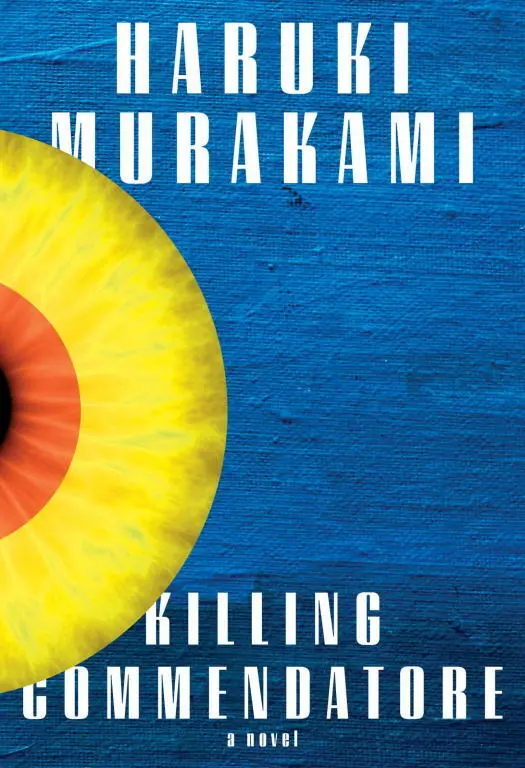
- Название:Killing Commendatore
- Автор:
- Издательство:Alfred A. Knopf
- Жанр:
- Год:2018
- Город:New York
- ISBN:978-0-5255-2005-4
- Рейтинг книги:5 / 5. Голосов: 1
-
Избранное:Добавить в избранное
- Отзывы:
-
Ваша оценка:
Killing Commendatore: краткое содержание, описание и аннотация
Предлагаем к чтению аннотацию, описание, краткое содержание или предисловие (зависит от того, что написал сам автор книги «Killing Commendatore»). Если вы не нашли необходимую информацию о книге — напишите в комментариях, мы постараемся отыскать её.
In Killing Commendatore, a thirty-something portrait painter in Tokyo is abandoned by his wife and finds himself holed up in the mountain home of a famous artist, Tomohiko Amada. When he discovers a previously unseen painting in the attic, he unintentionally opens a circle of mysterious circumstances. To close it, he must complete a journey that involves a mysterious ringing bell, a two-foot-high physical manifestation of an Idea, a dapper businessman who lives across the valley, a precocious thirteen-year-old girl, a Nazi assassination attempt during World War II in Vienna, a pit in the woods behind the artist’s home, and an underworld haunted by Double Metaphors.
A tour de force of love and loneliness, war and art—as well as a loving homage to The Great Gatsby—Killing Commendatore is a stunning work of imagination from one of our greatest writers.
Killing Commendatore — читать онлайн бесплатно полную книгу (весь текст) целиком
Ниже представлен текст книги, разбитый по страницам. Система сохранения места последней прочитанной страницы, позволяет с удобством читать онлайн бесплатно книгу «Killing Commendatore», без необходимости каждый раз заново искать на чём Вы остановились. Поставьте закладку, и сможете в любой момент перейти на страницу, на которой закончили чтение.
Интервал:
Закладка:
He spread his hands on the table and thought for a minute. He scratched his ear.
“Let’s see. For one thing, I’m getting a little tired carrying these ‘family skeletons’ around all by myself. Maybe I wanted to share them with someone. Someone who has nothing to gain from them, and who’ll keep his mouth shut. In that sense, you’re an ideal person to unburden myself to. Also, to tell the truth I’m feeling a little guilty where you’re concerned, so this may be my way of trying to pay you back.”
“Guilty?” I burst out. “In what way?”
Masahiko half closed his eyes. “I’d intended to tell you about that,” he said. “But there’s no more time today. My next appointment is one I can’t miss. Let’s meet again soon. Then we can talk all we want.”
Masahiko paid the tab. “Don’t worry,” he said. “This much I can write off.” I accepted with gratitude.
After that, I drove the Corolla station wagon back to Odawara. By the time I parked the dusty old heap in front of the house, the sun had almost reached the ridge of the western mountains. A large flock of cawing crows was winging across the valley, heading to their nests.
38
HE COULD NEVER BE A DOLPHIN
By the time Sunday rolled around, I had a pretty good idea how to attack the canvas I’d set aside for Mariye Akikawa’s portrait. I still wasn’t sure exactly what form the painting would take. But I did know how I should begin . Those first steps—which brush to use, what color, the direction of the first stroke—had come to me out of nowhere: they had gained a foothold in my mind and, bit by bit, taken on a tangible reality of their own. I loved this process.
It was a chilly morning. The kind of morning that heralds the coming of winter. I brewed coffee, ate a simple breakfast, went to the studio, laid out what I needed to paint, and then stood before my easel, which held the empty canvas. In front of the canvas, however, sat my sketchbook, open to the detailed pencil drawing I had done of the pit in the woods. I had tossed it off several mornings earlier without giving it much thought. I had even forgotten I had drawn it.
Nevertheless, the longer I stood there facing the drawing, the more it sucked me in. The mysterious stone chamber in the woods, the secret opening. The sodden earth, the patchwork of fallen leaves. The sunlight filtering through the branches. As my imagination filled in the penciled sketch, I began to see it as a colorful painting. I could breathe in the air of the place, smell the grass, hear the birds singing.
The pit I had drawn with such precision in my big sketchbook was beckoning me, luring me toward something—or was it somewhere? The pit was demanding that I paint it. I seldom thought of painting landscapes. I mean, I’d done virtually nothing but portraits for nearly ten years. But maybe a landscape painting wasn’t such a bad idea. The Pit in the Woods. This pencil sketch could be a first step in that direction.
I removed my sketchbook and closed it. The unblemished white canvas remained on the easel. The canvas that would soon be graced by my portrait of Mariye.
At a few minutes before ten, as before, the blue Toyota Prius rolled silently up the slope. The doors opened, and Mariye and her aunt Shoko stepped out. Shoko Akikawa was wearing a long, dark-gray herringbone jacket, a light-gray wool skirt, and patterned black stockings. Wrapped around her neck was a bright Missoni scarf. A chic late-fall outfit. Mariye was dressed much like before: a baggy varsity jacket, a windbreaker, jeans with holes in them, and dark-blue Converse sneakers. Her head was bare. The air was chilly, and a thin blanket of clouds covered the sky.
After a simple exchange of greetings, Shoko curled up on the sofa and, once again, immersed herself in her thick paperback. Mariye and I left her there and went into the studio. I sat on the same wooden stool, Mariye on the same simple straight-backed chair. Six feet or so separated us. Mariye took off her jacket, folded it, and laid it next to her chair. Then she removed her windbreaker. Underneath was a blue short-sleeved T-shirt and, beneath that, a gray long-sleeved T-shirt. Her chest was as flat as ever. She ran her fingers through her straight black hair.
“Aren’t you cold?” I asked. There was an old-fashioned kerosene space heater in the studio, but it was unlit.
Mariye gave a slight shake of her head. As if to say No, not particularly .
“I’ll start painting today,” I said. “You don’t have to do anything. It’s enough if you just sit there. You can leave the rest to me.”
“I can’t not do anything,” she said, looking me straight in the eye.
“What does that mean?” I asked, my hands on my knees.
“Like, I’m living and breathing and thinking all kinds of stuff.”
“Of course,” I said. “Please, breathe as much as you want and think as many thoughts as you can. All I meant was, there’s nothing special you have to do. I just want you to be yourself.”
Yet Mariye continued to stare straight at me. As if my explanation was too simple to swallow.
“But I want to do something,” she said.
“Like what?”
“I want to help you paint.”
“I appreciate that, but what do you mean exactly? Help me in what way?”
“Mentally, of course.”
“I see,” I said. Yet I couldn’t think of anything specific she could do “mentally” to help.
“I’d like to see things as you see them,” she said. “Look at myself through your eyes while you’re painting me. I think I’d understand myself better if I did that. And you’d probably understand me better, too.”
“I’d love that,” I said.
“Really?”
“Yes, really.”
“It might get pretty scary sometimes.”
“Knowing more about yourself, you mean?”
Mariye nodded. “If you want to know yourself better you have to bring in something different from someplace else.”
“Are you saying you can’t know yourself unless you add a third-person perspective?”
“A third-person perspective?”
“In other words,” I explained, “to understand the relationship between A and B you might need C, a third point of view. What we call ‘triangulation.’”
Mariye thought for a moment. “Maybe,” she said with a shrug.
“Are you saying that what you bring in might be scary, depending on the situation?”
Mariye nodded.
“Have you had that scary feeling before?”
Mariye didn’t respond.
“If I can draw you the right way, maybe you’ll be able to see yourself through my eyes,” I said. “If all goes well, of course.”
“That’s why we need pictures.”
“You’re right—that’s why we need pictures. Or literature, or music, or anything of that sort.”
If all goes well, I said to myself.
“So let’s get started,” I said to Mariye. Looking at her face, I started mixing the brown for the underdrawing. Then I selected the first brush I would use on the painting.
The work progressed slowly but smoothly. The painting would show her from the waist up. She was a beautiful girl, but beauty wasn’t what I was after. Instead, I had to find what was hidden beneath the surface. What underlay her personality—what allowed it to subsist. I had to find that something and bring it to the canvas. It didn’t have to be pretty. Sometimes it might even be ugly. In either case, though, I had to know her well enough to discover what that something was. Not through words or logic, but as a singular form, a composite of light and shadow.
I concentrated on layering lines and color on the canvas. Rapidly at times, at other times with painstaking care. Mariye sat, unmoving, on the straight-backed chair, her expression never wavering. She had mustered her willpower, I sensed, and was sustaining it for as long as necessary. I could feel her strength. “I can’t not do anything,” she had said. And indeed, she was doing something . To help me, most likely. An unmistakable current of some kind was flowing between this thirteen-year-old girl and myself.
Читать дальшеИнтервал:
Закладка:
Похожие книги на «Killing Commendatore»
Представляем Вашему вниманию похожие книги на «Killing Commendatore» списком для выбора. Мы отобрали схожую по названию и смыслу литературу в надежде предоставить читателям больше вариантов отыскать новые, интересные, ещё непрочитанные произведения.




Обсуждение, отзывы о книге «Killing Commendatore» и просто собственные мнения читателей. Оставьте ваши комментарии, напишите, что Вы думаете о произведении, его смысле или главных героях. Укажите что конкретно понравилось, а что нет, и почему Вы так считаете.