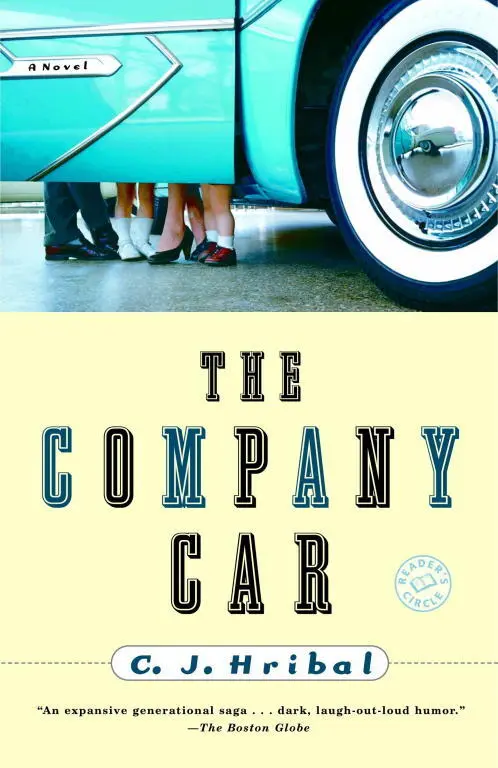
C Hribal - The Company Car
Здесь есть возможность читать онлайн «C Hribal - The Company Car» весь текст электронной книги совершенно бесплатно (целиком полную версию без сокращений). В некоторых случаях можно слушать аудио, скачать через торрент в формате fb2 и присутствует краткое содержание. Город: New York, Год выпуска: 2005, ISBN: 2005, Издательство: Random House, Жанр: Современная проза, на английском языке. Описание произведения, (предисловие) а так же отзывы посетителей доступны на портале библиотеки ЛибКат.
- Название:The Company Car
- Автор:
- Издательство:Random House
- Жанр:
- Год:2005
- Город:New York
- ISBN:1-58836-468-2
- Рейтинг книги:3 / 5. Голосов: 1
-
Избранное:Добавить в избранное
- Отзывы:
-
Ваша оценка:
The Company Car: краткое содержание, описание и аннотация
Предлагаем к чтению аннотацию, описание, краткое содержание или предисловие (зависит от того, что написал сам автор книги «The Company Car»). Если вы не нашли необходимую информацию о книге — напишите в комментариях, мы постараемся отыскать её.
“Are we there yet?” It’s the time-honored question of kids on a long family car trip—and Emil Czabek’s children are no exception. Yet Em asks himself the same thing as the family travels to celebrate his parents’ fiftieth wedding anniversary, and he wonders if he has escaped their wonderfully bad example.
The midwestern drive is Em’s occasion to recall the Czabek clan’s amazing odyssey, one that sprawls through the second half of the twentieth century. It begins with his parents’ wedding on the TV show It’s Your Marriage, and careens from a suburban house built sideways by a drunken contractor to a farm meant to shelter the Czabeks from a country coming apart. It is the story of Em’s father, Wally—diligent, distant, hard-drinking—and his attempts to please, protect, or simply placate his nervous, restless, and sensual wife, Susan, all in plain sight of the children they can’t seem to stop having.
As the tumultuous decades merge in his mind like the cars on the highway, Em must decide whether he should take away his parents’ autonomy and place them in the Heartland Home for the Elders. Beside him, his wife, Dorie, a woman who has run both a triathlon and for public office, makes him question what he’s inherited and whether he himself has become the responsible spouse of a drifting partner—especially since she’s packing a diaphragm and he’s had a vasectomy.
Wildly comic and wrenchingly poignant, The Company Car is a special achievement, a book that drives through territory John Irving and Jonathan Franzen have made popular to arrive at a stunning destination all its own.
The Company Car — читать онлайн бесплатно полную книгу (весь текст) целиком
Ниже представлен текст книги, разбитый по страницам. Система сохранения места последней прочитанной страницы, позволяет с удобством читать онлайн бесплатно книгу «The Company Car», без необходимости каждый раз заново искать на чём Вы остановились. Поставьте закладку, и сможете в любой момент перейти на страницу, на которой закончили чтение.
Интервал:
Закладка:
“What happened to you, Walter? You look incinerated.”
“I was putting up a pool for my kids,” Dad answered, a little sheepishly.
“A family man, I like that,” said Shirley. She let out a great lungful of smoke and sighed. “I have always depended upon the kindness of family men,” she said in a fake southern accent. I don’t know why she did that, but my father gave a little pained laugh. Heh-heh-heh, said my father, which was unusual for him, because he usually had a big booming laugh that you could hear clear across a room. You heard that laugh at social gatherings and invariably somebody would say, “What’s Walter think is so funny?” And somebody else would say, “Walter thinks everything’s funny,” which was news to us, seeing as how we lived with him and the laughs didn’t seem all that continuous.
My father straightened up, and that let her see me behind him. Her face lit up in a sickly sort of way. “Oh, and I see you brought your little boy with you. How sweet.” She brought her cigarette up to her lips again. “Maybe your little boy could meet my little girl sometime.”
Now I didn’t like her. She’d called me a little boy. No boy who thinks of himself as big likes being called little, not when he’s out on an adventure with his father, one he is sworn not to tell Mom about. There was something guilty and delicious about playing hooky from Mom. If Shirley had said “little man,” that would have been all right. But she hadn’t. She’d said “little boy,” and that riled me. She kept saying it, too. “I like little boys,” Shirley said to my father. “Does your little boy like to come out and play sometimes? I like little boys who can come out and play. Maybe your little boy could do that, come out and play? Unless, of course, he has too many chores around the house?” She said this last part really slowly, with pauses between each word, and her voice went all singsongy, with lots of emphasis on chores.
I wanted to say, no, no, my afternoon was free, but she wasn’t paying me any attention.
She got off her stool. She stood beside my dad, and the way she lifted his shirt I was reminded of nurses in burn wards in the war movies, how they were so gentle around the men swathed in bandages, only the men’s eyes showing, and how they cooed and ahed as they gave the men sponge baths, and the look that came over their faces when they saw the horrible burns themselves, this look of pained sympathy they got.
“You don’t tan well, do you?” She seemed nicer now, and my antipathy toward her lessened. She had arms like my mother’s, a little soft beneath her biceps.
My father allowed that he did not.
“Somebody is going to have to be gentle with you,” Shirley said, peeking inside my father’s shirt collar. She curled all her fingers except her index finger into her fist and with the tip of her blood-red fingernail started writing in the unguent smeared on the back of my father’s neck. I craned my own neck to see. “S-h-i-r,” she’d written in cursive. My father’s back arched and shivered. Her fingernail kept going: “l-e-y.” She was done. She rearranged my father’s collar, pinching it between her thumb and forefinger, then wiped her fingers on a cocktail napkin. She was smiling at my father with intense interest. My father smiled sheepishly into his drink. I wanted to tell him she’d written her name on the back of his neck in unguent, but I didn’t know if I should. Usually in the wayback you kept your mouth shut.
“Tell me, did your little boy get burned, too?”
“I’m right here,” I said, waving. “I’m fine. Just a little red on my face.” Something about how she’d written her name on my father’s neck made me want to speak up, to receive the same attention my father’d received. I wanted her fingernail to write across my neck in cursive. I bet it tickled. Or maybe it felt different if you were covered in unguent. I wanted to find out.
“That’s sweet,” said Shirley. “You must be pleased,” she said to my dad, “having a little boy who’s so well-mannered. So polite. I bet he’d stand at attention if we asked him.” And then again with the singsongy voice: “Or does he only take orders from one drill sergeant?”
I was about to leap off my stool and stand perfectly still, arms at my sides, just to prove to her I could do it, but my dad put a hand on my shoulder and squeezed. I was to stay put.
“He only takes orders from one drill sergeant,” said my father. His tone had changed. He sounded apologetic, but something else was in there, too, a certain hardness, as though he had resolved to be apologetic and was sticking to that, no matter how else he felt.
“I’m disappointed to hear that,” said Shirley. “I thought maybe we could do a little close order drilling some night, after the other little soldiers have all been put to bed.”
“Some other time,” said my father. “I need to be getting back to the base now.”
“Well,” said Shirley, sitting back on her stool and lifting her Rob Roy again, “you give your commandant my best regards. She must be quite the commander.”
“I will,” said my father. “And she is,” he added, picking up his singles and putting them back in his pocket.
Shirley reached into her little frog of a pocketbook. “Here,” she said and gave my dad a card. It had flowers on it. My father put it into his wallet, a wallet thick with gas cards and business cards and prayer cards and held together with rubber bands.
“Dad,” I whispered as we were leaving. “You left one. On the bar. One of your dollar bills.”
“That’s called a tip,” said my father. “And I’ll give you another. Loose lips sink ships.”
I had no idea what he was talking about, but I nodded like I knew, like I’d just been given a valuable piece of knowledge that would last me for the rest of my life.

8. Kids Bounce
Cumulus clouds stacked in a blue, blue sky. By rights we should not get a day like this in March. It’s flirting with sixty degrees, and Ike and Ernie have set up a feast in the front yard: venison sausage and steaks, trout and bass and walleye fillets, batter-fried perch and shrimp. Coolers jammed with beer, soda, wine. Ernie’s drinking too much, but then he’s always drinking too much. What you hope is that he calls it quits early, as our father sometimes did, and then coasts into the evening, lubricated but pacified. To distract him, we talk about the marinades and the batter, both Ernie’s recipes, and the fish, which he caught. Peg Leg Meg and Dorie and Robert Aaron’s wife, Audrey, dish out potato salad and three-bean salad and Jell-O and potato chips for the grandkids, nearly twenty of them now, who then parade past the fish and meats, load their plates some more, and eat till they’re stuffed. What they leave for the ants could feed a small village.
Out on the lawn now they’re kicking a soccer ball around, playing quoits and lawn jarts. A Frisbee passes over our heads. There are enough of us for volleyball, but given the relative girth and/or immobility of most of the adults, we have settled for croquet. Our mother’s red ball hits our father’s green one, and we laugh as our mother nestles the balls together, places her foot on her ball, and on her backswing says, “Wally-Bear, I’m sending you into the next county.” Her swing has within it both jocularity and vengeance, fondness and fury. We expect a great clack!— our father’s ball rocketing off. There were times, we know, when our mother would have liked to have done this very thing with his cojones. Only she would not have allowed them to skitter to rest under a pine tree ninety feet away, which is where she’s aiming.
Читать дальшеИнтервал:
Закладка:
Похожие книги на «The Company Car»
Представляем Вашему вниманию похожие книги на «The Company Car» списком для выбора. Мы отобрали схожую по названию и смыслу литературу в надежде предоставить читателям больше вариантов отыскать новые, интересные, ещё непрочитанные произведения.






Обсуждение, отзывы о книге «The Company Car» и просто собственные мнения читателей. Оставьте ваши комментарии, напишите, что Вы думаете о произведении, его смысле или главных героях. Укажите что конкретно понравилось, а что нет, и почему Вы так считаете.