C Hribal - The Company Car
Здесь есть возможность читать онлайн «C Hribal - The Company Car» весь текст электронной книги совершенно бесплатно (целиком полную версию без сокращений). В некоторых случаях можно слушать аудио, скачать через торрент в формате fb2 и присутствует краткое содержание. Город: New York, Год выпуска: 2005, ISBN: 2005, Издательство: Random House, Жанр: Современная проза, на английском языке. Описание произведения, (предисловие) а так же отзывы посетителей доступны на портале библиотеки ЛибКат.
- Название:The Company Car
- Автор:
- Издательство:Random House
- Жанр:
- Год:2005
- Город:New York
- ISBN:1-58836-468-2
- Рейтинг книги:3 / 5. Голосов: 1
-
Избранное:Добавить в избранное
- Отзывы:
-
Ваша оценка:
The Company Car: краткое содержание, описание и аннотация
Предлагаем к чтению аннотацию, описание, краткое содержание или предисловие (зависит от того, что написал сам автор книги «The Company Car»). Если вы не нашли необходимую информацию о книге — напишите в комментариях, мы постараемся отыскать её.
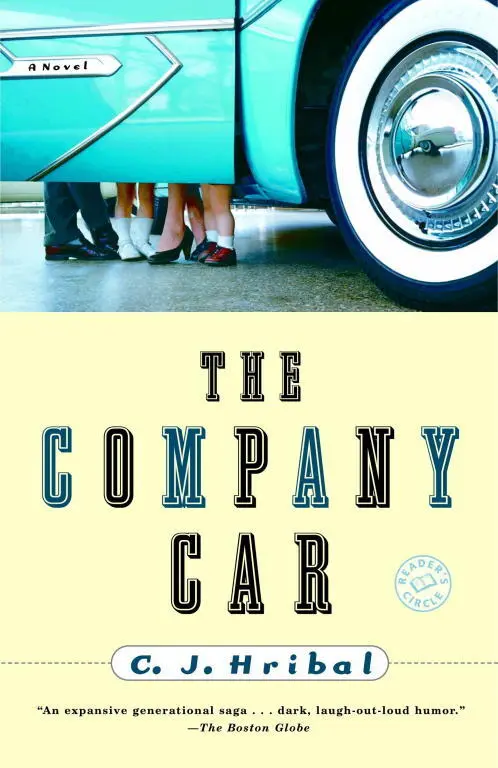
“Are we there yet?” It’s the time-honored question of kids on a long family car trip—and Emil Czabek’s children are no exception. Yet Em asks himself the same thing as the family travels to celebrate his parents’ fiftieth wedding anniversary, and he wonders if he has escaped their wonderfully bad example.
The midwestern drive is Em’s occasion to recall the Czabek clan’s amazing odyssey, one that sprawls through the second half of the twentieth century. It begins with his parents’ wedding on the TV show It’s Your Marriage, and careens from a suburban house built sideways by a drunken contractor to a farm meant to shelter the Czabeks from a country coming apart. It is the story of Em’s father, Wally—diligent, distant, hard-drinking—and his attempts to please, protect, or simply placate his nervous, restless, and sensual wife, Susan, all in plain sight of the children they can’t seem to stop having.
As the tumultuous decades merge in his mind like the cars on the highway, Em must decide whether he should take away his parents’ autonomy and place them in the Heartland Home for the Elders. Beside him, his wife, Dorie, a woman who has run both a triathlon and for public office, makes him question what he’s inherited and whether he himself has become the responsible spouse of a drifting partner—especially since she’s packing a diaphragm and he’s had a vasectomy.
Wildly comic and wrenchingly poignant, The Company Car is a special achievement, a book that drives through territory John Irving and Jonathan Franzen have made popular to arrive at a stunning destination all its own.
The Company Car — читать онлайн бесплатно полную книгу (весь текст) целиком
Ниже представлен текст книги, разбитый по страницам. Система сохранения места последней прочитанной страницы, позволяет с удобством читать онлайн бесплатно книгу «The Company Car», без необходимости каждый раз заново искать на чём Вы остановились. Поставьте закладку, и сможете в любой момент перейти на страницу, на которой закончили чтение.
Интервал:
Закладка:
Peeing by myself in a public toilet was a strangely liberating experience. Maybe this was what my father meant about being men—a steady hand, a sure aim. I shuddered, shook myself, zipped. I washed my hands and dried them on the revolving towel, yanking down hard on the edges to leave a dry spot for the next guy, the way my father always did. Then I left, empty of bladder but very full of myself, ready to take on the world. Back at the bar I opened peanut shells and discarded the husks with gay abandon.
The men were talking now about where they lived and the new highway spur and what it was like getting around Chicago these days. “Me, I wouldn’t go in if you paid me,” said one. “I have to,” said my father. “I got a lot of clients there.” “Condolences,” said the other man.
“I hear you,” said my father. I knew what was coming next so I started to tune out again. Our father said the number-one rule of selling was Don’t piss people off. So whatever the other men said, our father would answer with one of his thousands of one-size-fits-all comments: “You can’t keep a good man down.” Or “There she goes,” or “You’re up the creek without a paddle.” “Sure as shootin’,” he’d say. “You betcha. You can’t squeeze blood out of turnip.” I wondered sometimes what it would be like to have an actual conversation with him. I wondered sometimes what it was he was thinking, what he was feeling. When he got started like this you never knew.
My eyes started looking for something to latch on to again. The moose was interesting, but its range of expression was limited. Then I saw something behind Bobo that I hadn’t noticed before. It was an advertisement for Hamm’s beer—the Hamm’s bear cartoon figure was on the left side of the sign. In red script letters at the bottom was the Hamm’s beer slogan: FROM THE LAND OF SKY-BLUE WATERS… . That made me hear the theme song itself, a drum going and a kind of Indian chant: “From the land of sky-ey blue-ue wa-a-ters… comes the beer refreshing… Hamm’s the beer refreshing… Hamm’s the beer refreshing… H-a-a-m-m-m-s-s-s-s…” the drums hitting really hard on the word Hamm’s. But it was the sign itself that held me. It was a lake scene, only it seemed to be on a scroll, and as you watched, the sky blue water and sky blue sky and the evergreen trees slowly scrolled out of the frame, the sun twinkling, twinkling on water and rocks alike until you came to a couple of canoes pulled up onshore, and then you panned down the stream—it was a stream now, all pebbly with rocks—and the lake started over again. A circular universe, amazing. I got lost in it, until the front door jingled and heads turned, including mine.
It was a woman, and from the reaction of the men in the bar, this was unusual. It was hard to make her out at first, and we squinted as though we had resided too long in the dark and she was made of the light from outside, had brought it in with her. She was wearing a broad-brimmed straw sun hat and had on Jackie Kennedy sunglasses and a cotton sundress with a rose pattern—big roses—scattered all over it. She seemed a little heavyset, but she carried it well. For some reason I expected her to be wearing gloves, white kid gloves up to her elbows, but she wasn’t. She sat on the opposite side of my father, between him and the two men closest to us.
“Can a body get a drink?” she asked Bobo, and Bobo rolled the toothpick around in his mouth. “A body like that can, sure,” said Bobo.
“Sure as shootin’,” said my father. I think he just wanted to say something to be polite. Besides not disagreeing with people, our father often said meaningless things just to break the ice, but this woman seemed to regard my father seriously.
“Well,” she said, lighting a cigarette, “aren’t you the eager beaver.”
I thought she was talking to me. I was often described in school as “an eager beaver,” so it seemed natural for her to call me that, but seeing as how I was sitting on the opposite side of my father, and he was massive, it seemed rather amazing that she had noticed me at all.
“Fill ’er up, Bobo,” said my father. We were back at the Sinclair station. I always felt excited at the Sinclair station. There was plenty to watch—the dinosaur on the sign, for example, and the attendants who scurried about our father’s car, filling it with gas, checking its oil, cleaning the windshield and side windows, even the triangular vent window that we loved to have open—but we never felt we were part of the proceedings except as an audience inside the car’s bubble. Things went on around us and we watched. It was like that now with the three men at the bar, and Bobo behind it, and the woman sitting among them. Things went on among the five of them, and it was like I was now in the bubble, sealed off from the proceedings but watching.
The woman’s name was Shirley. One of the men sitting at the end of the bar said, “What’s your name, sugar? I’m Roy, and this here’s Charlie,” indicating the man next to him.
“That’s a nice name,” the woman said. Then to Bobo, “I think I’ll have one of those.”
“One of what?” said Bobo.
“A Rob Roy,” said the woman. Everybody was still looking at her. My father was smiling or grimacing, I couldn’t tell which.
“I asked you what’s your name, sugar,” Roy said. He was a burly looking man with a big forehead on account of he had almost no hair on his head. He had a round face and long strands of hair that came from just above his ears and were greased onto the top of his head like colonists forced to live in a barren new country. The few indigenous strands stood up short and wild and were highlighted white by the window behind him.
“I heard you, Roy,” said the woman, waving her hand at him. She had the reddest nails I’d ever seen. It was like the tips of her fingers were dipped in blood. She turned to my father just as Bobo was setting her drink down in front of her and taking the singles from the small stack sitting in front of my dad. She lifted her Rob Roy and made a little toasting gesture. “Thank you,” she said to my father. “My name’s Shirley. And who might my benefactor be?”
“Walt,” said my father, still smiling and grimacing. He looked embarrassed, pained, and pleased to boot.
“Walt,” said Shirley. “I like that name. Walt. Do you mind if I call you Walter?” She was already taking another cigarette out of her pack. She kept them in a little green purse with a clasp, and when she opened the purse it looked like a frog opening its mouth. “I never liked my name,” said Shirley. “You know who I was named for, Walter? Shirley Temple. I hate that.” She had the cigarette in the corner of her mouth, but before she could light it herself my father had his lighter out. He didn’t smoke anymore, but he still carried his silver Zippo with his ship and ship’s number etched on the side. She bent her head for the flame, and when she straightened up she was already blowing out smoke.
“Shirley,” said Roy. “I always kinda liked that name.”
“Me, too,” said Charlie. “I known a lotta Shirleys and I liked ’em all.”
My father dipped his head and whispered to me for the second time, “These are men. Never forget that.” He was creeping me out again. I knew they were men. What else could they be? Except for Shirley, of course, who looked a little like Mrs. Duckwa, unhappy and hungry. My father sat back. “And this,” he said a little louder, indicating Shirley, “this is a lady.”
“Why thank you, Walter. For the light and the compliment.”
There was silence for a few moments then when nobody knew what to say. It was like they were waiting for the conversation to get going again after all the small talk had been depleted. I could tell Roy and Charlie would have liked for her to talk to them; they were leaning forward on the bar, hungry looks on their faces, but Shirley had turned so she was facing my dad. She’d crossed her legs, too—she had thick ankles—and was holding her cigarette at an angle in a way that years later I learned was called a “studied” pose. She looked like somebody from a 1940s movie, sort of glamorous and desperate all at the same time. She smoked for a while and just sat there, regarding my father with what I guessed was curiosity and interest. Then she leaned forward with a look of concern on her face.
Читать дальшеИнтервал:
Закладка:
Похожие книги на «The Company Car»
Представляем Вашему вниманию похожие книги на «The Company Car» списком для выбора. Мы отобрали схожую по названию и смыслу литературу в надежде предоставить читателям больше вариантов отыскать новые, интересные, ещё непрочитанные произведения.





Обсуждение, отзывы о книге «The Company Car» и просто собственные мнения читателей. Оставьте ваши комментарии, напишите, что Вы думаете о произведении, его смысле или главных героях. Укажите что конкретно понравилось, а что нет, и почему Вы так считаете.