C Hribal - The Company Car
Здесь есть возможность читать онлайн «C Hribal - The Company Car» весь текст электронной книги совершенно бесплатно (целиком полную версию без сокращений). В некоторых случаях можно слушать аудио, скачать через торрент в формате fb2 и присутствует краткое содержание. Город: New York, Год выпуска: 2005, ISBN: 2005, Издательство: Random House, Жанр: Современная проза, на английском языке. Описание произведения, (предисловие) а так же отзывы посетителей доступны на портале библиотеки ЛибКат.
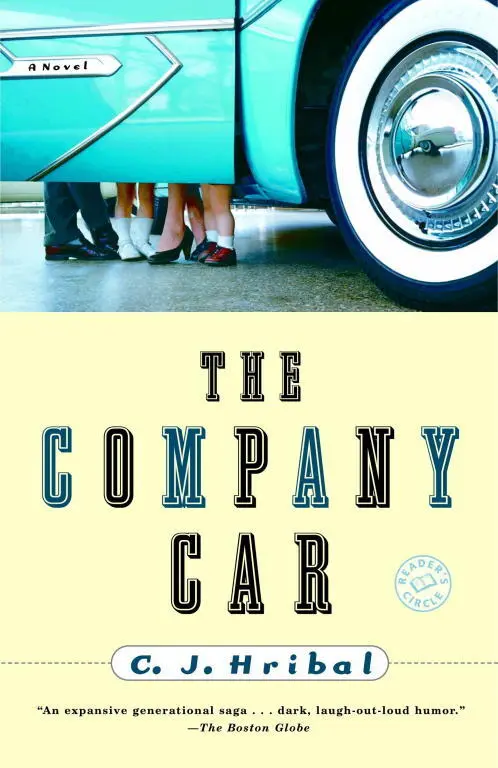
- Название:The Company Car
- Автор:
- Издательство:Random House
- Жанр:
- Год:2005
- Город:New York
- ISBN:1-58836-468-2
- Рейтинг книги:3 / 5. Голосов: 1
-
Избранное:Добавить в избранное
- Отзывы:
-
Ваша оценка:
The Company Car: краткое содержание, описание и аннотация
Предлагаем к чтению аннотацию, описание, краткое содержание или предисловие (зависит от того, что написал сам автор книги «The Company Car»). Если вы не нашли необходимую информацию о книге — напишите в комментариях, мы постараемся отыскать её.
“Are we there yet?” It’s the time-honored question of kids on a long family car trip—and Emil Czabek’s children are no exception. Yet Em asks himself the same thing as the family travels to celebrate his parents’ fiftieth wedding anniversary, and he wonders if he has escaped their wonderfully bad example.
The midwestern drive is Em’s occasion to recall the Czabek clan’s amazing odyssey, one that sprawls through the second half of the twentieth century. It begins with his parents’ wedding on the TV show It’s Your Marriage, and careens from a suburban house built sideways by a drunken contractor to a farm meant to shelter the Czabeks from a country coming apart. It is the story of Em’s father, Wally—diligent, distant, hard-drinking—and his attempts to please, protect, or simply placate his nervous, restless, and sensual wife, Susan, all in plain sight of the children they can’t seem to stop having.
As the tumultuous decades merge in his mind like the cars on the highway, Em must decide whether he should take away his parents’ autonomy and place them in the Heartland Home for the Elders. Beside him, his wife, Dorie, a woman who has run both a triathlon and for public office, makes him question what he’s inherited and whether he himself has become the responsible spouse of a drifting partner—especially since she’s packing a diaphragm and he’s had a vasectomy.
Wildly comic and wrenchingly poignant, The Company Car is a special achievement, a book that drives through territory John Irving and Jonathan Franzen have made popular to arrive at a stunning destination all its own.
The Company Car — читать онлайн бесплатно полную книгу (весь текст) целиком
Ниже представлен текст книги, разбитый по страницам. Система сохранения места последней прочитанной страницы, позволяет с удобством читать онлайн бесплатно книгу «The Company Car», без необходимости каждый раз заново искать на чём Вы остановились. Поставьте закладку, и сможете в любой момент перейти на страницу, на которой закончили чтение.
Интервал:
Закладка:
My mother’s answer chilled me. “I don’t care what your father says,” my mother said, clutching her belly like it was a basket full of laundry.
She must have seen the look of horror on my face. “We’ll get him something, too,” she said brightly, and indeed, in choosing a goldfish and a pair of neon tetras for our father, her mood noticeably brightened, as though the purpose of our trip had been to get him a present all along.
To buy my silence my mother also said I could pick out a turtle. They were all alike, but I spent a great deal of time trying to find one with the right personality, one that could contemplate the world impassively, yet also paddle around just for the fun of it when I wanted a more lively companion. This was nigh impossible since the turtles seemed to do only one thing or the other, but at last I chose one, a slow paddler that came ashore on the wading pool’s hump of sand. He winked at me—I was sure it was a wink, not a random blink—assuring me that he could go a lot faster if I wanted him to. He was still resting when the Woolworth’s clerk followed my finger and plucked my turtle out from the masses. “You got a good one,” said the clerk, a thin, balding older gentleman with glasses slipping down his nose, and I wondered how he knew. Still, it confirmed my choice. The Woolworth’s man had concurred with me, his white lab coat lending an air of esteem and wisdom to my choice.
Meanwhile our mother was picking out equipment for this mélange of wildlife she had suddenly decided to buy. She had to get a cart from the front to hold it all. I didn’t look when she paid, it was too embarrassing. This pregnant woman (which, as far as I knew, was simply how our mother always looked) trying to push both a stroller with Wally Jr. in it and a cart filled with the accoutrements of her sudden whim: a fishbowl, a windmill for the fishbowl, a squat bag of fish, a birdcage (mildly Victorian with its gazebolike roof), a box of birdseed, some gizmo for the parakeet to sharpen its beak on, a little plastic tub for my turtle, and a shoebox with my turtle in it. For all this she laid out what looked like a week’s worth of grocery money.
We must have been quite a sight, struggling out of the store and across the railroad tracks to where we could pick up the bus back to York and Madison. A woman with a polka-dotted housedress stretched across her middle and a determined, exasperated look on her face trying to steer a stroller loaded to the gills while clutching the hand of an eggheaded two-year-old, his abashed older brother lagging behind.
Balanced precariously atop the packages in the stroller was the bag of fish and the cage with the parakeet. I expected both at any moment to topple into the street. I could see it very clearly: the bag bursting open, the fish gasping and flipping in the street, the parakeet chirping piteously as cars struck it glancing blows until a Wonder Bread delivery van put it out of its misery with a direct hit. This seemed like the logical conclusion to our adventure.
That we made it home without incident was due only to our mother’s quick hands at constantly righting the pile, and her determination to ignore the wails of Wally Jr., who was now missing his nap. “You’re making a spectacle of yourself,” our mother hissed to Wally Jr., as though a whiny two-year-old could be looked at separately from his milieu. To our mother, making a spectacle of yourself was one of the worst things you could do. She had an endearing sort of blindness in applying this notion to herself.
“Look what we brought, look what we brought!” our mother cried as we arrived home. She was tired, but she put on a show of exuberance so that we would all be excited with “our” acquisitions before our father came home. He would be less likely to order everything back to the store if we were wildly enthusiastic. “Walter, the children,” our mother could say, and our father could concede or play the ogre, a role he played often but never consciously. To our mother’s credit, she used this stratagem seldom, but she used it on this particular day, putting all the packages on the kitchen table and calling everyone in before she began the grand unveiling. The goldfish and the neon tetras were our father’s, she said, but the parakeet and the turtle were everyone’s. “Look, see what Emmie has in the box for us.”
For us? I thought. No, for me. It was my turtle. I clutched the shoe box to my chest. We were home now; new rules were being applied. “It’s everybody’s turtle,” our mother said. She had a hard look in her eye. I knew I shouldn’t mess with her, not with what we’d just been through, but I was adamant. “But I’ve already named him Eddie,” I said.
“Fine,” said our mother lightly, definitively. “Everybody’s turtle is named Eddie.”
Our father didn’t stand a chance of getting her to go back on this one.
It turned out he didn’t have to. His attention, when he got home hours later, was directed elsewhere. After everyone oohed and aahed over the animals and Nomi’d gotten her cautionary shot in (“I don’t normally take Walter’s side, Susan, but what were you thinking?”), our mother cleared everything away. Lucky’s cage with Lucky inside was put under a blanket in the living room (“He needs to get acclimated to his new home,” explained our mother), my turtle and tub were put in the bathroom (“Until he’s acclimated; then he goes outside,” said our mother. “Fat chance,” said Nomi), and the fish, still inside their bag, were put into their fishbowl, filled now with cool water (“Until they get acclimated, ” said Cinderella). Our mother folded the bags and put them under the sink. Then she got a huge wicker basket full of whites and went downstairs with Cinderella to put them in the washer while the rest of us—except for Wally Jr., who went down for his nap—went to study Eddie as he pawed the sides of his tub, looking for a way out.
The crash and the kathumping and the screams we heard next were absolutely chilling. Shrieks of pure terror, shrieks so high-pitched they sounded like air-raid sirens. Bottomless screams, without beginning or end, ascending as they did into registers only dogs could hear. We heard them plenty well, and they froze us. We caught each other’s eyes, Ike and Robert Aaron and I. Then we pummeled into the hallway, sick with dread. What would we see, what would we see? Nothing, if Nomi had her way. The door to the basement was open, and Nomi was at the top of the stairs. “Good God,” she said and gestured us away. Then she hobbled her way down to where Cinderella was shrieking, quite plainly beyond reason.
Nomi’s shooing gesture caused us to back up, but as soon as she was down the stairs we crowded forward. Our mother was down there, splayed at the foot of the stairs in a pool of blood. One arm was crooked over her head, and the other cupped her belly. Her head was tipped sideways. That was where all the blood was coming from. Ike burst into wailing, forming a duet with our sister. “Robert! For God’s sake get them back.” Nomi waved, and Robert got us to edge back from the stairway. Then we crept forward again, fascinated and sick at heart. We knew what was down there: the concrete basement floor, the open stairs, the lack of a railing. We could imagine the missed step, the grab for support that wasn’t there. What we couldn’t imagine was the rest of it, how our mother had tumbled, how she had landed. We had seen the results, but we didn’t know how she had gotten there, and we did and didn’t want to know.
For a moment we dared not look. We could hear Nomi calming Cinderella, hear the ripping of sheets. Nomi was saying that Cinderella had to run next door, to the Duckwas, and ask them to call an ambulance. I think she just wanted to get her out of there. As Cinderella came up, I peered over the threshold again. Our mother was awkwardly twisted at the bottom of the stairs, and the sheets and underwear and socks in the laundry basket were scattered about her head or draped over her like a robe. The whites were crimson. Nomi was kneeling next to our mother, lifting her head and wiping away the blood so she could see the extent of the damage. Robert Aaron asked, “Is she—? Is she—?” That was as far as he could get. My brain answered in a monotone. Our mother looked like a bloody angel, and there were these words, teletyped and scrolling off the screen of my mind over and over, like on TV when the stations are reporting thunderstorms or tornadoes. My brain kept repeating the words, as though through repetition they wouldn’t mean anything anymore, certainly not what I knew them to mean: My mother is dead, my mother is dead, my mother is dead.
Читать дальшеИнтервал:
Закладка:
Похожие книги на «The Company Car»
Представляем Вашему вниманию похожие книги на «The Company Car» списком для выбора. Мы отобрали схожую по названию и смыслу литературу в надежде предоставить читателям больше вариантов отыскать новые, интересные, ещё непрочитанные произведения.







Обсуждение, отзывы о книге «The Company Car» и просто собственные мнения читателей. Оставьте ваши комментарии, напишите, что Вы думаете о произведении, его смысле или главных героях. Укажите что конкретно понравилось, а что нет, и почему Вы так считаете.