Олдос Хаксли - Mortal Coils
Здесь есть возможность читать онлайн «Олдос Хаксли - Mortal Coils» весь текст электронной книги совершенно бесплатно (целиком полную версию без сокращений). В некоторых случаях можно слушать аудио, скачать через торрент в формате fb2 и присутствует краткое содержание. Год выпуска: 2014, Издательство: epubBooks Classics, Жанр: Современная проза, на английском языке. Описание произведения, (предисловие) а так же отзывы посетителей доступны на портале библиотеки ЛибКат.
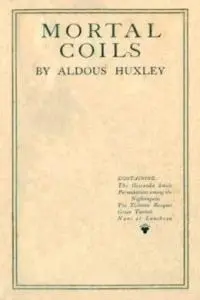
- Название:Mortal Coils
- Автор:
- Издательство:epubBooks Classics
- Жанр:
- Год:2014
- ISBN:нет данных
- Рейтинг книги:5 / 5. Голосов: 1
-
Избранное:Добавить в избранное
- Отзывы:
-
Ваша оценка:
Mortal Coils: краткое содержание, описание и аннотация
Предлагаем к чтению аннотацию, описание, краткое содержание или предисловие (зависит от того, что написал сам автор книги «Mortal Coils»). Если вы не нашли необходимую информацию о книге — напишите в комментариях, мы постараемся отыскать её.
Mortal Coils — читать онлайн бесплатно полную книгу (весь текст) целиком
Ниже представлен текст книги, разбитый по страницам. Система сохранения места последней прочитанной страницы, позволяет с удобством читать онлайн бесплатно книгу «Mortal Coils», без необходимости каждый раз заново искать на чём Вы остановились. Поставьте закладку, и сможете в любой момент перейти на страницу, на которой закончили чтение.
Интервал:
Закладка:
Oh, these Fascisti! Would life be worth living when he was always going out with pistols and bombs and things? They would bring him back one day on a stretcher. She saw it. Pale, pale, with blood on him. Il signore è ferito. Nel petto. Gruvamente. E morto .
How could she bear it? It was too awful; too, too terrible. Her breath came in a kind of sob; she shuddered as though she had been hurt. E morto, E morto . The tears came into her eyes.
She was roused suddenly by a dazzling light. The storm had receded far enough into the distance to permit of Mrs. Topes's opening the shutters.
"It's quite stopped raining."
To be disturbed in one's intimate sorrow and self–abandonment at a death–bed by a stranger's intrusion, an alien voice…. Barbara turned her face away from the light and surreptitiously wiped her eyes. They might see and ask her why she had been crying. She hated Mrs. Topes for opening the shutters; at the inrush of the light something beautiful had flown, an emotion had vanished, irrecoverably. It was a sacrilege.
Mr. Buzzacott looked at his watch. "Too late, I fear, for a siesta now," he said. "Suppose we ring for an early tea."
"An endless succession of meals," said Mr. Topes, with a tremolo and a sigh. "That's what life seems to be—real life."
"I have been calculating"—Mr. Buzzacott turned his pale green eyes towards his guest—"that I may be able to afford that pretty little cinque cassone, after all. It would be a bit of a squeeze." He played with his beard. "But still…."
After tea, Barbara and Mr. Topes went for a walk along the beach. She didn't much want to go, but Mrs. Topes thought it would be good for her; so she had to. The storm had passed and the sky over the sea was clear. But the waves were still breaking with an incessant clamour on the outer shallows, driving wide sheets of water high up the beach, twenty or thirty yards above the line where, on a day of calm, the ripples ordinarily expired. Smooth, shining expanses of water advanced and receded like steel surfaces moved out and back by a huge machine. Through the rain–washed air the mountains appeared with an incredible clarity. Above them hung huge masses of cloud.
"Clouds over Carrara," said Mr. Topes, deprecating his remark with a little shake of the head and a movement of the shoulders. "I like to fancy sometimes that the spirits of the great sculptors lodge among these marble hills, and that it is their unseen hands that carve the clouds into these enormous splendid shapes. I imagine their ghosts"—his voice trembled—"feeling about among superhuman conceptions, planning huge groups and friezes and monumental figures with blowing draperies; planning, conceiving, but never quite achieving. Look, there's something of Michelangelo in that white cloud with the dark shadows underneath it." Mr. Topes pointed, and Barbara, nodded and said, "Yes, yes," though she wasn't quite sure which cloud he meant. "It's like Night on the Medici tomb; all the power and passion are brooding inside it, pent up. And there, in that sweeping, gesticulating piece of vapour—you see the one I mean—there's a Bernini. All the passion's on the surface, expressed; the gesture's caught at its most violent. And that sleek, smug white fellow over there, that's a delicious absurd Canova." Mr. Topes chuckled.
"Why do you always talk about art?" said Barbara. "You bring these dead people into everything. What do I know about Canova or whoever it is?" They were none of them alive. She thought of that dark face, bright as a lamp with life. He at least wasn't dead. She wondered whether the letters were still there in the sand before the cabin. No, of course not; the rain and the wind would have blotted them out.
Mr. Topes was silent; he walked with slightly bent knees and his eyes were fixed on the ground; he wore a speckled black–and–white straw hat. He always thought of art; that was what was wrong with him. Like an old tree he was; built up of dead wood, with only a few fibres of life to keep him from rotting away. They walked on for a long time in silence.
"Here's the river," said Mr. Topes at last.
A few steps more and they were on the bank of a wide stream that came down slowly through the plain to the sea. Just inland from the beach it was fringed with pine trees; beyond the trees one could see the plain, and beyond the plain were the mountains. In this calm light after the storm everything looked strange. The colours seemed deeper and more intense than at ordinary times. And though all was so clear, there was a mysterious air of remoteness about the whole scene. There was no sound except the continuous breathing of the sea. They stood for a little while, looking; then turned back.
Far away along the beach two figures were slowly approaching. White flannel trousers, a pink skirt.
"Nature," Mr. Topes enunciated, with a shake of the head. "One always comes back to nature. At a moment such as this, in surroundings like these, one realises it. One lives now—more quietly, perhaps, but more profoundly. Deep watery. Deep waters…."
The figures drew closer. Wasn't it the marquis? And who was with him? Barbara strained her eyes to see.
"Most of one's life," Mr. Topes went on, "is one prolonged effort to prevent oneself thinking. Your father and I, we collect pictures and read about the dead. Other people achieve the same results by drinking, or breeding rabbits, or doing amateur carpentry. Anything rather than think calmly about the important things."
Mr. Topes was silent. He looked about him, at the sea, at the mountains, at the great clouds, at his companion. A frail Montagna madonna, with the sea and the westering sun, the mountains and the storm, all eternity as a background. And he was sixty, with all a life, immensely long and yet timelessly short, behind him, an empty life. He thought of death and the miracles of beauty; behind his round, glittering spectacles he felt inclined to weep.
The approaching couple were quite near now.
"What a funny old walrus," said the lady.
"Walrus? Your natural history is quite wrong." The marquis laughed. "He's much too dry to be a walrus. I should suggest some sort of an old cat."
"Well, whatever he is, I'm sorry for that poor little girl. Think of having nobody better to go about with!"
"Pretty, isn't she?"
"Yes, but too young, of course."
"I like the innocence."
"Innocence? Cher ami! These English girls. Oh, la la! They may look innocent But, believe me…."
"Sh, sh. They'll hear you."
"Pooh, they don't understand Italian."
The marquis raised his hand. "The old walrus…." he whispered; then addressed himself loudly and jovially to the newcomers.
"Good evening, signorina. Good evening, Mr. Topes. After a storm the air is always the purest, don't you find, eh?"
Barbara nodded, leaving Mr. Topes to answer. It wasn't his sister. It was the Russian woman, the one of whom Mrs. Topes used to say that it was a disgrace she should be allowed to stay at the hotel. She had turned away, dissociating herself from the conversation; Barbara looked at the line of her averted face. Mr. Topes was saying something about the Pastoral Symphony. Purple face powder in the daylight; it looked hideous.
"Well, au revoir."
The flash of the marquis's smile was directed at them. The Russian woman turned back from the sea, slightly bowed, smiled languidly. Her heavy white eyelids were almost closed; she seemed the prey of an enormous ennui.
"They jar a little," said Mr. Topes when they were out of earshot—"they jar on the time, on the place, on the emotion. They haven't the innocence for this … this…."—he wriggled and tremoloed out the just, the all too precious word—"this prelapsarian landscape."
He looked sideways at Barbara and wondered what she was so thoughtfully frowning over. Oh, lovely and delicate young creature! What could he adequately say of death and beauty and tenderness? Tenderness….
Читать дальшеИнтервал:
Закладка:
Похожие книги на «Mortal Coils»
Представляем Вашему вниманию похожие книги на «Mortal Coils» списком для выбора. Мы отобрали схожую по названию и смыслу литературу в надежде предоставить читателям больше вариантов отыскать новые, интересные, ещё непрочитанные произведения.

![Олдос Хаксли - О дивный новый мир [Прекрасный новый мир]](/books/11834/oldos-haksli-o-divnyj-novyj-mir-prekrasnyj-novyj-thumb.webp)

Обсуждение, отзывы о книге «Mortal Coils» и просто собственные мнения читателей. Оставьте ваши комментарии, напишите, что Вы думаете о произведении, его смысле или главных героях. Укажите что конкретно понравилось, а что нет, и почему Вы так считаете.