Харуки Мураками - Absolutely on Music
Здесь есть возможность читать онлайн «Харуки Мураками - Absolutely on Music» весь текст электронной книги совершенно бесплатно (целиком полную версию без сокращений). В некоторых случаях можно слушать аудио, скачать через торрент в формате fb2 и присутствует краткое содержание. Год выпуска: 2016, Издательство: Random House, Жанр: Современная проза, на английском языке. Описание произведения, (предисловие) а так же отзывы посетителей доступны на портале библиотеки ЛибКат.
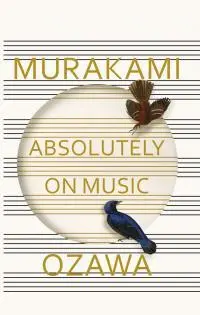
- Название:Absolutely on Music
- Автор:
- Издательство:Random House
- Жанр:
- Год:2016
- ISBN:нет данных
- Рейтинг книги:3 / 5. Голосов: 1
-
Избранное:Добавить в избранное
- Отзывы:
-
Ваша оценка:
Absolutely on Music: краткое содержание, описание и аннотация
Предлагаем к чтению аннотацию, описание, краткое содержание или предисловие (зависит от того, что написал сам автор книги «Absolutely on Music»). Если вы не нашли необходимую информацию о книге — напишите в комментариях, мы постараемся отыскать её.
Haruki Murakami's passion for music runs deep. Before turning his hand to writing, he ran a jazz club in Tokyo, and the aesthetic and emotional power of music permeates every one of his much-loved books. Now, in *Absolutely on Music,* Murakami fulfills a personal dream, sitting down with his friend, acclaimed conductor Seiji Ozawa, to talk about their shared interest.
They discuss everything from Brahms to Beethoven, from Leonard Bernstein to Glenn Gould, from record collecting to pop-up orchestras, and much more.
Absolutely on Music — читать онлайн бесплатно полную книгу (весь текст) целиком
Ниже представлен текст книги, разбитый по страницам. Система сохранения места последней прочитанной страницы, позволяет с удобством читать онлайн бесплатно книгу «Absolutely on Music», без необходимости каждый раз заново искать на чём Вы остановились. Поставьте закладку, и сможете в любой момент перейти на страницу, на которой закончили чтение.
Интервал:
Закладка:
OZAWA: Yes, it is. He often tells the students that, in order to make sure that those weak notes come out properly, you make the notes just before them a touch stronger. If you make the earlier notes weak, you’ve got nowhere to go. He’s got all those things figured out.
MURAKAMI: He also said, “I can hear those notes in this place, but not in a big auditorium.”
OZAWA: Yes, that’s the result of years of experience. Even if you’re playing in a small space, you always anticipate the sound you’ll need in a big hall.
MURAKAMI: I asked Sadao Harada about that. He said that the true sound is one that can be heard properly in either kind of place, big or small. There are musicians who play differently depending on the size of the hall, but that’s probably not the right way to perform.
OZAWA: That’s probably the best way to put it. It’s tough to actually do it, but that’s the best way to put it.
MURAKAMI: The academy’s Geneva concert took place in Victoria Hall and the concert in Paris will be in the Salle Gaveau. The two halls have totally different acoustics. The students seem to be quite confused by the difference.
OZAWA: You’re right about that. They had to rehearse well if they wanted to hear each other.
MURAKAMI: Oh, another thing that Robert Mann said a lot was “Speak!” Not “sing,” but “speak,” “talk to each other.”
OZAWA: Yes, he was talking about something more than just “singing” back and forth to each other with their instruments. When you sing, you just go ta-daaaa! [ He stretches his arms out wide. ] Of course, the musicians have to sing to each other, but in addition they also have to signal to each other clearly when they are going to start singing or stop singing. I think he’s telling them to be conscious of each of those stages as they play.
MURAKAMI: Another thing he said in that connection was that each composer has a unique language, and the students should “speak” to each other in that language.
OZAWA: He’s talking about the composer’s style. You have to internalize the composer’s unique voice.
MURAKAMI: At the same time, he said that Smetana has expressions that “speak” Czech, and Ravel has expressions that “speak” French, and the musicians ought to keep such things in mind. I thought that was a very interesting point. Robert Mann is obviously very clear in his opinions, and he gives voice to them over and over. He doesn’t change his teaching method from one student to the next. He has his own unique philosophy, and he holds to it firmly and consistently.
OZAWA: Again, this is something that comes from his long experience. He has his own unique way of looking at things. After all, he’s been exclusively devoted to chamber music longer than anyone, and he has richer experience than anyone.
MURAKAMI: I suppose there are components to his instruction that conflict with what the permanent faculty teach—people like Pamela Frank or Nobuko Imai or Sadao Harada.
OZAWA: Of course, that’s only natural. I always say that to the students—that it’s natural for different teachers to have different opinions. I say that to the instructors and to Robert Mann, too. That’s just music—it’s what makes music so interesting. Different teachers have different things to say, but they may arrive at the same point. Or not!
MURAKAMI: Can you give me some concrete examples of differences that have emerged?
OZAWA: Well, here’s something that happened the other day when Robert Mann was offering guidance on the Ravel Quartet. The score indicates this long slur. Most violinists and cellists interpret this to mean that they should play those linked notes without reversing the bow. In other words, they take it as a practical instruction concerning how to move the bow. Some composers, though, use the slur to indicate a musical phrase, which is how Mann was interpreting it, and he told the students to stop the bow.
MURAKAMI: In other words, it was okay for them to stop and reverse the bow in the middle of the slur.
OZAWA: Right. But before that, Pamela had given them the opposite instruction: since the composer had made a point of writing in the slur, they should try drawing the bow across the strings without reversing. It was completely the opposite. Pamela immediately followed Mann’s instruction, pointing out that she had just told them to do it the other way.
MURAKAMI: Oh, so that’s what that was about. It was a matter of technique, so I didn’t quite get it.
OZAWA: The way Pamela saw it, the students should at least try to play it the way the composer wrote it, even if there might be some difficulty involved.
MURAKAMI: So she was telling them to respect the original score and at least try to draw the bow in a single stroke from grip to tip, even if that’s hard to do. But in Mann’s opinion, there was no need to do anything so difficult.
OZAWA: No need at all. As long as they produced the sound the composer was aiming for, it was no problem if they reversed the bow. The bow has a certain fixed length, so there was no point in trying too hard. That was his opinion. Both were correct. The students should try doing it both ways and choose the way they believed to be right.
MURAKAMI: I suppose different people will arrive at different conclusions.
OZAWA: The same way different singers will sing the same phrase differently depending on whether or not they have the lung capacity. Do they have to take a breath or not? Some violinists can play the phrase with a single stroke of the bow and some cannot.
MURAKAMI: Now that you mention it, Mann said a lot about the breath. When people sing, they have to take a breath at some point. But “unfortunately,” he said, string instruments don’t have to breathe, so you have to keep the breath in mind as you play. That “unfortunately” was interesting. He also talked a lot about silence. Silence is not just the absence of sound: there is a sound called silence.
OZAWA: Ah, that’s the same as the Japanese idea of ma. The same concept comes up in gagaku, and in playing the biwa and the shakuhachi. It’s very much like that. This kind of ma is written into the score in some Western music, but there is also some in which it’s not written. Mann has a very good understanding of these things.
MURAKAMI: Another thing that surprised me was that he had very little to say about bowing or fingering. I figured that as a specialist, he would give a lot more detailed instruction on those matters.
OZAWA: The students who come here have already gone past that point, I suppose. His teaching is at a level above that. Bowing and fingering are not a problem anymore. That’s what I think.
MURAKAMI: He did, though, have a lot to say about certain technical matters, like “You should play this closer to the bridge,” or “Play this on the fingerboard.”
OZAWA: Well, that would change the sound. It softens when you play on the fingerboard and becomes clearer when you play near the bridge. Certainly, that’s something he would talk a lot about.
MURAKAMI: I’m not a musician, but I learned a lot from watching his instruction.
OZAWA: I’m sure that’s true. Being able to watch such a thing is a rare and valuable opportunity, an excellent learning experience. We recorded it all on video so people can see it later.
MURAKAMI: Robert Mann is a person who is very clear about his method: he knows exactly what he wants to do. But I felt that you were rather different as a mentor. You change your approach in different situations.
OZAWA: That’s true. Professor Saito was very much like Robert Mann. He always had a very clear method. But I always resisted that. They know exactly what they’re going to say. It’s all fixed for them. But I’ve always felt that that’s not all there is to music. I’ve always made a point of doing things differently.
Читать дальшеИнтервал:
Закладка:
Похожие книги на «Absolutely on Music»
Представляем Вашему вниманию похожие книги на «Absolutely on Music» списком для выбора. Мы отобрали схожую по названию и смыслу литературу в надежде предоставить читателям больше вариантов отыскать новые, интересные, ещё непрочитанные произведения.



Обсуждение, отзывы о книге «Absolutely on Music» и просто собственные мнения читателей. Оставьте ваши комментарии, напишите, что Вы думаете о произведении, его смысле или главных героях. Укажите что конкретно понравилось, а что нет, и почему Вы так считаете.