J.G. Ballard - Cocaine Nights
Здесь есть возможность читать онлайн «J.G. Ballard - Cocaine Nights» — ознакомительный отрывок электронной книги совершенно бесплатно, а после прочтения отрывка купить полную версию. В некоторых случаях можно слушать аудио, скачать через торрент в формате fb2 и присутствует краткое содержание. Жанр: Современная проза, на английском языке. Описание произведения, (предисловие) а так же отзывы посетителей доступны на портале библиотеки ЛибКат.
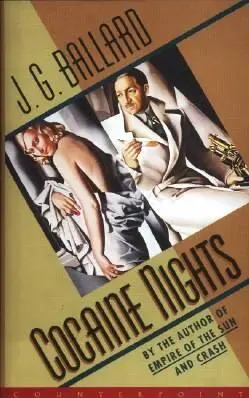
- Название:Cocaine Nights
- Автор:
- Жанр:
- Год:неизвестен
- ISBN:нет данных
- Рейтинг книги:5 / 5. Голосов: 1
-
Избранное:Добавить в избранное
- Отзывы:
-
Ваша оценка:
Cocaine Nights: краткое содержание, описание и аннотация
Предлагаем к чтению аннотацию, описание, краткое содержание или предисловие (зависит от того, что написал сам автор книги «Cocaine Nights»). Если вы не нашли необходимую информацию о книге — напишите в комментариях, мы постараемся отыскать её.
Outward appearances suggest the wholesale adoption of a new ethos of high-spirited, well-controlled collective exuberance. But there’s the matter of the fire: The house and household of an aged, wealthy industrialist has gone up in flames, claiming five lives, while virtually the entire town stood and watched. There’s the matter of the petty crime, the burglaries, muggings, and auto thefts which have begun to nibble away at the edges of Estrella Del Mar’s security despite the guardhouses and surveillance cameras. There’s the matter of the new, flourishing trade in drugs and pornography. And there’s the matter of Frank Prentice, who sits in Marbella jail awaiting trial for arson and five counts of murder, and who, despite being clearly innocent, has happily confessed.
It is up to Charles Prentice, Frank’s brother, to peel away the onionlike layers of denial and deceit which hide the rather ugly truth about this seaside idyll, its residents, and the horrific crime which brought him here. But as is usually the case in a J.G. Ballard book, the truth comes with a price tag attached, and likely without any easing of discomfort for his principal characters.
Cocaine Nights marks a partial return on Ballard’s part to the provocative, highly-successful mid-career methodology employed in novels such as Crash and High Rise: after establishing himself as a science fiction guru in the 1960s, Ballard stylistically shifted gears towards an unnerving, futuristic variant on social realism in the 1970s. Both Crash and High Rise were what-if novels, posing questions as to what the likely results would be if our collective fascination with such things as speed, violence, status, power, and sex were carried just a little bit further: How insane, how brutal could our world become if we really cut loose?
Cocaine Nights asks a question better suited to the ’90s, the age of gated communities and infrared home security systems: Does absolute security guarantee isolation and cultural death? Conversely, is a measure of crime an essential ingredient in a vibrant, living, properly functioning social system? Is it true, as a character asserts, that “Crime and creativity go together, always have done,” and that “total security is a disease of deprivation”? Suffice to say that the answers presented in Nights will be anathema to moral absolutists; the world of Ballard’s fiction, like life in the hyperkinetic, relativistic 1990s, abounds with uncomfortable grey areas.
On the surface, Cocaine Nights is a whodunit and a race against time, but as it proceeds – and as preconceived conceptions of good and evil begin to dissolve – it evolves into a thoughtful, faintly frightening look at under-examined aspects of 1990s western society. As is his wont, Ballard confronts his readers with some faintly outlandish hypotheses unlikely to be embraced by many, but which nonetheless serve to provoke both thought and a bit of paranoia; it’s a method that Ballard has developed and refined on his own, and as usual, it propels his novel along marvellously.
Cocaine Nights doesn’t have either the broad sweep or brute impact of the landmark Crash, but it retains enough social relevance and low-key creepiness to more than satisfy Ballardphiles. As is often the case in Ballard’s alternate reality, it’s a given that his most appealing, human characters turn out to be the most twisted, and that even the most normal of events turn out to be governed by a perverse, malformed logic; that this logic turns out to be grounded in sound sociological and psychological principles is its most horrific feature.
David B. Livingstone
Cocaine Nights — читать онлайн ознакомительный отрывок
Ниже представлен текст книги, разбитый по страницам. Система сохранения места последней прочитанной страницы, позволяет с удобством читать онлайн бесплатно книгу «Cocaine Nights», без необходимости каждый раз заново искать на чём Вы остановились. Поставьте закладку, и сможете в любой момент перейти на страницу, на которой закончили чтение.
Интервал:
Закладка:
'Andersson, I need to ask – were you at the party?'
'For the English Queen? Yes, I drank the toast.'
'You saw Bibi Jansen on the upstairs veranda?'
'She was there. Standing with the Hollingers.'
'Did she seem well?'
'Too well.' His face was crossed by flickers of light from the dark water lapping the yachts. 'She was very fine.'
'After the toast she went to her room. Why didn't she come down to meet you and the other guests?'
'The Hollingers… they didn't like her mixing with too many people.'
'Too many of the wrong people? Especially the kind who might have given her acid and cocaine?'
Andersson stared at me wearily. 'Bibi was on drugs, Mr Prentice – the drugs that society approves. Sanger and the Hollingers made her into quiet little Princess Prozac.'
'Better than acid, though, for someone who's overdosed. Or the new amphetamines the chemists are cooking up with their molecular roulette.'
Andersson put a hand on my shoulder, sympathizing with my lack of insight. 'Bibi was a free spirit – her best friends were acid and cocaine. When she took acid she made us part of her dreams. Sanger and the Hollingers reached inside her head and took out the small white bird. They broke its wings, closed the cage again and said to everyone: "Bibi is happy."'
I waited as he sucked back the last of his cigarette smoke, scowling to himself as he overruled his emotions.
'You must have hated the Hollingers. Enough to kill them?'
'Mr Prentice, if I wanted to kill the Hollingers it wouldn't be because I hated them.'
'Bibi was found in the jacuzzi with Hollinger.'
'Impossible 'That they could have had sex together? You know she was pregnant? Were you the father?'
'I was her father. We were good friends. I never had sex with her, even when she asked me.'
'So who was the father? Sanger?'
Andersson wiped his mouth, trying to rid himself of the taste of Sanger's name. 'Mr Prentice, do psychiatrists sleep with their patients?'
'They do in Estrella de Mar.' We climbed the steps from the marina to the harbour road, where the evening crowds were already blocking the traffic. 'Andersson, something nightmarish happened up there, something no one counted on. You don't like looking at the Hollinger house, do you?'
'I don't like looking at anything, Mr Prentice. I dream in Braille.' He hoisted his work-bag on to his shoulder. 'You're a decent man, go back to London. Go home, go on your travels. There might be another attack on you. No one in Estrella de Mar wants you to be frightened He walked away through the crowd, a gloomy gallows-tree swaying above the cheerful diners.
I waited for Paula in the bar of the Restaurant du Cap, striking another name from my cast of suspects. As I listened to Anders-son there had been a hint of complicity, perhaps the same regret for having mocked the Hollingers that Paula had expressed, but I was sure that he could not have killed them. The Swede was too morose, too immersed in his grudge against the world, to be able to act decisively.
By nine-thirty Paula had not arrived, and I assumed that an emergency had kept her at the Clinic. I ate alone at my table, stretching the bouillabaisse as long as I could without attracting the Keswick sisters' curiosity. It was eleven o'clock when I left the restaurant, and the nightclubs along the quay were opening, their music booming across the marina. I paused by the boatyard, and stared at the huge powerboat on which Andersson had been working. I could imagine it outrunning the Spanish police cutters, racing across the Strait of Gibraltar with its cargo of hashish and heroin for the dealers of Estrella de Mar.
Feet rang against the metal steps that led down to the marina. A party of Arab visitors were returning to their craft in the short-term harbour beside the mole. I guessed that they were Middle Eastern tourists who had rented a summer palace at the Marbella Club. They wore full Puerto Banus fig, a dazzle in the dark of white drill, jewelled Rolexes and the plushest silks. One group of middle-aged men and young Frenchwomen boarded a cabin-cruiser tied up near the Halcyon. Expert with mooring lines and engine controls, they were about to set off when the younger men in the second group began to shout from the steps of the mole. They shook their fists and waved their yachting caps at a small, twin-engined speedboat that had slipped its moorings and was gliding silently through the undisturbed water.
As if unaware that he had stolen the craft, the thief stood calmly in the cockpit, thighs pressed against the helm. The beam of the Marbella lighthouse swept the sea, touching his pale arms and hair.
Within moments a chaotic sea-chase had begun. Jointly steered by two of its excited captains, the cabin-cruiser surged from its berth while the startled Frenchwomen clung to the leather banquettes. Unconcerned by the craft bearing down on him, the hijacker continued to motor towards the sea, barely leaving a wake behind him as he saluted the furious young men on the mole. At the last moment he rammed the throttle forward, expertly side-slipping into a lane of calm water between the moored yachts. Too clumsy to turn, the cabin-cruiser ploughed past and clipped the bowsprit of a venerable twelve-metre.
The thief eased back his throttle, seeing that his exit to the open sea was blocked by the cruiser. Changing course, he drove below the lattice footbridge to the central island, a maze of interlocking waterways and exits. Trying to cover every escape route, the cruiser reversed through a cloud of exhaust, then surged forward when the speedboat emerged from the darkness under its nose. Still standing at the helm, legs stylishly braced apart, the thief rolled the wheel and banked around the cruiser's bows. Free at last, the craft porpoised through the rough water towards the advancing waves.
I leaned against the harbour wall, surrounded by people who had carried their drinks from the nearby bars. Together we waited for the speedboat to disappear into one of a hundred bays along the coast, before slipping under the cover of night into a marina at Fuengirola or Benalmadena.
But the thief had still to satisfy his appetite for play. A game of tease and chase began in the open water three hundred yards from the mole. The cruiser swerved after the circling speedboat, which leapt nimbly past its pointed bows like a torero evading an overweight bull. Wallowing in the churned water, the cruiser's captains searched the criss-crossing wakes, their lights sweeping the confused waves. The speedboat's engines were silent, as if the thief had at last tired of his game and was about to slip into the shadows of the Estrella peninsula.
I decided to turn away when a blaze of orange fire lit up the sea, exposing a thousand wave-crests and the passengers standing on the foredeck of the cruiser. The speedboat was burning, its engines still pushing it through the water. In the moments before it sank, bows following the heavy outboards into the deep, a last explosion tore apart its fuel tank and bathed the marina and the watching crowds in a copper halo.
I looked down at my hands, which flared at me in the darkness. The harbour road was packed with cheering spectators who had stepped from the nightclubs and restaurants to enjoy the display, eyes gleaming like their summer jewellery. Arm-in-arm, a cheerful couple swayed past me into the path of a passing car. As it edged by them the man slapped its roof with his hand. Alarmed, the driver looked over her shoulder, and through the confused air I saw Paula Hamilton's anxious face.
'Paula!' I shouted. 'Wait for me… park by the boatyard.'
Had she come to look for me, or had I read her features into those of another driver? The car moved through the crowd, then left the harbour and joined the lower corniche road to Fuengirola. Half a mile away, below the ruins of a Moorish watch-tower, it stopped beside the breaking waves, its lights fading in the darkness.
Читать дальшеИнтервал:
Закладка:
Похожие книги на «Cocaine Nights»
Представляем Вашему вниманию похожие книги на «Cocaine Nights» списком для выбора. Мы отобрали схожую по названию и смыслу литературу в надежде предоставить читателям больше вариантов отыскать новые, интересные, ещё непрочитанные произведения.








Обсуждение, отзывы о книге «Cocaine Nights» и просто собственные мнения читателей. Оставьте ваши комментарии, напишите, что Вы думаете о произведении, его смысле или главных героях. Укажите что конкретно понравилось, а что нет, и почему Вы так считаете.