J.G. Ballard - Cocaine Nights
Здесь есть возможность читать онлайн «J.G. Ballard - Cocaine Nights» — ознакомительный отрывок электронной книги совершенно бесплатно, а после прочтения отрывка купить полную версию. В некоторых случаях можно слушать аудио, скачать через торрент в формате fb2 и присутствует краткое содержание. Жанр: Современная проза, на английском языке. Описание произведения, (предисловие) а так же отзывы посетителей доступны на портале библиотеки ЛибКат.
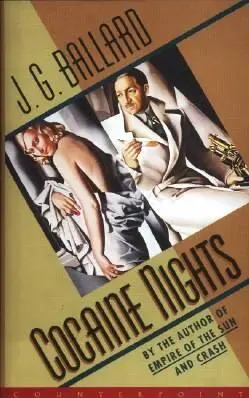
- Название:Cocaine Nights
- Автор:
- Жанр:
- Год:неизвестен
- ISBN:нет данных
- Рейтинг книги:5 / 5. Голосов: 1
-
Избранное:Добавить в избранное
- Отзывы:
-
Ваша оценка:
Cocaine Nights: краткое содержание, описание и аннотация
Предлагаем к чтению аннотацию, описание, краткое содержание или предисловие (зависит от того, что написал сам автор книги «Cocaine Nights»). Если вы не нашли необходимую информацию о книге — напишите в комментариях, мы постараемся отыскать её.
Outward appearances suggest the wholesale adoption of a new ethos of high-spirited, well-controlled collective exuberance. But there’s the matter of the fire: The house and household of an aged, wealthy industrialist has gone up in flames, claiming five lives, while virtually the entire town stood and watched. There’s the matter of the petty crime, the burglaries, muggings, and auto thefts which have begun to nibble away at the edges of Estrella Del Mar’s security despite the guardhouses and surveillance cameras. There’s the matter of the new, flourishing trade in drugs and pornography. And there’s the matter of Frank Prentice, who sits in Marbella jail awaiting trial for arson and five counts of murder, and who, despite being clearly innocent, has happily confessed.
It is up to Charles Prentice, Frank’s brother, to peel away the onionlike layers of denial and deceit which hide the rather ugly truth about this seaside idyll, its residents, and the horrific crime which brought him here. But as is usually the case in a J.G. Ballard book, the truth comes with a price tag attached, and likely without any easing of discomfort for his principal characters.
Cocaine Nights marks a partial return on Ballard’s part to the provocative, highly-successful mid-career methodology employed in novels such as Crash and High Rise: after establishing himself as a science fiction guru in the 1960s, Ballard stylistically shifted gears towards an unnerving, futuristic variant on social realism in the 1970s. Both Crash and High Rise were what-if novels, posing questions as to what the likely results would be if our collective fascination with such things as speed, violence, status, power, and sex were carried just a little bit further: How insane, how brutal could our world become if we really cut loose?
Cocaine Nights asks a question better suited to the ’90s, the age of gated communities and infrared home security systems: Does absolute security guarantee isolation and cultural death? Conversely, is a measure of crime an essential ingredient in a vibrant, living, properly functioning social system? Is it true, as a character asserts, that “Crime and creativity go together, always have done,” and that “total security is a disease of deprivation”? Suffice to say that the answers presented in Nights will be anathema to moral absolutists; the world of Ballard’s fiction, like life in the hyperkinetic, relativistic 1990s, abounds with uncomfortable grey areas.
On the surface, Cocaine Nights is a whodunit and a race against time, but as it proceeds – and as preconceived conceptions of good and evil begin to dissolve – it evolves into a thoughtful, faintly frightening look at under-examined aspects of 1990s western society. As is his wont, Ballard confronts his readers with some faintly outlandish hypotheses unlikely to be embraced by many, but which nonetheless serve to provoke both thought and a bit of paranoia; it’s a method that Ballard has developed and refined on his own, and as usual, it propels his novel along marvellously.
Cocaine Nights doesn’t have either the broad sweep or brute impact of the landmark Crash, but it retains enough social relevance and low-key creepiness to more than satisfy Ballardphiles. As is often the case in Ballard’s alternate reality, it’s a given that his most appealing, human characters turn out to be the most twisted, and that even the most normal of events turn out to be governed by a perverse, malformed logic; that this logic turns out to be grounded in sound sociological and psychological principles is its most horrific feature.
David B. Livingstone
Cocaine Nights — читать онлайн ознакомительный отрывок
Ниже представлен текст книги, разбитый по страницам. Система сохранения места последней прочитанной страницы, позволяет с удобством читать онлайн бесплатно книгу «Cocaine Nights», без необходимости каждый раз заново искать на чём Вы остановились. Поставьте закладку, и сможете в любой момент перейти на страницу, на которой закончили чтение.
Интервал:
Закладка:
Again I froze the frame and tried to sharpen the blurred image. A church spire was visible between the balcony rails, its weather-vane silhouetted against a white satellite dish on the roof of a building somewhere near the marina. Aligned together, they virtually pinpointed the apartment's location on the heights above Estrella de Mar.
I sat back and stared at the spire, for the first time unaware of the tennis machine as it fired its balls across the practice court. I realized now that it was this view across the town that I had been intended to see, and not the rape of Anne Hollinger. The police forensic team would have discovered the cassette within moments of searching the fire-gutted bedroom.
Someone had planted the cassette in the video-recorder, after learning that Paula and I were to visit the Hollinger house, confident that Cabrera would be too busy with his autopsy report to re-check the original findings. I remembered the Hollingers' chauffeur, endlessly buffing the old Bentley. Had this melancholy Andalucian become Anne's confidant and even, perhaps, her lover? His threatening stare, far from trying to make me Frank's guilty proxy, might have been an attempt to alert me to some undiscovered evidence.
At eight that evening Paula and I were meeting for dinner at the Restaurant du Cap, but I set off for the harbour an hour early, eager to search for the satellite dish. Pornographic filmmakers often rented expensive apartments for the day, rather than construct stage sets that could provide evidence for the police. The exact location of the rape scene would take me no nearer to the Hollinger murders, but the loose corners of too many carpets had begun to curl under my feet. The more I nailed down, the less likely was I to trip as I moved from one darkened room to the next.
While I walked down to the harbour, past the antique shops and art galleries, I scanned the rooftops of the town. The weather-vane of the Anglican church rose above the Plaza Iglesias, without doubt the one I had glimpsed in the film. I stood on the steps of the church, a white geometrical structure that was a modest replay of Corbusier's Ronchamp Chapel, more space-age cinema than house of God. The notice-board announced forthcoming performances of Eliot's Murder in the Cathedral, meetings of a help-the-elderly charity, and a guided tour of a Phoenician burial site on the southern tip of the peninsula, organized by a local archaeological society.
The weather-vane pointed towards Fuengirola but there was no sign of the satellite dish. Lit by the setting sun, the western skyline of Estrella de Mar ran from the Club Nautico to the ruin of the Hollinger house. A dozen apartment blocks looked down from the high corniche, a cliff-face of mysteries. On the roof of the yacht club a white satellite dish cupped the sky, but its bowl was at least twice the diameter of the modest dish in the video.
The tapas bars and seafood restaurants along the harbour were packed with residents relaxing after their day's work at the sculpture table and potter's wheel. Far from being dismayed by the Hollinger tragedy, they seemed more animated than ever, talking noisily across their copies of the New York Review of Books and the arts supplements of Le Monde and Liberation.
Intimidated by this cultural power-dressing, I stepped into the boatyard beside the marina, comforted by the presence of stripped-down engines and oily sumps. The yachts and motor-cruisers sat in their trestles, revealing their elegant hulls, a geometry graced by speed. Dominating all the other craft in the yard was a fibre-glass powerboat almost forty feet long, three immense outboards at its stern like the genitalia of a giant aquatic machine.
His engine-tuning over for the day, Gunnar Andersson stood beside the craft and washed his arms in a bucket of detergent. He nodded to me, but his narrow, bearded face was as closed and self-immersed as a Gothic saint's. He ignored the evening crowds and followed a flight of martins setting off for the coast of Africa. The flesh of his cheeks and scalp was stretched across the sharp points of his skull, as if constrained by some intense internal pressure. Watching him grimace at the noisy bars, I felt that he controlled his emotions from one second to the next, fearing that if he showed the slightest anger the skin would split and reveal the shrieking bones.
I walked past him, and admired the speedboat and its sculptured prow.
'It's almost too powerful to be beautiful,' I commented. 'Does anyone need to go this fast?'
He dried his hands before replying. 'Well, it's a working ship. It has to earn its keep. The Spanish patrol boats at Ceuta and Melilla can really shift.'
'So it crosses to North Africa?' He was about to move away, but I reached out and shook his hand, forcing him to face me. 'Mr Andersson? I saw you at the service in the Protestant cemetery. I'm sorry about Bibi Jansen.'
'Thank you for coming.' He looked me up and down, and then washed his hands again in the bucket. 'Did you know Bibi?'
'I wish I had. From what everyone says, she must have been great fun.'
'When she was given a chance.' He threw the towel into his work-bag. 'If you didn't know her, why were you there?'
'In a sense I was involved in her… death.' Gambling on the truth, I said: 'My brother is Frank Prentice, the manager of the Club Nautico.'
I expected him to turn on me and show some of the anger he had vented at the funeral, but he took out his tobacco pouch and rolled a cigarette with his large fingers. I guessed that he was already aware of my relationship to Frank.
'Frank? I worked on the engine of his thirty-footer. If I'm right, he hasn't paid me yet.'
'He's in jail in Malaga, as you know. Give me the bill and I'll settle it.'
'Don't worry-I can wait.'
'That could be a long time. He's pleaded guilty.'
Andersson drew on the loose-packed cigarette. Shreds of burning tobacco flew from the glowing tip and sparked briefly against his beard. His eyes roved around the boatyard, avoiding my face. 'Guilty? Frank has a special sense of humour.'
'It's not a joke. This is Spain, and he could serve twenty or thirty years. You don't believe he started the fire?'
Andersson raised his cigarette and scrawled a cryptic symbol on the night air. 'Who can say? So, you're in Estrella de Mar to find out what happened?'
'I'm trying to.'
'But not getting very far?'
'To tell the truth, I've made no headway at all. I've been up to the Hollinger house, talked to people who were there. No one believes Frank started the fire, not even the police. I may have to fly in a couple of detectives.'
'From London?' Andersson seemed more interested in me. 'I wouldn't do that.'
'Why not? They might find something I've missed. I'm not a professional investigator.'
'You'd be wasting your money, Mr Prentice. People in Estrella de Mar are very discreet.' He gestured with a long arm at the villas on the hillside, secure behind their surveillance cameras. 'I've lived here for two years and I'm still not sure if the place is real…'
He left the boatyard and led me along the walkway between the moored yachts and cabin-cruisers. The white-hulled craft seemed almost spectral in the dusk, a fleet waiting to sail on a phantom wind. Andersson stopped at the end of the quay, where a small sloop rode at anchor. Beneath the Club Nautico pennant at the stern was its name: Halcyon. Police exclusion tapes looped along its rails, falling into the water where they drifted like streamers from a forgotten party.
'The Halcyon?' I knelt down and peered through the miniature portholes. 'So this is Frank's boat?'
'You'll find nothing on board to help you. Frank asked Mr Hennessy to sell it for him.'
Andersson stared at the craft, raking his beard with his fingers, a gloomy Norseman exiled among the plastic hulls and radar scanners. As his eyes searched the sky over the town I noticed that he was looking everywhere but at the Hollinger house. His natural aloofness shaded into some unhappy emotion that I could only glimpse around the bony corners of his face.
Читать дальшеИнтервал:
Закладка:
Похожие книги на «Cocaine Nights»
Представляем Вашему вниманию похожие книги на «Cocaine Nights» списком для выбора. Мы отобрали схожую по названию и смыслу литературу в надежде предоставить читателям больше вариантов отыскать новые, интересные, ещё непрочитанные произведения.










Обсуждение, отзывы о книге «Cocaine Nights» и просто собственные мнения читателей. Оставьте ваши комментарии, напишите, что Вы думаете о произведении, его смысле или главных героях. Укажите что конкретно понравилось, а что нет, и почему Вы так считаете.