Ken Kesey - Demon Box
Здесь есть возможность читать онлайн «Ken Kesey - Demon Box» весь текст электронной книги совершенно бесплатно (целиком полную версию без сокращений). В некоторых случаях можно слушать аудио, скачать через торрент в формате fb2 и присутствует краткое содержание. Жанр: Современная проза, на английском языке. Описание произведения, (предисловие) а так же отзывы посетителей доступны на портале библиотеки ЛибКат.
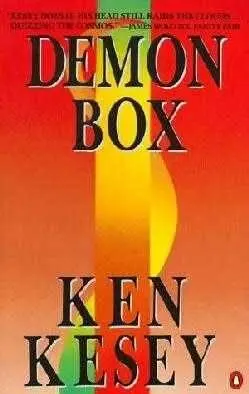
- Название:Demon Box
- Автор:
- Жанр:
- Год:неизвестен
- ISBN:нет данных
- Рейтинг книги:4 / 5. Голосов: 1
-
Избранное:Добавить в избранное
- Отзывы:
-
Ваша оценка:
Demon Box: краткое содержание, описание и аннотация
Предлагаем к чтению аннотацию, описание, краткое содержание или предисловие (зависит от того, что написал сам автор книги «Demon Box»). Если вы не нашли необходимую информацию о книге — напишите в комментариях, мы постараемся отыскать её.
The central theme running through this collection of stories (many of which seem to be primarily nonfiction with elements of fiction thrown in) by the author of One Flew Over the Cuckoo's Nest is the struggle to come to terms with the legacy of the 1960s. Kesey draws largely on his own experiences after returning to his Oregon farm following a brief stint in prison on drug charges. A series of tales, apparently sections from a novel in progress, star an alter-ego named Devlin Deboree: his relatively tranquil post-jail farm existence is disturbed both by memories of now-dead companions and the seemingly extinct passions of the '60s, and by burned-out refugees from that era who intermittently arrive on his doorstep, hoping for some sort of help from the most famous survivor of the psychedelic wars. Pieces on visiting Egypt and covering a Chinese marathon examine the complex relationship between Americans and people from other cultures. Kesey's distinctive gift with language and tough sense of humor unify this somewhat disorganized collection, and his elegy for the passing of the mad energy of the '60s will strike a responsive chord with all those who lived through those dangerous, liberating years. 30,000 first printing; BOMC and QPBC alternates.
From Library Journal
Kesey fans have waited long for his latest offering, a collection of experiences, stories, and poetry. Most of the tales concern the life and times of "Devlin E. Deboree," a counterculture author who serves time in Mexico on a narcotics charge and later returns to his family farm in Oregon. Though he gives himself an alias, Kesey usually identifies his friends, including Jack Kerouac, Larry McMurtry, Hunter Thompson, and a Rolling Stone reporter who accompanies him to the great pyramids. The collection fluctuates in mood, ranging from warm "farm" pieces such as "Abdul Ebenezer" (concerning a bull and a cow) to pieces dealing with loss of friends and a common cause that reflect a nostalgia for the Sixties. These more personal pieces, especially the title essay, are particularly strong. Susan Avallone, "Library Journal"
***
"Here's good news for pundits and pranksters everywhere: Ken Kesey can still write… Those metaphoric tales illuminate our lives and make us laugh and cry." – San Francisco Chronicle
Ken Kesey: legendary writer, counterculture folk hero – chief trickster of the sixties' tuned-in, turned-on generation. Now, kesey comes to terms with his own legend, as he reveals his fascinating passage from the psychedelic sixties to the contradictory eighties.
Assuming the guise of Devlin Deboree (pronounced debris), Kesey begins with his release from prison and his return to an unusual domestic life; recounts various foreign excursions (to Egypt to visit the Sphinx, and to China to cover the Bejing Marathon); relates lively stories of farm and family and, in the voice of his grandmother, a tall tale and a narrative prayer. Most poignantly, Kesey looks at the hard lessons to be found in the deaths of Neal Cassady and John Lennon.
As always, Kesey challenges public and private demons with sure, subtle strokes – and with the brave and deceptive embrace of the wrestler.
"In these forceful, engaging, sometimes touching pieces, Kesey shows that he remains a concerned, sometimes vitrolic, but ultimately responsible observer of American society and and the human condition." – The Philidelphia Inquirer
Demon Box — читать онлайн бесплатно полную книгу (весь текст) целиком
Ниже представлен текст книги, разбитый по страницам. Система сохранения места последней прочитанной страницы, позволяет с удобством читать онлайн бесплатно книгу «Demon Box», без необходимости каждый раз заново искать на чём Вы остановились. Поставьте закладку, и сможете в любой момент перейти на страницу, на которой закончили чтение.
Интервал:
Закладка:
"About one hundred years ago there lived a British physicist named James Clerk Maxwell. Entropy fascinated him also. As a physicist he had great affection for the wonders of our physical universe, and it seemed to him too cruel that all the moving things of our world, all the marvelous, spinning, humming, ticking, breathing things, should be doomed to run down and die. Was there no remedy to this unfair fate? The problem gnawed at him and, in British bulldog fashion, he gnawed back. At length he felt he had devised a solution, a loophole around one of the bleakest laws on the books. What he did was… he devised this."
Carefully cradling the checkbook near the flame so all could see, he began to draw on the back of a check, a simple rectangular box. "Professor Maxwell postulated, 'Imagine we have a box, sealed, full of the usual assortment of molecules careening about in the dark… and inside this box a dividing partition, and in this partition a door' "
At the bottom of the partition he outlined a door with tiny hinges and doorknob.
" 'And standing beside this door… a demon!' " He sketched a crude stick figure with a tiny stick arm reaching for the doorknob.
" 'Now further imagine,' said our Professor, 'that this demon is trained to open and close this door for those flying molecules. When he sees a hot molecule approaching he lets it pass through to this side' " – he drew a large block H on the right half of the box – " 'and when he sees a cold, slow-moving molecule our obedient demon closes the door, containing it on this, the cold side of the box.' "
Mesmerized, we watched the puckered hand draw the C.
" 'Should not it then follow,' Professor Maxwell reasoned, 'that as the left side of the box got colder the right side would begin to get hot? Hot enough to boil steam and turn a turbine? A very small turbine, to be certain, but theoretically capable of generating energy none the less, free, and from within a closed system? Thus actually circumventing the second law of thermodynamics would it not?' "
Dobbs had to admit that it seemed to him like it ought to work; he said he had encountered such demons as looked like they had the muscle to manage it.
"Ah, precisely – the muscle. So. Within a few decades another fascinated physicist published another essay, which argued that even granted that such a system could be made, and that the demon-slave could be compelled to perform the system's task without salary, the little imp still would not be without expense! He would need muscles to move the door, and sustenance to give those muscles strength. In short, he would need food.
"Another few decades pass. Another pessimist theorizes that the demon would also have to have light, to be able to see the molecules. Further energy outlay to be subtracted from the profit. The twentieth century brings theorists that are more pessimistic still. They insist that Maxwell's little dybbuk will not only require food and light but some amount of education as well, to enable him to evaluate which molecules are fast-moving and hot enough, which are too slow and cool. Mr. Demon must enroll in special courses, they maintain. This means tuition, transportation to class, textbooks, perhaps eyeglasses. More expense. It adds up…
"The upshot? After a century of theoretical analysis, the world of physics reached a very distressing conclusion: that Maxwell's little mechanism will not only consume more energy than it produces and cost more than it can ever make, it will continue to do so in increase! Does this remind you of anything, children?"
"It reminds me," my brother Buddy said, "of the atomic power plants they're building up in Washington."
"Just so, yah, only worse. Now. Imagine again, please, that this box" – he bent again over the picture with his ballpoint, changing the H into a G - - "represents the cognitive process of Modern civilization. Eh? And that this side, let's say, represents 'Good.' This other side, 'bad.' "
He changed the C to an ornate B, then waggled the picture at us through the steam.
"Our divided mind! in all its doomed glory! And ensconced right in the middle is this medieval slavey, under orders to sort through the whirling blizzard of experience and separate the grain from the chaff. He must deliberate over everything, and to what end? Purportedly to further us in some way, eh? Get us an edge in wheat futures, a master's degree, another rung up the ladder of elephant shit. Glorious rewards supposedly await us if our slave piles up enough 'good.' But he must accomplish this before he bankrupts us, is the catch. Und all this deliberating, it makes him hungry. He needs more energy. Such an appetite."
His hand had drifted down to float on the surface, the checkbook still pinched aloft between thumb and finger.
"Our accounts begin to sink into the red. We have to float loans from the future. At the wheel we sense something dreadfully wrong. We are losing way! We must maintain way or we lose the rudder! We hammer on the bulkhead of the engine room: 'Stoker! More hot molecules, damn your ass! We're losing way!' But the hammering only seems to make him more ravenous. At last it becomes clear: we must fire this fireman."
We watched the hand. It was gradually sinking, checkbook and all, into the dark waters.
"But these stokers have built up quite the maritime union over the past century, and they have an ironclad contract, binding their presence on board to our whole crew of conscious faculties. If Stokey goes, everybody goes, from the navigator right down to the sphincter's mate. We may be drifting for the rocks but there is nothing we can do but stand at the wheel, helpless, and wait for the boat to go… down."
He held the vowel, bowing his voice like a fine cello. "O, my sailors, what I say is sad but true – our brave new boat is sinking. Every day finds more of us drowning in depression, or drifting aimlessly in a sea of antidepressants, or grasping at such straws as psychodrama and regression catharsis. Fah! The problem does not lie in poo-poo fantasies from our past. It is this mistake we have programmed into the machinery of our present that has scuttled us!"
The book was gone. Not a ripple remained. Finally the court recorder broke the spell with her flat, cornbelt voice.
"Then what do you advise we do, doctor? You've figured somethin', I can tell by the way you're leadin' us on."
That voice was the only thing flat she'd brought from Nebraska. Woofner leered at her for a moment, his face streaming moisture like some kind of seagoing Pan's; then he sighed and raised the checkbook high to let the water trickle out of it.
"I'm sorry, dear. The doctor has not figured anything. Maybe someday. Until then, his considered advice is to live with your demon as peacefully as possible, to make fewer demands and be satisfied with less results… and above all, mine students, to strive constantly to be here!"
The wet checkbook slapped the water. We jumped like startled frogs again. Woofner wheezed a laugh and surged standing, puffy and pale as Moby Dick himself.
"Class dismissed. Miss Omaha? A student in such obviously fit condition shouldn't object to helping a poor old pedagogue up to his bed, yah?"
"How about if I walk along?" I had to ask. "It's time I checked on the bus."
"By all means, Devlin." He grinned. "The fit and the fascinated. You may carry the wine."
After getting dressed, I accompanied the girl and the old man on the walk up to the cottages. We walked in single file up the narrow path, the girl in the middle. I was still in a steam from the hot-tub talk and wanting to keep after it, but the doctor didn't seem so inclined. He inquired instead about my legal status. He'd followed the bust in the papers – was I really involved in all those chemical experiments, or was that merely more San Francisco Chronicle crap? Mostly crap, I told him. I was flattered that he asked.
Читать дальшеИнтервал:
Закладка:
Похожие книги на «Demon Box»
Представляем Вашему вниманию похожие книги на «Demon Box» списком для выбора. Мы отобрали схожую по названию и смыслу литературу в надежде предоставить читателям больше вариантов отыскать новые, интересные, ещё непрочитанные произведения.







Обсуждение, отзывы о книге «Demon Box» и просто собственные мнения читателей. Оставьте ваши комментарии, напишите, что Вы думаете о произведении, его смысле или главных героях. Укажите что конкретно понравилось, а что нет, и почему Вы так считаете.