Kiran Desai - The Inheritance of Loss
Здесь есть возможность читать онлайн «Kiran Desai - The Inheritance of Loss» весь текст электронной книги совершенно бесплатно (целиком полную версию без сокращений). В некоторых случаях можно слушать аудио, скачать через торрент в формате fb2 и присутствует краткое содержание. Жанр: Современная проза, на английском языке. Описание произведения, (предисловие) а так же отзывы посетителей доступны на портале библиотеки ЛибКат.
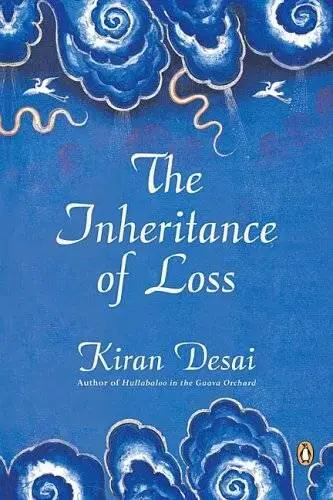
- Название:The Inheritance of Loss
- Автор:
- Жанр:
- Год:неизвестен
- ISBN:нет данных
- Рейтинг книги:3 / 5. Голосов: 1
-
Избранное:Добавить в избранное
- Отзывы:
-
Ваша оценка:
The Inheritance of Loss: краткое содержание, описание и аннотация
Предлагаем к чтению аннотацию, описание, краткое содержание или предисловие (зависит от того, что написал сам автор книги «The Inheritance of Loss»). Если вы не нашли необходимую информацию о книге — напишите в комментариях, мы постараемся отыскать её.
***
Desai's second novel is set in the nineteen-eighties in the northeast corner of India, where the borders of several Himalayan states – Bhutan and Sikkim, Nepal and Tibet – meet. At the head of the novel's teeming cast is Jemubhai Patel, a Cambridge-educated judge who has retired from serving a country he finds "too messy for justice." He lives in an isolated house with his cook, his orphaned seventeen-year-old granddaughter, and a red setter, whose company Jemubhai prefers to that of human beings. The tranquillity of his existence is contrasted with the life of the cook's son, working in grimy Manhattan restaurants, and with his granddaughter's affair with a Nepali tutor involved in an insurgency that irrevocably alters Jemubhai's life. Briskly paced and sumptuously written, the novel ponders questions of nationhood, modernity, and class, in ways both moving and revelatory.
The Inheritance of Loss — читать онлайн бесплатно полную книгу (весь текст) целиком
Ниже представлен текст книги, разбитый по страницам. Система сохранения места последней прочитанной страницы, позволяет с удобством читать онлайн бесплатно книгу «The Inheritance of Loss», без необходимости каждый раз заново искать на чём Вы остановились. Поставьте закладку, и сможете в любой момент перейти на страницу, на которой закончили чтение.
Интервал:
Закладка:
At fourteen, he was hired by the judge at twelve rupees a month. Those were days when it was still pertinent to know that if you tied a pot of cream to the underside of a cow, as you walked to the next camp it would churn itself into butter by day’s end. That a portable meat safe could be made with an upside-down open umbrella tied about with mosquito netting.
"We were always on tour," said the cook, "three weeks out of four. Only in the worst days of the monsoon did we stop. Your grandfather would drive in his car if he could, but the district was mostly without roads, and hardly any bridges spanned the rivers, so more often he had to ride out on horseback. Now and then, through jungly areas and through deeper, swifter currents, he crossed on elephant. We would travel before him in a train of bullock carts piled with the china, tents, furniture, carpets – everything. There were porters, orderlies, a stenographer. There was a thunder box for the bathroom tent and even a murga-murgi in a cage under the cart. They were a foreign breed and that hen laid more eggs than any other murgi I have known."
"Where did you sleep?" Sai asked.
"We would put up tents in villages all over the district: a big bedroom tent like a top for your grandfather, with an attached tent bathroom, dressing room, drawing room, and dining room. The tents were very grand, Kashmiri carpets, silver dishes, and your grandfather dressed for dinner even in the jungle, in black dinner jacket and bow tie.
"As I said, we went first, so that when your grandfather arrived, everything was set up exactly as it had been left in the old camp, the same files open at the same angle turned to the same page. If it was even a little bit different, he would lose his temper.
"The timetable was strictly enforced – we couldn’t be late by even five minutes, so we all had to learn how to read a clock.
"At five-forty-five I would take the bed tea on a tray to your grandfather’s tent. ‘Bed tea,’ I would call out as I lifted the tent flap.
"Bad tea," was how it sounded. " Baaad teee. Baaad teeee. "Sai began to laugh.
The judge stared at his chessboard, but after the burning memory of his beginnings, he experienced the sweet relief now of recalling his life as a touring official in the civil service.
The tight calendar had calmed him, as did the constant exertion of authority. How he relished his power over the classes that had kept his family pinned under their heels for centuries – like the stenographer, for example, who was a Brahmin. There he was, crawling into a tiny tent to the side, and there was Jemubhai reclining like a king in a bed carved out of teak, hung with mosquito netting.
"Bed tea," the cook would shout. "Baaad tee."
He would sit up to drink.
6:30: he’d bathe in water that had been heated over the fire so it was redolent with the smell of wood smoke and flecked with ash. With a dusting of powder he graced his newly washed face, with a daub of pomade, his hair. Crunched up toast like charcoal from having been toasted upon the flame, with marmalade over the burn.
8:30: he rode into the fields with the local officials and everyone else in the village going along for fun. Followed by an orderly holding an umbrella over his head to shield him from the glare, he measured the fields and checked to make sure his yield estimate matched the headman’s statement. Farms were growing less than ten maunds an acre of rice or wheat, and at two rupees a maund, every single man in a village, sometimes, was in debt to the bania. (Nobody knew that Jemubhai himself was noosed, of course, that long ago in the little town of Piphit in Gujarat, money lenders had sniffed out in him a winning combination of ambition and poverty… that they still sat waiting cross-legged on a soiled mat in the market, snapping their toes, cracking their knuckles in anticipation of repayment…)
2:00: after lunch, the judge sat at his desk under a tree to try cases, usually in a cross mood, for he disliked the informality, hated the splotch of leaf shadow on him imparting an untidy mongrel look. Also, there was a worse aspect of contamination and corruption: he heard cases in Hindi, but they were recorded in Urdu by the stenographer and translated by the judge into a second record in English, although his own command of Hindi and Urdu was tenuous; the witnesses who couldn’t read at all put their thumbprints at the bottom of "Read Over and Acknowledged Correct," as instructed. Nobody could be sure how much of the truth had fallen between languages, between languages and illiteracy; the clarity that justice demanded was nonexistent. Still, despite the leaf shadow and language confusion, he acquired a fearsome reputation for his speech that seemed to belong to no language at all, and for his face like a mask that conveyed something beyond human fallibility. The expression and manner honed here would carry him, eventually, all the way to the high court in Lucknow where, annoyed by lawless pigeons shuttlecocking about those tall, shadowy halls, he would preside, white powdered wig over white powdered face, hammer in hand.
His photograph, thus attired, thus annoyed, was still up on the wall, in a parade of history glorifying the progress of Indian law and order.
4:30: tea had to be perfect: drop scones made in the frying pan. He would embark on them with forehead wrinkled, as if angrily mulling over something important, and then, as it would into his retirement, the draw of the sweet took over, and his stern work face would hatch an expression of tranquility.
5:30: out he went into the countryside with his fishing rod or gun. The countryside was full of game; lariats of migratory birds lassoed the sky in October; quail and partridge with lines of babies strung out behind whirred by like nursery toys that emit sound with movement; pheasant – fat foolish creatures, made to be shot – went scurrying through the bushes. The thunder of gunshot rolled away, the leaves shivered, and he experienced the profound silence that could come only after violence. One thing was always missing, though, the proof of the pudding, the prize of the action, the manliness in manhood, the partridge for the pot, because he returned with -
Nothing!
He was a terrible shot.
8:00: the cook saved his reputation, cooked a chicken, brought it forth, proclaimed it "roast bastard," just as in the Englishman’s favorite joke book of natives using incorrect English. But sometimes, eating that roast bustard, the judge felt the joke might also be on him, and he called for another rum, took a big gulp, and kept eating feeling as if he were eating himself, since he, too, was (was he?) part of the fun…
9:00: sipping Ovaltine, he filled out the registers with the day’s gleanings. The Petromax lantern would be lit – what a noise it made – insects fording the black to dive-bomb him with soft flowers (moths), with iridescence (beetles). Lines, columns, and squares. He realized truth was best looked at in tiny aggregates, for many baby truths could yet add up to one big size unsavory lie. Last, in his diary also to be submitted to his superiors, he recorded the random observations of a cultured man, someone who was observant, schooled in literature as well as economics; and he made up hunting triumphs: two partridge… one deer with thirty-inch horns…
11:00: he had a hot water bottle in winter, and, in all seasons, to the sound of the wind buffeting the trees and the cook’s snoring, he fell asleep.
The cook had been disappointed to be working for Jemubhai. A severe comedown, he thought, from his father, who had served white men only.
Читать дальшеИнтервал:
Закладка:
Похожие книги на «The Inheritance of Loss»
Представляем Вашему вниманию похожие книги на «The Inheritance of Loss» списком для выбора. Мы отобрали схожую по названию и смыслу литературу в надежде предоставить читателям больше вариантов отыскать новые, интересные, ещё непрочитанные произведения.









Обсуждение, отзывы о книге «The Inheritance of Loss» и просто собственные мнения читателей. Оставьте ваши комментарии, напишите, что Вы думаете о произведении, его смысле или главных героях. Укажите что конкретно понравилось, а что нет, и почему Вы так считаете.