Amy Tan - The Joy Luck Club
Здесь есть возможность читать онлайн «Amy Tan - The Joy Luck Club» весь текст электронной книги совершенно бесплатно (целиком полную версию без сокращений). В некоторых случаях можно слушать аудио, скачать через торрент в формате fb2 и присутствует краткое содержание. Жанр: Современная проза, на английском языке. Описание произведения, (предисловие) а так же отзывы посетителей доступны на портале библиотеки ЛибКат.
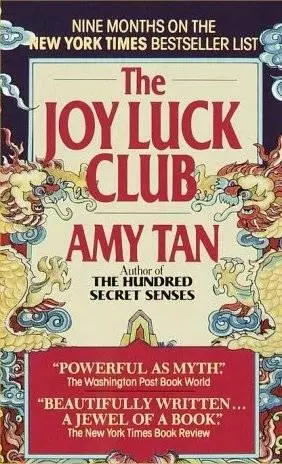
- Название:The Joy Luck Club
- Автор:
- Жанр:
- Год:неизвестен
- ISBN:нет данных
- Рейтинг книги:5 / 5. Голосов: 1
-
Избранное:Добавить в избранное
- Отзывы:
-
Ваша оценка:
The Joy Luck Club: краткое содержание, описание и аннотация
Предлагаем к чтению аннотацию, описание, краткое содержание или предисловие (зависит от того, что написал сам автор книги «The Joy Luck Club»). Если вы не нашли необходимую информацию о книге — напишите в комментариях, мы постараемся отыскать её.
Amy Tan wrote The Joy Luck Club to try to understand her own relationship with her mother. Tan's Chinese parents wanted Americanized children but expected them to think like Chinese. Tan found this particularly difficult as an adolescent. While the generational differences were like those experienced by other mothers and daughters, the cultural distinctions added another dimension. Thus, Tan wrote not only to sort out her cultural heritage but to learn how she and her mother could get along better.
Critics appreciate Tan's straightforward manner as well as the skill with which she talks about Chinese culture and mother/daughter relationships. Readers also love The Joy Luck Club: women of all ages identify with Tan's characters and their conflicts with their families, while men have an opportunity through this novel to better understand their own behaviors towards women. Any reader can appreciate Tan's humor, fairness, and objectivity.
The Joy Luck Club — читать онлайн бесплатно полную книгу (весь текст) целиком
Ниже представлен текст книги, разбитый по страницам. Система сохранения места последней прочитанной страницы, позволяет с удобством читать онлайн бесплатно книгу «The Joy Luck Club», без необходимости каждый раз заново искать на чём Вы остановились. Поставьте закладку, и сможете в любой момент перейти на страницу, на которой закончили чтение.
Интервал:
Закладка:
"Already cooked enough for you. See? One soup, four dishes. You don't eat it, only have to throw it away. Wasted!"
How could we refuse? Three days later, Auntie Suyuan had a thank-you letter from Rich and me. "Rich said it was the best Chinese food he has ever tasted," I wrote.
And the next day, my mother called me, to invite me to a belated birthday dinner for my father. My brother Vincent was bringing his girlfriend, Lisa Lum. I could bring a friend, too.
I knew she would do this, because cooking was how my mother expressed her love, her pride, her power, her proof that she knew more than Auntie Su. "Just be sure to tell her later that her cooking was the best you ever tasted, that it was far better than Auntie Su's," I told Rich. "Believe me."
The night of the dinner, I sat in the kitchen watching her cook, waiting for the right moment to tell her about our marriage plans, that we had decided to get married next July, about seven months away. She was chopping eggplant into wedges, chattering at the same time about Auntie Suyuan: "She can only cook looking at a recipe. My instructions are in my fingers. I know what secret ingredients to put in just by using my nose!" And she was slicing with such a ferocity, seemingly inattentive to her sharp cleaver, that I was afraid her fingertips would become one of the ingredients of the red-cooked eggplant and shredded pork dish.
I was hoping she would say something first about Rich. I had seen her expression when she opened the door, her forced smile as she scrutinized him from head to toe, checking her appraisal of him against that already given to her by Auntie Suyuan. I tried to anticipate what criticisms she would have.
Rich was not only not Chinese, he was a few years younger than I was. And unfortunately, he looked much younger with his curly red hair, smooth pale skin, and the splash of orange freckles across his nose. He was a bit on the short side, compactly built. In his dark business suits, he looked nice but easily forgettable, like somebody's nephew at a funeral. Which was why I didn't notice him the first year we worked together at the firm. But my mother noticed everything.
"So what do you think of Rich?" I finally asked, holding my breath.
She tossed the eggplant in the hot oil and it made a loud, angry hissing sound. "So many spots on his face," she said.
I could feel the pinpricks on my back. "They're freckles. Freckles are good luck, you know," I said a bit too heatedly in trying to raise my voice above the din of the kitchen.
"Oh?" she said innocently.
"Yes, the more spots the better. Everybody knows that."
She considered this a moment and then smiled and spoke in Chinese: "Maybe this is true. When you were young, you got the chicken pox. So many spots, you had to stay home for ten days. So lucky, you thought."
I couldn't save Rich in the kitchen. And I couldn't save him later at the dinner table.
He had brought a bottle of French wine, something he did not know my parents could not appreciate. My parents did not even own wineglasses. And then he also made the mistake of drinking not one but two frosted glasses full, while everybody else had a half-inch "just for taste."
When I offered Rich a fork, he insisted on using the slippery ivory chopsticks. He held them splayed like the knock-kneed legs of an ostrich while picking up a large chunk of sauce-coated eggplant. Halfway between his plate and his open mouth, the chunk fell on his crisp white shirt and then slid into his crotch. It took several minutes to get Shoshana to stop shrieking with laughter.
And then he had helped himself to big portions of the shrimp and snow peas, not realizing he should have taken only a polite spoonful, until everybody had had a morsel.
He had declined the sautéed new greens, the tender and expensive leaves of bean plants plucked before the sprouts turn into beans. And Shoshana refused to eat them also, pointing to Rich: "He didn't eat them! He didn't eat them!"
He thought he was being polite by refusing seconds, when he should have followed my father's example, who made a big show of taking small portions of seconds, thirds, and even fourths, always saying he could not resist another bite of something or other, and then groaning that he was so full he thought he would burst.
But the worst was when Rich criticized my mother's cooking, and he didn't even know what he had done. As is the Chinese cook's custom, my mother always made disparaging remarks about her own cooking. That night she chose to direct it toward her famous steamed pork and preserved vegetable dish, which she always served with special pride.
"Ai! This dish not salty enough, no flavor," she complained, after tasting a small bite. "It is too bad to eat."
This was our family's cue to eat some and proclaim it the best she had ever made. But before we could do so, Rich said, "You know, all it needs is a little soy sauce." And he proceeded to pour a riverful of the salty black stuff on the platter, right before my mother's horrified eyes.
And even though I was hoping throughout the dinner that my mother would somehow see Rich's kindness, his sense of humor and boyish charm, I knew he had failed miserably in her eyes.
Rich obviously had had a different opinion on how the evening had gone. When we got home that night, after we put Shoshana to bed, he said modestly, "Well. I think we hit it off A-o-kay ." He had the look of a dalmatian, panting, loyal, waiting to be petted.
"Uh-hmm," I said. I was putting on an old nightgown, a hint that I was not feeling amorous. I was still shuddering, remembering how Rich had firmly shaken both my parents' hands with that same easy familiarity he used with nervous new clients. "Linda, Tim," he said, "we'll see you again soon, I'm sure." My parents' names are Lindo and Tin Jong, and nobody, except a few older family friends, ever calls them by their first names.
"So what did she say when you told her?" And I knew he was referring to our getting married. I had told Rich earlier that I would tell my mother first and let her break the news to my father.
"I never had a chance," I said, which was true. How could I have told my mother I was getting married, when at every possible moment we were alone, she seemed to remark on how much expensive wine Rich liked to drink, or how pale and ill he looked, or how sad Shoshana seemed to be.
Rich was smiling. "How long does it take to say, Mom, Dad, I'm getting married?"
"You don't understand. You don't understand my mother."
Rich shook his head. "Whew! You can say that again. Her English was so bad. You know, when she was talking about that dead guy showing up on Dynasty , I thought she was talking about something that happened in China a long time ago."
That night, after the dinner, I lay in bed, tense. I was despairing over this latest failure, made worse by the fact that Rich seemed blind to it all. He looked so pathetic. So pathetic , those words! My mother was doing it again, making me see black where I once saw white. In her hands, I always became the pawn. I could only run away. And she was the queen, able to move in all directions, relentless in her pursuit, always able to find my weakest spots.
I woke up late, with teeth clenched and every nerve on edge. Rich was already up, showered, and reading the Sunday paper. "Morning, doll," he said between noisy munches of cornflakes. I put on my jogging clothes and headed out the door, got into the car, and drove to my parents' apartment.
Marlene was right. I had to tell my mother-that I knew what she was doing, her scheming ways of making me miserable. By the time I arrived, I had enough anger to fend off a thousand flying cleavers.
My father opened the door and looked surprised to see me. "Where's Ma?" I asked, trying to keep my breath even. He gestured to the living room in back.
Читать дальшеИнтервал:
Закладка:
Похожие книги на «The Joy Luck Club»
Представляем Вашему вниманию похожие книги на «The Joy Luck Club» списком для выбора. Мы отобрали схожую по названию и смыслу литературу в надежде предоставить читателям больше вариантов отыскать новые, интересные, ещё непрочитанные произведения.






Обсуждение, отзывы о книге «The Joy Luck Club» и просто собственные мнения читателей. Оставьте ваши комментарии, напишите, что Вы думаете о произведении, его смысле или главных героях. Укажите что конкретно понравилось, а что нет, и почему Вы так считаете.