Larry McMurtry - Lonesome Dove
Здесь есть возможность читать онлайн «Larry McMurtry - Lonesome Dove» весь текст электронной книги совершенно бесплатно (целиком полную версию без сокращений). В некоторых случаях можно слушать аудио, скачать через торрент в формате fb2 и присутствует краткое содержание. Жанр: Современная проза, на английском языке. Описание произведения, (предисловие) а так же отзывы посетителей доступны на портале библиотеки ЛибКат.
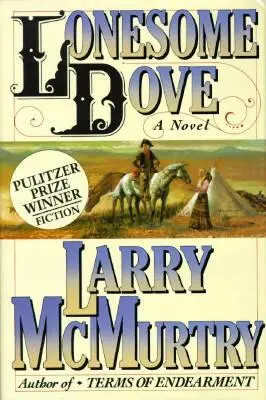
- Название:Lonesome Dove
- Автор:
- Жанр:
- Год:неизвестен
- ISBN:нет данных
- Рейтинг книги:5 / 5. Голосов: 1
-
Избранное:Добавить в избранное
- Отзывы:
-
Ваша оценка:
Lonesome Dove: краткое содержание, описание и аннотация
Предлагаем к чтению аннотацию, описание, краткое содержание или предисловие (зависит от того, что написал сам автор книги «Lonesome Dove»). Если вы не нашли необходимую информацию о книге — напишите в комментариях, мы постараемся отыскать её.
A love story, an adventure, an American epic, Lonesome Dove embraces all the West – legend and fact, heroes and outlaws, whoeres and ladies, Indians and settlers – in a novel that recreates the central American experience, the most enduring of our national myths.
Set in the late nineteenth century, Lonesome Dove is the story of a cattle drive from Texas to Montana – and much more. It is a drive that represents for everybody involved not only a daring, even a foolhardy, adventure, but a part of the American Dream – the attempt to carve out of the last remaining wilderness a new life.
Agustus McCrae and W.F. Call are former Texas Rangers, partners and friends who have shared hardship and danger together without ever quite understanding (or wanting to understand) each other's deepest emotions. Gus is the romantic, a reluctant rancher who has a way with women and the sense to leave well enough alone. Call is a driven, demanding man, a natural authority figure with no patience for weaknesses, and not many of his own. He is obsessed with the dream of creating his own empire, and with the need to conceal a secret sorrow of his own. The two men could hardly be more different, but both are tough, redoubtable fighters who have learned to count on each other, if nothing else.
Call's dream not only drags Gus along in its wake, but draws in a vast cast of characters:
– Lorena, the whore with the proverbial heart of gold, whom Gus (and almost everyone else) loves, and who survives one of the most terrifying experiences any woman could have…
– Elmira, the restless, reluctant wife of a small-time Arkansas sheriff, who runs away from the security of marriage to become part of the great Western adventure…
– Blue Duck, the sinister Indian renegade, one of the most frightening villains in American fiction, whose steely capacity for cruelty affects the lives of everyone in the book…
– Newt, the young cowboy for whom the long and dangerous journey from Texas to Montana is in fact a search for his own identity…
– Jake, the dashing, womanizing ex-Ranger, a comrade-in-arms of Gus and Call, whose weakness leads him to an unexpected fate…
– July Johnson, husband of Elmira, whose love for her draws him out of his secure life into the wilderness, and turns him into a kind of hero…
Lonesome Dove sweeps from the Rio Grande (where Gus and Call acquire the cattle for their long drive by raiding the Mexicans) to the Montana highlands (where they find themselves besieged by the last, defiant remnants of an older West).
It is an epic of love, heroism, loyalty, honor, and betrayal – faultlessly written, unfailingly dramatic. Lonesome Dove is the novel about the West that American literature – and the American reader – has long been waiting for.
Lonesome Dove — читать онлайн бесплатно полную книгу (весь текст) целиком
Ниже представлен текст книги, разбитый по страницам. Система сохранения места последней прочитанной страницы, позволяет с удобством читать онлайн бесплатно книгу «Lonesome Dove», без необходимости каждый раз заново искать на чём Вы остановились. Поставьте закладку, и сможете в любой момент перейти на страницу, на которой закончили чтение.
Интервал:
Закладка:
July felt scared he would do something wrong with the baby. He also was a little scared of Clara.
"I don't know anything about babies," he said.
"No, and you've never lived any place but Arkansas," Clara said. "But you ain't stupid and you ain't nailed down. You can live other places and you can learn about children-people dumber than you learn about them."
Again, July felt belabored by the tireless thing in Clara. Ellie might not look at him, but she didn't pursue him relentlessly with words, as Clara did.
"Stay here," she said. "Do you hear me? Stay here! Martin needs a pa and I could use a good hand. If you go trailing after that woman, either the Indians will kill you or that buffalo hunter will, or you'll just get lost and starve. It's a miracle you made it this far. You don't know the plains and I don't believe you know your wife, either. How long did you know her before you married?"
July tried to remember. The trial in Missouri had lasted three days, but he had met Ellie nearly a week before that.
"Two weeks, I guess," he said.
"That's short acquaintance," Clara said. "The smartest man alive can't learn much about a woman in two weeks."
"Well, she wanted to marry," July said. It was all he could remember about it. Ellie had made it clear she wanted to marry.
"That could have been another way of saying she wanted a change of scene," Clara said. "People get a hankering to quit what they're doing. They think they want to try something else. I do it myself. 1-JaIf the time I think I'd like to pack up these girls and go live with my aunt in Richmond, Virginia."
"What would you do there?" July asked.
"I might write books," Clara said. "I've a hankering to try it. But then it'll come a pretty morning and I see the horses grazing and think how I'd miss them. So I doubt I'll get off to Richmond."
Just then the baby began to cry, squirming in his hands. July looked at Clara, but she made no effort to take the baby. July didn't know what to do. He was afraid he might drop the child, who twisted in his hands like a rabbit and yelled so loud he turned red as a beet.
"Is he sick?" July asked.
"No, he's fine," Clara said. "Maybe he's telling you off for ignoring him all this time. I wouldn't blame him."
With that she turned and went back in the house, leaving him with the baby, who at once began to cry even harder. July hoped one of the girls would come out and help, but neither seemed to be around. It seemed very irresponsible of Clara to simply leave him with the child. He felt again that she was not a very helpful woman. But then Ellie hadn't been helpful, either.
He was afraid to stand up with the baby squirming so-he might drop him. So he sat, wondering why in the world people wanted children. How could anyone know what a baby wanted, or what to do for them?
But, as abruptly as he had started, the baby stopped crying. He whimpered a time or two, stuck his fist in his mouth, and then simply stared at July again as he had at first. July was so relieved that he scarcely moved.
"Talk to him a little," Clara said. She stood in the door behind him.
"What do you say?"
She made a snort of disgust. "Introduce yourself, if you can't think of nothing else," she said. "Or sing him a song. He's sociable. He likes a little talk."
July looked at the baby, but couldn't think of a song.
"Can't you even hum?" Clara asked, as if it were a crime that he had not immediately started singing.
July remembered a saloon song he had always liked: "Lorena." He tried humming a little of it. The baby, who had been wiggling, stopped at once and looked at him solemnly. July felt silly humming, but since it calmed the baby, he kept on. He was holding the baby almost at arm's length.
"Put him against your shoulder," Clara said. "You don't have to hold him like that-he ain't a newspaper."
July tried it. The baby soon wet his shirt with slobbers, but he wasn't crying. July continued to hum "Lorena."
Then, to his relief, Clara took the baby.
"That's progress," she said. "Rome wasn't built in a day."
Dusk came and July didn't leave. He sat on the porch, his rifle across his lap, trying to make up his mind to go. He knew he ought to. However difficult she was, Ellie was still his wife. She might be in danger, and it was his duty to try and save her. If he didn't go, he would be giving up forever. He might never even know if she had lived or died. He didn't want to be the kind of man who would just let his wife blow out of his life like a weed. And yet that was what he was doing. He felt too tired to do otherwise. Even if the Indians didn't get him, or them, even if he didn't get lost on the plains, he might just find her, in some other room, and have her turn her face away again. Then what? She could go on running, and he would go on chasing, until something really bad happened.
When Clara came out again to call him to supper, he felt worn out from thinking. He almost flinched when he heard Clara's step, for he had a feeling she was ill-disposed toward him and might have something sharp to say. Again he was wrong. She walked down the steps and paused to watch three cranes flying across the sunset, along the silver path of the Platte.
"Ain't they great birds?" she said quietly. "I wonder which I'd miss most, them or the horses, if I was to move away."
July didn't suppose she would move away. She seemed so much of the place that it didn't seem likely.
After watching the birds, she looked at him as if just noticing that he was still there.
"Are you willing to stay?" she asked.
July had rather she hadn't asked-rather it had been something that just happened. He didn't feel he had made a decision-and yet he hadn't left.
"I guess I oughtn't to chase her," he said finally. "I guess I ought to let her be."
"It doesn't do to sacrifice for people unless they want you to," Clara said. "It's just a waste."
"Ma, it's getting cold," Betsey said from the doorway.
"I was just enjoying the summer for a minute," Clara said.
"Well, you're always telling us how much you hate to serve cold food," Betsey said.
Clara looked at her daughter for a moment and then went up the steps.
"Come on, July," she said. "These girls mean to see that we keep up our standards."
He put the rifle back in the saddle scabbard and followed her into the house.
83.
AS THE HERD wound across the brown prairies toward the Platte, whoring became the only thing the men could talk about. Of course, they always liked to talk about it, but there had been sections of the drive when they occasionally mentioned other things-the weather, cards, the personalities of horses, trials and tribulations of the past. After Jake's death they had talked a good deal about the vagaries of justice, and what might cause a pleasant man to go bad. Once in a while they might talk about their families, although that usually ended with everyone getting homesick. Though a popular subject, it was tricky to handle.
By the time they were within a week of Ogallala, all subjects other than whoring were judged to be superfluous. Newt and the Rainey boys were rather surprised. They were interested in whoring too, in a vague sort of way, but listening to the grown men talk at night, or during almost any stop, they concluded there must be more to whoring than they had imagined. Getting to visit a whore quickly came to seem the most exciting prospect life had to offer.
"What if the Captain don't even want to stop in Ogallala?" Lippy asked, one night. "He ain't much of a stopper."
"Nobody's asking him to stop," Needle said. "He can keep driving, if he's a mind. We're the ones need to stop."
"I don't guess he likes whores," Lippy said. "He didn't come in the saloon much, that I remember."
Читать дальшеИнтервал:
Закладка:
Похожие книги на «Lonesome Dove»
Представляем Вашему вниманию похожие книги на «Lonesome Dove» списком для выбора. Мы отобрали схожую по названию и смыслу литературу в надежде предоставить читателям больше вариантов отыскать новые, интересные, ещё непрочитанные произведения.








Обсуждение, отзывы о книге «Lonesome Dove» и просто собственные мнения читателей. Оставьте ваши комментарии, напишите, что Вы думаете о произведении, его смысле или главных героях. Укажите что конкретно понравилось, а что нет, и почему Вы так считаете.