Larry McMurtry - Lonesome Dove
Здесь есть возможность читать онлайн «Larry McMurtry - Lonesome Dove» весь текст электронной книги совершенно бесплатно (целиком полную версию без сокращений). В некоторых случаях можно слушать аудио, скачать через торрент в формате fb2 и присутствует краткое содержание. Жанр: Современная проза, на английском языке. Описание произведения, (предисловие) а так же отзывы посетителей доступны на портале библиотеки ЛибКат.
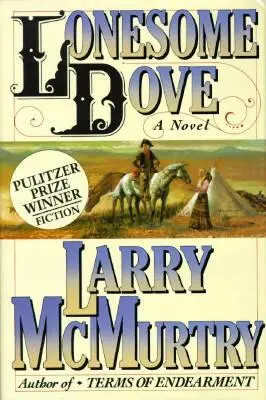
- Название:Lonesome Dove
- Автор:
- Жанр:
- Год:неизвестен
- ISBN:нет данных
- Рейтинг книги:5 / 5. Голосов: 1
-
Избранное:Добавить в избранное
- Отзывы:
-
Ваша оценка:
Lonesome Dove: краткое содержание, описание и аннотация
Предлагаем к чтению аннотацию, описание, краткое содержание или предисловие (зависит от того, что написал сам автор книги «Lonesome Dove»). Если вы не нашли необходимую информацию о книге — напишите в комментариях, мы постараемся отыскать её.
A love story, an adventure, an American epic, Lonesome Dove embraces all the West – legend and fact, heroes and outlaws, whoeres and ladies, Indians and settlers – in a novel that recreates the central American experience, the most enduring of our national myths.
Set in the late nineteenth century, Lonesome Dove is the story of a cattle drive from Texas to Montana – and much more. It is a drive that represents for everybody involved not only a daring, even a foolhardy, adventure, but a part of the American Dream – the attempt to carve out of the last remaining wilderness a new life.
Agustus McCrae and W.F. Call are former Texas Rangers, partners and friends who have shared hardship and danger together without ever quite understanding (or wanting to understand) each other's deepest emotions. Gus is the romantic, a reluctant rancher who has a way with women and the sense to leave well enough alone. Call is a driven, demanding man, a natural authority figure with no patience for weaknesses, and not many of his own. He is obsessed with the dream of creating his own empire, and with the need to conceal a secret sorrow of his own. The two men could hardly be more different, but both are tough, redoubtable fighters who have learned to count on each other, if nothing else.
Call's dream not only drags Gus along in its wake, but draws in a vast cast of characters:
– Lorena, the whore with the proverbial heart of gold, whom Gus (and almost everyone else) loves, and who survives one of the most terrifying experiences any woman could have…
– Elmira, the restless, reluctant wife of a small-time Arkansas sheriff, who runs away from the security of marriage to become part of the great Western adventure…
– Blue Duck, the sinister Indian renegade, one of the most frightening villains in American fiction, whose steely capacity for cruelty affects the lives of everyone in the book…
– Newt, the young cowboy for whom the long and dangerous journey from Texas to Montana is in fact a search for his own identity…
– Jake, the dashing, womanizing ex-Ranger, a comrade-in-arms of Gus and Call, whose weakness leads him to an unexpected fate…
– July Johnson, husband of Elmira, whose love for her draws him out of his secure life into the wilderness, and turns him into a kind of hero…
Lonesome Dove sweeps from the Rio Grande (where Gus and Call acquire the cattle for their long drive by raiding the Mexicans) to the Montana highlands (where they find themselves besieged by the last, defiant remnants of an older West).
It is an epic of love, heroism, loyalty, honor, and betrayal – faultlessly written, unfailingly dramatic. Lonesome Dove is the novel about the West that American literature – and the American reader – has long been waiting for.
Lonesome Dove — читать онлайн бесплатно полную книгу (весь текст) целиком
Ниже представлен текст книги, разбитый по страницам. Система сохранения места последней прочитанной страницы, позволяет с удобством читать онлайн бесплатно книгу «Lonesome Dove», без необходимости каждый раз заново искать на чём Вы остановились. Поставьте закладку, и сможете в любой момент перейти на страницу, на которой закончили чтение.
Интервал:
Закладка:
But he found he couldn't stand it to wait-he had to see her again, even if she wouldn't look at him. At least he could look at her and know he had found her after all. Maybe, if he was patient, she would change.
He saddled and rode to town. But when he got to the doctor's, no one was there at all. The room Ellie had been in was empty, the big man no longer to be found.
By asking around, he found the doctor, who was delivering a baby in one of the whorehouses.
"She's left," the doctor said. "I came home yesterday and she was gone. She didn't leave a note."
"But she was sick," July said.
"Only unhappy," Patrick Arandel said. He felt sorry for the young man. Five idle young whores were listening to the conversation, while one of their friends lay in labor in the next room.
"She took it hard when they hung that killer," he added. "That and the childbirth nearly killed her. I thought she would die-she ran one of the highest fevers I've ever seen. It's a good sign that she left. It means she's decided to live a little longer."
The man at the livery stable shook his head when July asked which way they went.
"The wrong way," he said. "If they get past them Sioux they're lucky people."
July felt frantic. He had not even brought his rifle to town, or his bedroll or anything. They had a day's start, though they were traveling in a wagon and would have to move slow. Still, he would lose another half day going back to the ranch to get his gear. He was tempted to follow with just his pistol, and he even rode to the east end of town. But there were the vast, endless plains. They had almost swallowed him once.
He turned back, racing for the ranch. He wore the horse half down, and he remembered it was a borrowed horse, so he slowed up. By the time he got back to Clara's he was not racing at all. He seemed to have no strength, and his head hurt again. He was barely able to unsaddle; instead of going right to the house, he sat down behind the saddle shed and wept. Why would Ellie keep leaving? What was he supposed to do? Didn't she know about the Indians? It seemed he would have to chase her forever, and yet catching her did no good.
When he stood up, he saw Clara. She had been on her way back from the garden with a basket of vegetables. It was hot, and she had rolled the sleeves up on her dress. Her arms were thin and yet strong, as if they were all bone.
"Did she leave?" Clara asked.
July nodded. He didn't want to talk.
"Come help me shuck this corn," Clara said. "The roasting ears are about gone. I get so hungry for them during the winter, I could eat a dozen."
She went on toward the house, carrying her heavy garden basket. When she didn't hear his footsteps, she looked back at him. July wiped his face and followed her to the house.
82.
THE NEXT MORNING, when he managed to get up, July came into the kitchen to find Cholo sharpening a thin-bladed knife. The baby lay on the table, kicking his bare feet, and Clara, wearing a man's hat, was giving the two girls instructions.
"Don't feed him just because he hollers," she said. "Feed him when it's time."
She looked at July, who felt embarrassed. He was not sick, and yet he felt as weak as if he had had a long fever. A plate with some cold eggs on it and a bit of bacon sat on the table-his breakfast, no doubt. Being the last one up made him feel a burden.
Cholo stood up. It was clear he and Clara were contemplating some work. July knew he ought to offer to help, but his legs would barely carry him to the table. He couldn't understand it. He had long since been over his jaundice, and yet he had no strength.
"We've got to geld some horses," Clara said. "We've put it off too long, hoping Bob would get back on his feet."
"I hate it when you do that," Sally said.
"You'd hate it worse if we had a bunch of studs running around here," Clara said. "One of them might crack your head just like that mustang cracked your father's."
She paused by the table a minute and tickled one of the baby's feet.
"I'd like to help," July said.
"You don't look that vigorous," she said.
"I'm not sick," July said. "I must have slept too hard."
"I expect you did something too hard," she said. "Stay and make conversation with these girls. That's harder work than gelding horses."
July liked the girls, though he had not said much to them. They seemed fine girls to him, always chattering. Mostly they fought over who got to tend the baby.
Clara and Cholo left and July slowly ate his breakfast, feeling guilty. Then he remembered what had happened-Ellie was gone, into Indian country. He had to go after her as soon as he ate. The baby, still on the table, gurgled at him. July had scarcely looked at it, though it seemed a good baby. Clara wanted it, the girls fought over it, and yet Ellie had left it. Thinking about it made him more confused.
After breakfast he got his rifle, but instead of leaving, he walked down to the lots. Every now and then he heard the squeal of a young horse. Walking, he didn't feel quite so weak, and it occurred to him that he ought to try and be some help-he could start after Ellie later.
It was hot, and the young horses were kicking up dust in the lots. To his surprise, he saw that Clara was doing the cutting, while the old man held the ropes. It was hard work-the horses were strong, and they badly needed another man. July quickly climbed into the lots and helped the old man anchor the hind legs of a quivering young bay.
Clara paused a moment, wiping the sweat off her forehead with her shirttail. Her hands were bloody.
"Shouldn't one of us do it?" July asked.
"No," Cholo said. "She is better."
"Bob taught me," Clara said. "We didn't have any help when we first came here. I wasn't strong enough to hold the horses so I got stuck with the messier job."
They gelded fifteen young horses and left them in the pen where they could be watched. July had stopped feeling weak, but even so it was a wonder to him how hard Clara and the old man worked. They didn't stop to rest until the job was done, by which time they were all soaked with sweat. Clara splashed water out of the horse trough to wash her hands and forearms, and immediately started for the house.
"I hope those worthless girls have been cooking," she said. "I've built an appetite."
"Do you know anything about the Indian situation?" July asked.
"I know Red Cloud," Clara said. "Bob was good to him. They lived on our horses that hard winter we had four years ago-they couldn't find buffalo."
"I've heard they're dangerous," July said.
"Yes," Clara said. "Red Cloud's fed up. Bob treated them fair and we've never had to fear them. I was more scared as a girl. The Comanches would come right into Austin and take children. I always dreamed they'd get me and I'd have red babies."
July had never felt so irresolute. He ought to go, and yet he didn't. Though he had worked hard, he had little appetite, and after the meal spent more time cleaning his gun than was really necessary.
When he finished, he sat the rifle against the porch railing, telling himself that he would get up and leave. But before he could get up, Clara walked out on the porch with no warning at all and put the baby into his hands. She practically dropped the child into his lap, an act July felt was very reckless. He had to catch him.
"That's a good sign," Clara said. "At least you'd catch him if somebody threw him off a roof."
The baby stared at July with wide eyes, as surprised, evidently, as he was. July looked at Clara, who seemed angry.
"I think it's time you took a look at him," she said. "He's your boy. He might come to like you, in which case he'll bring you more happiness than that woman ever will. He needs you a sight more than she does, too."
Читать дальшеИнтервал:
Закладка:
Похожие книги на «Lonesome Dove»
Представляем Вашему вниманию похожие книги на «Lonesome Dove» списком для выбора. Мы отобрали схожую по названию и смыслу литературу в надежде предоставить читателям больше вариантов отыскать новые, интересные, ещё непрочитанные произведения.









Обсуждение, отзывы о книге «Lonesome Dove» и просто собственные мнения читателей. Оставьте ваши комментарии, напишите, что Вы думаете о произведении, его смысле или главных героях. Укажите что конкретно понравилось, а что нет, и почему Вы так считаете.