Ha Jin - War Trash
Здесь есть возможность читать онлайн «Ha Jin - War Trash» весь текст электронной книги совершенно бесплатно (целиком полную версию без сокращений). В некоторых случаях можно слушать аудио, скачать через торрент в формате fb2 и присутствует краткое содержание. Жанр: Современная проза, на английском языке. Описание произведения, (предисловие) а так же отзывы посетителей доступны на портале библиотеки ЛибКат.
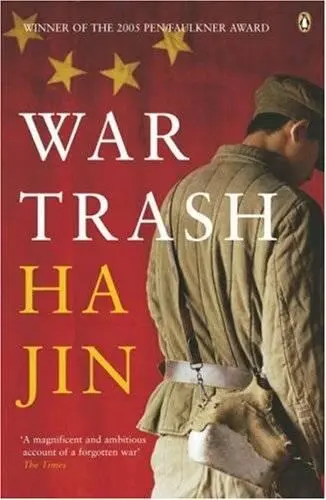
- Название:War Trash
- Автор:
- Жанр:
- Год:неизвестен
- ISBN:нет данных
- Рейтинг книги:5 / 5. Голосов: 1
-
Избранное:Добавить в избранное
- Отзывы:
-
Ваша оценка:
War Trash: краткое содержание, описание и аннотация
Предлагаем к чтению аннотацию, описание, краткое содержание или предисловие (зависит от того, что написал сам автор книги «War Trash»). Если вы не нашли необходимую информацию о книге — напишите в комментариях, мы постараемся отыскать её.
Jin (Waiting; The Crazed; etc.) applies his steady gaze and stripped-bare storytelling to the violence and horrifying political uncertainty of the Korean War in this brave, complex and politically timely work, the story of a reluctant soldier trying to survive a POW camp and reunite with his family. Armed with reams of research, the National Book Award winner aims to give readers a tale that is as much historical record as examination of personal struggle. After his division is decimated by superior American forces, Chinese "volunteer" Yu Yuan, an English-speaking clerical officer with a largely pragmatic loyalty to the Communists, rejects revolutionary martyrdom and submits to capture. In the POW camp, his ability to communicate with the Americans thrusts him to the center of a disturbingly bloody power struggle between two factions of Chinese prisoners: the pro-Nationalists, led in part by the sadistic Liu Tai-an, who publicly guts and dissects one of his enemies; and the pro-Communists, commanded by the coldly manipulative Pei Shan, who wants to use Yu to save his own political skin. An unofficial fighter in a foreign war, shameful in the eyes of his own government for his failure to die, Yu can only stand and watch as his dreams of seeing his mother and fiancée again are eviscerated in what increasingly looks like a meaningless conflict. The parallels with America 's current war on terrorism are obvious, but Jin, himself an ex-soldier, is not trying to make a political statement. His gaze is unfiltered, camera-like, and the images he records are all the more powerful for their simple honesty. It is one of the enduring frustrations of Jin's work that powerful passages of description are interspersed with somewhat wooden dialogue, but the force of this story, painted with starkly melancholy longing, pulls the reader inexorably along.
From The New Yorker
Ha Jin's new novel is the fictional memoir of a Chinese People's Volunteer, dispatched by his government to fight for the Communist cause in the Korean War. Yu Yuan describes his ordeal after capture, when P.O.W.s in the prison camp have to make a wrenching choice: return to the mainland as disgraced captives, or leave their families and begin new lives in Taiwan. The subject is fascinating, but in execution the novel often seems burdened by voluminous research, and it strains dutifully to illustrate political truisms. In a prologue, Yuan claims to be telling his story in English because it is "the only gift a poor man like me can bequeath his American grandchildren." Ha Jin accurately reproduces the voice of a non-native speaker, but the labored prose is disappointing from an author whose previous work – "Waiting" and " Ocean of Words " – is notable for its vividness and its emotional precision.
War Trash — читать онлайн бесплатно полную книгу (весь текст) целиком
Ниже представлен текст книги, разбитый по страницам. Система сохранения места последней прочитанной страницы, позволяет с удобством читать онлайн бесплатно книгу «War Trash», без необходимости каждый раз заново искать на чём Вы остановились. Поставьте закладку, и сможете в любой момент перейти на страницу, на которой закончили чтение.
Интервал:
Закладка:
Soon the leaders reached a consensus: we would go on a hunger strike and demand to talk with Colonel Kelly in person. Since it was already too dark to contact the prison house and the other compounds, they decided that we should go ahead and act on our own the next day.
The kitchen was ordered not to make breakfast, so the cooks happily slept in the next morning. As soon as it was light we signaled our decision to the other compounds and then to Commissar Pei. The guards on the tower noticed that few inmates stirred, so they asked us why the compound was so quiet. Having learned about the hunger strike and our demand, they reported the situation to their superior without delay, but Captain Larsen ignored us.
For a whole morning our barracks lost its daily activity; most prisoners lounged in bed doing nothing. Nobody was allowed to leave his shed unless he had to go to the outhouse. Our leaders had told us not to make any noise, because they intended to affect the guards with our silence. After ten-thirty, the time for the cooks to prepare the midday meal, none of the chimneys in the ten compounds spat smoke, and all the kitchens remained locked. This unnerved Larsen, who hadn't expected that the entire camp would participate in the hunger strike. He came to our front gate and stood beside the three gunnysacks of barley and a huge hamper of turnip greens, delivered by a truck two hours ago but rejected by our cooks. From time to time Larsen beckoned to inmates passing by, probably meaning he'd like to talk with them, but they ignored him. He lit a cigarette and chatted with the guards for a while. Then a GI handed him a megaphone, through which the captain yelled at us, "I order you to eat lunch. The vegetable is rotting in the sun, and I won't tolerate this kind of waste."
His words amused some prisoners, who laughed, saying, "As though he owned our mouths."
This was the first time that all the compounds had gone on a hunger strike in Camp 8. When we were on Koje Island, this kind of protest had been commonplace and the prison authorities had known how to cope with it, but here Colonel Kelly, somewhat disturbed, readily agreed to meet with the chiefs of the battalions. We were encouraged by his agreement, though uncertain whether he really intended to resolve the crisis.
Toward midafternoon Wanren and I, representing our compound, went to the guards' headquarters. In the lounge outside Kelly's office, more than a dozen prisoners were already seated on folding chairs, but the colonel himself was not in. Chaolin nodded at me and I waved back. I went over and sat down behind him. Yet we couldn't chat freely because Interpreter Peng, an officer from Taiwan working for the camp administration, was within hearing, his rear end resting on the windowsill. Chaolin turned around and said to me, "I've heard you did a great job in helping others." He was alluding to my assistance to Wanren.
I replied, "In a hellhole like this we ought to help each other." I noticed that Interpreter Peng was all ears, so I switched the topic and asked Chaolin, "Are you ready to spend the winter here?"
"Sure, we each just got another blanket."
That was news to me; our compound hadn't received additional clothing for the coming winter yet. A surge of sadness gripped my heart, but I managed to ask him again, referring to the dry socket on his upper gum, "What happened to your tooth?"
"A GI knocked it out of me last month."
"Does it still hurt?"
"It's all right now."
So he had lost an incisor in the battle for raising the flag, and the loss didn't seem to bother him.
Captain Larsen went to the front and clapped loudly to cut short our chattering. He said, "When Colonel Kelly comes in, everybody must get up, okay?"
There was no response. I sat next to Wanren, fascinated by the rhythmic clatter of a typewriter in a room down the hall. In the opposite corner of the lounge stood a cluster of dwarf bamboos set in an earthen pot. Beside the plant was a coffeemaker on a metal desk, gurgling staccato. The door opened and Colonel Kelly stepped in, but none of us stood up, whereas Captain Larsen and Interpreter Peng both sprang to their feet. Anger distorted Larsen's face.
The colonel stopped in front of us, a pistol on his brass-studded belt over which hung his beer belly. He bunched up his lips and said to us, "I have only twenty minutes, so just tell me why you started the hunger strike."
We had figured out our demands beforehand, which Chaolin began to present to him. As Chaoli's interpreter, I wondered if I should stand up, but decided not to, seeing that he remained seated. Then Colonel Kelly motioned for me to stop because he wanted Peng to do the translation. This was all the better for me.
Chaolin told Kelly that we had two demands: first, Captain Larsen must release our comrades; second, the camp authorities must investigate the death of Wenfu and punish the murderers. To our surprise, Kelly smiled and said, "The three prisoners will be sent back. There's no reason for us to keep them. Actually they may be already on their way back to the compound." He fixed a stare on Larsen as though annoyed by his inability to handle us by himself. Then he resumed, "But the investigation of the death will take time, and we cannot reach any conclusion before the process is complete, so I can't promise you what I'm going to do."
"Do you agree to investigate or not?" challenged Chaolin.
"Of course I do. I'll have to write a report to my higher-ups on this case as well, so I'm going to look into it."
"Will you let us know the result of the investigation?"
"That's something we can talk about."
"We want the murderers punished."
"Let's not jump the gun, all right? What you should do now is call off the hunger strike."
"But we want you to promise you'll investigate the murder case and punish the guilty party."
"Like I said, I'm going to look into it and if somebody's guilty, we'll handle him accordingly. Now, you must stop starving yourselves."
"Are you going to share the result of the investigation with us or not?"
"I shall do that only if you end the hunger strike."
"Is this a promise?"
"Yes."
"In that case our kitchens will cook again."
"When?"
"Today."
"Good, I'm pleased to hear that."
I didn't expect the dialogue to be so reasonable. Somehow Chaolin and the other chiefs didn't raise more questions. They should have asked the colonel approximately how long it would take him to finish the investigation and when we would hear from him, just as Kelly had pressed Chaolin for the exact time the hunger strike would be called off. I didn't remind them of this negligence because I wanted the crisis to end as soon as possible.
Before we left, the colonel even shook Chaolin's hand as though they had known each other for years. I was surprised by his cordiality, which made Chaolin so uncomfortable that he grinned at us tightly.
The three detained men had been returned while Wanren and I were away at the guards' headquarters. One had suffered a smashed hand and the other two had swollen faces. Although we agreed to eat dinner that day, that same evening we again shouted "Kill!" when Larsen dismissed us at the end of the head count. Crimson-faced, he got hold of Wanren and said, "Will you please stop this silly trick?" I translated the question.
Our chief answered, "You beat up my men and we must get even."
Larsen put on an innocent look and said, "I didn't touch them, I swear. It was those guys at the central office who mishandled them. I protested to them already and said they just made my job more difficult. Will you stop your men from shouting that silly word?"
His explanation seemed convincing to Wanren, who had heard from the three injured fellows that some strange Americans had whacked them. Slow of words, Wanren didn't counter with the fact that it had been Larsen who ordered their arrest. Instead, he argued, "We have freedom of speech, don't we? We've done nothing wrong."
Читать дальшеИнтервал:
Закладка:
Похожие книги на «War Trash»
Представляем Вашему вниманию похожие книги на «War Trash» списком для выбора. Мы отобрали схожую по названию и смыслу литературу в надежде предоставить читателям больше вариантов отыскать новые, интересные, ещё непрочитанные произведения.





Обсуждение, отзывы о книге «War Trash» и просто собственные мнения читателей. Оставьте ваши комментарии, напишите, что Вы думаете о произведении, его смысле или главных героях. Укажите что конкретно понравилось, а что нет, и почему Вы так считаете.