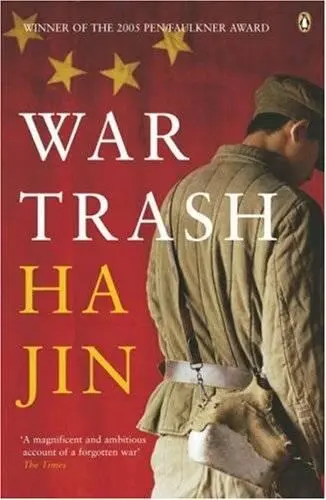
Ha Jin - War Trash
Здесь есть возможность читать онлайн «Ha Jin - War Trash» весь текст электронной книги совершенно бесплатно (целиком полную версию без сокращений). В некоторых случаях можно слушать аудио, скачать через торрент в формате fb2 и присутствует краткое содержание. Жанр: Современная проза, на английском языке. Описание произведения, (предисловие) а так же отзывы посетителей доступны на портале библиотеки ЛибКат.
- Название:War Trash
- Автор:
- Жанр:
- Год:неизвестен
- ISBN:нет данных
- Рейтинг книги:5 / 5. Голосов: 1
-
Избранное:Добавить в избранное
- Отзывы:
-
Ваша оценка:
War Trash: краткое содержание, описание и аннотация
Предлагаем к чтению аннотацию, описание, краткое содержание или предисловие (зависит от того, что написал сам автор книги «War Trash»). Если вы не нашли необходимую информацию о книге — напишите в комментариях, мы постараемся отыскать её.
Jin (Waiting; The Crazed; etc.) applies his steady gaze and stripped-bare storytelling to the violence and horrifying political uncertainty of the Korean War in this brave, complex and politically timely work, the story of a reluctant soldier trying to survive a POW camp and reunite with his family. Armed with reams of research, the National Book Award winner aims to give readers a tale that is as much historical record as examination of personal struggle. After his division is decimated by superior American forces, Chinese "volunteer" Yu Yuan, an English-speaking clerical officer with a largely pragmatic loyalty to the Communists, rejects revolutionary martyrdom and submits to capture. In the POW camp, his ability to communicate with the Americans thrusts him to the center of a disturbingly bloody power struggle between two factions of Chinese prisoners: the pro-Nationalists, led in part by the sadistic Liu Tai-an, who publicly guts and dissects one of his enemies; and the pro-Communists, commanded by the coldly manipulative Pei Shan, who wants to use Yu to save his own political skin. An unofficial fighter in a foreign war, shameful in the eyes of his own government for his failure to die, Yu can only stand and watch as his dreams of seeing his mother and fiancée again are eviscerated in what increasingly looks like a meaningless conflict. The parallels with America 's current war on terrorism are obvious, but Jin, himself an ex-soldier, is not trying to make a political statement. His gaze is unfiltered, camera-like, and the images he records are all the more powerful for their simple honesty. It is one of the enduring frustrations of Jin's work that powerful passages of description are interspersed with somewhat wooden dialogue, but the force of this story, painted with starkly melancholy longing, pulls the reader inexorably along.
From The New Yorker
Ha Jin's new novel is the fictional memoir of a Chinese People's Volunteer, dispatched by his government to fight for the Communist cause in the Korean War. Yu Yuan describes his ordeal after capture, when P.O.W.s in the prison camp have to make a wrenching choice: return to the mainland as disgraced captives, or leave their families and begin new lives in Taiwan. The subject is fascinating, but in execution the novel often seems burdened by voluminous research, and it strains dutifully to illustrate political truisms. In a prologue, Yuan claims to be telling his story in English because it is "the only gift a poor man like me can bequeath his American grandchildren." Ha Jin accurately reproduces the voice of a non-native speaker, but the labored prose is disappointing from an author whose previous work – "Waiting" and " Ocean of Words " – is notable for its vividness and its emotional precision.
War Trash — читать онлайн бесплатно полную книгу (весь текст) целиком
Ниже представлен текст книги, разбитый по страницам. Система сохранения места последней прочитанной страницы, позволяет с удобством читать онлайн бесплатно книгу «War Trash», без необходимости каждый раз заново искать на чём Вы остановились. Поставьте закладку, и сможете в любой момент перейти на страницу, на которой закончили чтение.
Интервал:
Закладка:
They nodded. So the two American officers were taken to the front gate and released. That afternoon we received messages from the other compounds, inquiring about what had happened. We were obligated to inform them truthfully. After dinner the battalion headquarters held a meeting, at which Wanren was mildly criticized by the other officers. But we all felt lucky that we had forestalled the potential trouble peacefully by ourselves. Because the secret operation had been exposed to the whole compound, Wanren seemed mortified and a bit ornery. Probably he feared that he had revealed his incompetence to his men, or that I had stood out as a more capable officer in handling this case. Afterward he was reluctant to talk with me as casually as before.
A week later Captain Larsen was demoted and transferred to a different prison camp. By order of Commissar Pei, a meeting was held among the leaders of our compound, presided over by our political instructor, Manpu. Wanren made self-criticism at the meeting and admitted that his vigilance had slackened. He said he was grateful to all the comrades who had helped him get the signed sheet back, otherwise the enemy would definitely have utilized it to sabotage our victory in defending our flag. But he didn't mention me, because Commissar Pei had awarded me another citation, second class this time, which I didn't really care about anymore. By contrast, Wanren got a disciplinary warning, though he remained in charge of our battalion.
After the detainment of Captain Larsen, Wanren and I could no longer get along. But now and then we still played chess together, with pieces we made out of cement, each bearing a handwritten name on its face, such as Horse, Elephant, Cannon, and Carriage. He was highly skilled at the game, and I was among the few who didn't have to receive the handicap of a carriage or a cannon as his opponent. Although I was still indispensable to him when he had to deal with the Americans, he wouldn't come to me for advice anymore. He was an honest man, probably above small maneuvers; still, I took care not to give him any handle against me.
28. ENTERTAINMENT AND WORK
Unlike Compound 602 on Koje Island, in this camp any large-scale cultural project, such as a full-length play or an art show, was out of the question. The singers, actors, painters, composers, and calligraphers had been scattered among the battalions, and there was no way to assemble them. At first this state of isolation caused us some difficulties, but soon every compound formed its own cultural staff. As a result, there were ten groups of "artists" in the camp, around whom many prisoners gathered.
Among the ten groups, the one in Compound 9 had more talents than the others and was most active. Meng Feihan, the composer and stage director who had lost a foot, was there. Besides him, the chief of that battalion had a fondness for cultural work, having once led a song-and-dance ensemble in an artillery division. Every evening you could hear music and songs rising from their barracks. Throughout the camp many inmates took part in musical activities of this kind. I participated too, though briefly. I tried to teach others how to read music, but my voice was so tuneless that whenever I sang to illustrate musical notes, some men would chuckle or cackle. So I gave up.
The POWs also contrived several kinds of instruments, including drums, flutes, violins, and horns. The first bugle was fashioned out of tinplate. A bugler by chance had brought into the camp his mouthpiece, which later served as a casting model for the lead mouthpieces on all the wind instruments here. Drums were relatively easy to produce, and there were several sizes of them; all were made out of sawed oil drums, water pails, and gas cans, covered with rain cloth fastened by rope. My friend Weiming, the short Cantonese man who was very protective of Shanmin, was an expert in making stringed instruments, which were more difficult to create than the wind ones. He was tone-deaf, however, and couldn't read musical notes or play any instrument; but he was more inventive than others. He turned a tin can into the resonator for an erhu, a two-stringed Chinese violin; he also used wooden boards, bamboo pipes, rat skins, and other materials. Ignorant of music, he had to have helpers and testers, of whom he had many, since others had lined up to join him. In fact, every instrument the prisoners made was a result of teamwork. There were dozens of instrument-making groups in the camp. They even produced several guitars that had three or four strings. They also created various kinds of violins: resin was obtained from steeped pine chips; the bows were mostly thin iron rods bent on both ends; as for the hair, they unraveled pieces of rope, soaked the hemp in warm water, combed it straight, then picked the sturdy strands to be tied to the sticks. Most "silk strings" came from the jackets and boots they wore, whereas all the metal strings had one source – electric wires, which could be found at the construction sites. By far the Western violin was the hardest to make, because it had four different metal strings that were difficult to come by. Nevertheless, one group managed to come up with a kind of strings, which were entwined with threads to make them sound close to the standard G, D, A, and E strings. It took a great deal of experimentation to create a Western violin.
Throughout the summer, our compound was like an instrument factory, and some sort of manufacturing was under way in most of the sheds. The prisoners took the work as seriously as if it were their livelihood. In addition, many men had begun to learn how to play the instruments and formed small bands. I often wondered why they were so earnest about such activities. I guessed they were probably bored and just meant to have some fun, frittering away the time that hung heavy on their hands. But I was mistaken. I soon realized that for them this was serious business, a matter of survival. Usually four or five men worked together at one instrument, so the product embodied a kind of collective will and effort. Likewise, a band always belonged to a platoon or company as "a special weapon in fighting the enemy." That was the language the leaders used. I wondered why they applied such hyperbole to a mere band. Perhaps they believed music could bolster the comrades' courage and kindle their hatred and thus turn them into better fighting machines.
On occasion, a skit or a comic talk accompanied by bamboo clappers was enacted in our compound, though none of the pieces was exceptional. Some prisoners tried to write short scripts for the stage and some composed songs, but few of these efforts resulted in passable work. Once in a while they would draw cartoons to ridicule the Americans, who would be given cucumber noses or bloated midriffs. The blackboards in our compound always carried jokes, drawings, and poems. Yet by far the most popular form of entertainment was the songfest.
Whenever a satisfactory song was composed, it began circulating briskly among the inmates, and within two weeks all the ten battalions could sing it. Meng Feihan in Compound 9 was the major composer; in general his music was solemn, strenuous, and high-minded. Two of his disciples were good at singing folk songs, so they blended light melodies into some satirical airs, which became immensely popular, such as "The Loudspeaker Always Lies, Don't Listen to It," "God, I'm Scared," and "Truman Is Done For." The prisoners enjoyed these erratic, uncanny tunes so much that they would croon them even when they were alone, whereas they would sing the serious songs only in groups. The leaders made good use of the musical talents. Whenever something important happened, they would have a song composed to mark the occasion. For instance, to commemorate the fight for raising our national flag, a song was made a week after the massacre. It went as follows:
Читать дальшеИнтервал:
Закладка:
Похожие книги на «War Trash»
Представляем Вашему вниманию похожие книги на «War Trash» списком для выбора. Мы отобрали схожую по названию и смыслу литературу в надежде предоставить читателям больше вариантов отыскать новые, интересные, ещё непрочитанные произведения.




Обсуждение, отзывы о книге «War Trash» и просто собственные мнения читателей. Оставьте ваши комментарии, напишите, что Вы думаете о произведении, его смысле или главных героях. Укажите что конкретно понравилось, а что нет, и почему Вы так считаете.