Ha Jin - War Trash
Здесь есть возможность читать онлайн «Ha Jin - War Trash» весь текст электронной книги совершенно бесплатно (целиком полную версию без сокращений). В некоторых случаях можно слушать аудио, скачать через торрент в формате fb2 и присутствует краткое содержание. Жанр: Современная проза, на английском языке. Описание произведения, (предисловие) а так же отзывы посетителей доступны на портале библиотеки ЛибКат.
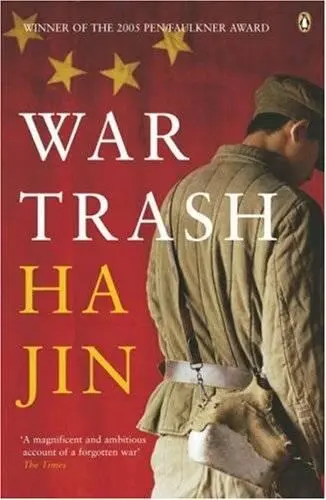
- Название:War Trash
- Автор:
- Жанр:
- Год:неизвестен
- ISBN:нет данных
- Рейтинг книги:5 / 5. Голосов: 1
-
Избранное:Добавить в избранное
- Отзывы:
-
Ваша оценка:
War Trash: краткое содержание, описание и аннотация
Предлагаем к чтению аннотацию, описание, краткое содержание или предисловие (зависит от того, что написал сам автор книги «War Trash»). Если вы не нашли необходимую информацию о книге — напишите в комментариях, мы постараемся отыскать её.
Jin (Waiting; The Crazed; etc.) applies his steady gaze and stripped-bare storytelling to the violence and horrifying political uncertainty of the Korean War in this brave, complex and politically timely work, the story of a reluctant soldier trying to survive a POW camp and reunite with his family. Armed with reams of research, the National Book Award winner aims to give readers a tale that is as much historical record as examination of personal struggle. After his division is decimated by superior American forces, Chinese "volunteer" Yu Yuan, an English-speaking clerical officer with a largely pragmatic loyalty to the Communists, rejects revolutionary martyrdom and submits to capture. In the POW camp, his ability to communicate with the Americans thrusts him to the center of a disturbingly bloody power struggle between two factions of Chinese prisoners: the pro-Nationalists, led in part by the sadistic Liu Tai-an, who publicly guts and dissects one of his enemies; and the pro-Communists, commanded by the coldly manipulative Pei Shan, who wants to use Yu to save his own political skin. An unofficial fighter in a foreign war, shameful in the eyes of his own government for his failure to die, Yu can only stand and watch as his dreams of seeing his mother and fiancée again are eviscerated in what increasingly looks like a meaningless conflict. The parallels with America 's current war on terrorism are obvious, but Jin, himself an ex-soldier, is not trying to make a political statement. His gaze is unfiltered, camera-like, and the images he records are all the more powerful for their simple honesty. It is one of the enduring frustrations of Jin's work that powerful passages of description are interspersed with somewhat wooden dialogue, but the force of this story, painted with starkly melancholy longing, pulls the reader inexorably along.
From The New Yorker
Ha Jin's new novel is the fictional memoir of a Chinese People's Volunteer, dispatched by his government to fight for the Communist cause in the Korean War. Yu Yuan describes his ordeal after capture, when P.O.W.s in the prison camp have to make a wrenching choice: return to the mainland as disgraced captives, or leave their families and begin new lives in Taiwan. The subject is fascinating, but in execution the novel often seems burdened by voluminous research, and it strains dutifully to illustrate political truisms. In a prologue, Yuan claims to be telling his story in English because it is "the only gift a poor man like me can bequeath his American grandchildren." Ha Jin accurately reproduces the voice of a non-native speaker, but the labored prose is disappointing from an author whose previous work – "Waiting" and " Ocean of Words " – is notable for its vividness and its emotional precision.
War Trash — читать онлайн бесплатно полную книгу (весь текст) целиком
Ниже представлен текст книги, разбитый по страницам. Система сохранения места последней прочитанной страницы, позволяет с удобством читать онлайн бесплатно книгу «War Trash», без необходимости каждый раз заново искать на чём Вы остановились. Поставьте закладку, и сможете в любой момент перейти на страницу, на которой закончили чтение.
Интервал:
Закладка:
This situation agitated me. In appearance I was calm, like an experienced officer, but at heart I was afraid that our country had forsaken us and that the commissar might wage another full-blown battle to create another newsworthy incident. Some time ago I had read in Stars and Stripes that the U.S. delegates at the Panmunjom negotiations had made the issue of POWs their top priority, whereas the Korean and Chinese generals had refused to consider the issue first – instead, they wanted to focus on the territorial dispute. I hadn't told the news to anyone, not even to our battalion chief, Wanren.
Later, some years after we returned to China, I came across an article that reported that the top Korean delegate at the cease-fire talks at Panmunjom, General Nam Il, had launched a protest about the massacre in our camp at General William Harrison on October 4, 1952, but the Chinese side had remained reticent. Clearly the POWs were not an urgent item on our generals' agenda, though as usual, our delegates demanded that all the Chinese prisoners be repatriated, including those who refused to go home.
Leaves began dropping from elms and oaks, and grass was turning yellow. In the morning the ground was often sprinkled with patches of hoarfrost, and in the south Mount Halla, over six thousand feet tall, which was said to be the highest in Korea, had lost its green cover; more rocks were visible on its rugged ridges now. Cheju Town was in the east, tucked away from the turbulence of the war. It had several two-story buildings and hundreds of houses that all had hip roofs and latticed windows covered with white paper instead of panes. From the distance they looked like a swarm of hayricks. I had passed that town once with a group of prisoners in a truck. Unlike the houses on the Korean mainland, the homes here were all built of volcanic rocks. Their thatched roofs were fastened with hemp ropes, evenly crisscrossed, to keep the rice straw from being blown away by sea winds.
Viewed from nearby, the roofs brought to mind turtle shells, convex and neatly checkered. As an interpreter I had the opportunity to leave the camp once in a while. One day, standing at the shoulder of the eastern knoll, I had gazed at that town, whose sun-drenched tranquillity moved me. The rice paddies beyond a thin brook reminded me of the countryside near the Yangtze River, where my paternal grandparents had lived. Though strewn with rocks, the land here was pretty and peaceful, dotted with clumps of daylilies and wild chrysanthemums. Pampas grass spread everywhere, its long flowers like fluffy rabbit tails rippling in the breeze. If not imprisoned, I wouldn't have minded living for a year or two in such a place, away from the turmoil of the world. If I had not been engaged to Julan or had my old mother at home, I could have imagined myself marrying a Korean woman and settling down here forever, just like many Chinese who had emigrated to Korea before the war. Women on the island were cheerful, hardworking, and tolerant of men; they made devoted wives, I was told. What else should a common man like me want besides a comfortable home filled with children and a good woman? What's more, the island climate was mild, with distinct seasons. Although it was often windy and rained in torrents, there were not the biting winds and the snowstorms of the northern winter.
I was surprised by thoughts of this kind, which I hadn't dared think before. I realized I was more capable of enduring loneliness now. Indeed, I was quiet and preferred to be solitary whenever it was possible.
We were positive that there were guerrillas on the island, because we had heard gunshots several times coming from a hill in the south, on which there were bunkers and tunnels left by the Japanese army garrisoned here during the Second World War. But no Korean comrades had ever contacted us. We were indeed like a batch of lost souls, whose fate the outside world seemed no longer to care about. "This is worse than Siberia, where at least some people would go visit," I often said to myself. If only we could know what was in store for us. If only there were a radio set with which we could hear news.
Ever since the October 1 incident, the Americans had stepped up security in the camp. They often came to search the compounds and made a shambles of our barracks. We knew they wanted to get hold of the self-made weapons we had hidden away. One afternoon in late October, a company of GIs suddenly arrived and ordered us to get out of our living quarters. Our battalion was gathered on the shriveled grass outside the barbed-wire fence. Every one of us was made to turn his pockets inside out and put all his personal belongings in front of him on the ground. While the guards looked through our stuff, we couldn't help but watch the GIs poking and digging around in our barracks with shovels, picks, and spreading forks. By regulations, they were not supposed to take guns into the compounds unless their lives were threatened, so only the guards searching us outside the fence were armed. Captain Larsen, the head of the guards at our compound, was leading the hunt, directing the GIs to rummage through our sheds and kitchen. He was a burly man, over six feet tall, slightly whiskered. He barked at a sergeant, "Hey, Walt, don't let them get smart with you."
"I won't, sir," cried back the sergeant, who was listening to a complaining prisoner.
Suddenly a GI burst out of our headquarters, shouting, "I got it!" He was holding our flag, which we had secreted in a wall. The find excited the Americans so much that some of them whistled. One did a jig with the flag wrapped around himself while others flung their heads back guffawing. Captain Larsen took the flag, raised it above his head, waving it at us, then started tapping his heels.
Although enraged and restless, we had no idea what to do. Most of us thought that at all costs we must not let them take our flag away. Some still remembered the self-sacrifice of the comrades in the Fifth and Seventh Battalions, so they were spoiling for a fight. Stealthily a few leaders went over to Wanren so that they could work out a plan of action. They talked and decided to let Shenning, a stout man who was the head of the Second Company, lead a group of prisoners to get the flag back. Without delay Shenning went to rejoin his men and tell them what to do.
When the Americans had finished searching, we were filing back into our quarters. Outside the fence the guards looked relaxed, while inside the compound their spoils were still on display – besides the flag there were daggers, spears, pliers, flashlights. Captain Larsen gave us a sneering smile that bared his long teeth to the gums. Slowly I was moving toward the gate, anxious about what was going to happen. I could feel the tension in the air. Many eyes were fixed on the flag held by the captain, who somehow didn't sense any danger. As Shenning and his men were approaching the gate, another group of inmates turned up, led by Little Hou, as if they too were coming to charge at Larsen. Shenning hesitated for a moment, wondering why Hou's group had appeared. Little Hou, our only code man, was under special protection and shouldn't participate in such an action. Inquiringly Shenning looked at Little Hou, who just nodded at him without a word. More prisoners entered the gate now. Passing Larsen, Shenning cried, "Get it from him!" In a flash a dozen men surrounded the captain and some grabbed the flag, struggling to pull it away. But Larsen held the other end of the flag with both hands and wouldn't let it go. He yelled at his men, "Give me a hand!" A short tug of war ensued, which scared us – if the GIs outside the fence came in with their weapons we wouldn't be able to continue the tussle. Little Hou bent down and bit the back of Larsen's hand. "Ouch!" the captain yelled and loosened his grip. With the flag in his hands Shenning dashed away, but, unclear where to go, he just ran. One of the GIs grabbed a shovel and set out chasing Shenning, who was frantically bolting along the fence.
Читать дальшеИнтервал:
Закладка:
Похожие книги на «War Trash»
Представляем Вашему вниманию похожие книги на «War Trash» списком для выбора. Мы отобрали схожую по названию и смыслу литературу в надежде предоставить читателям больше вариантов отыскать новые, интересные, ещё непрочитанные произведения.




Обсуждение, отзывы о книге «War Trash» и просто собственные мнения читателей. Оставьте ваши комментарии, напишите, что Вы думаете о произведении, его смысле или главных героях. Укажите что конкретно понравилось, а что нет, и почему Вы так считаете.