Ha Jin - War Trash
Здесь есть возможность читать онлайн «Ha Jin - War Trash» весь текст электронной книги совершенно бесплатно (целиком полную версию без сокращений). В некоторых случаях можно слушать аудио, скачать через торрент в формате fb2 и присутствует краткое содержание. Жанр: Современная проза, на английском языке. Описание произведения, (предисловие) а так же отзывы посетителей доступны на портале библиотеки ЛибКат.
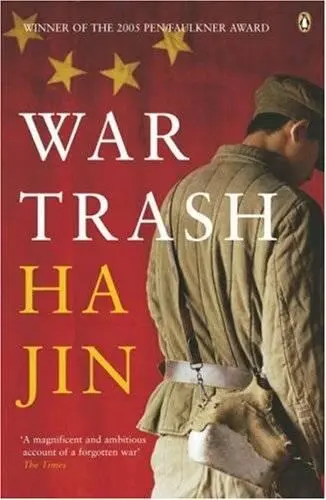
- Название:War Trash
- Автор:
- Жанр:
- Год:неизвестен
- ISBN:нет данных
- Рейтинг книги:5 / 5. Голосов: 1
-
Избранное:Добавить в избранное
- Отзывы:
-
Ваша оценка:
War Trash: краткое содержание, описание и аннотация
Предлагаем к чтению аннотацию, описание, краткое содержание или предисловие (зависит от того, что написал сам автор книги «War Trash»). Если вы не нашли необходимую информацию о книге — напишите в комментариях, мы постараемся отыскать её.
Jin (Waiting; The Crazed; etc.) applies his steady gaze and stripped-bare storytelling to the violence and horrifying political uncertainty of the Korean War in this brave, complex and politically timely work, the story of a reluctant soldier trying to survive a POW camp and reunite with his family. Armed with reams of research, the National Book Award winner aims to give readers a tale that is as much historical record as examination of personal struggle. After his division is decimated by superior American forces, Chinese "volunteer" Yu Yuan, an English-speaking clerical officer with a largely pragmatic loyalty to the Communists, rejects revolutionary martyrdom and submits to capture. In the POW camp, his ability to communicate with the Americans thrusts him to the center of a disturbingly bloody power struggle between two factions of Chinese prisoners: the pro-Nationalists, led in part by the sadistic Liu Tai-an, who publicly guts and dissects one of his enemies; and the pro-Communists, commanded by the coldly manipulative Pei Shan, who wants to use Yu to save his own political skin. An unofficial fighter in a foreign war, shameful in the eyes of his own government for his failure to die, Yu can only stand and watch as his dreams of seeing his mother and fiancée again are eviscerated in what increasingly looks like a meaningless conflict. The parallels with America 's current war on terrorism are obvious, but Jin, himself an ex-soldier, is not trying to make a political statement. His gaze is unfiltered, camera-like, and the images he records are all the more powerful for their simple honesty. It is one of the enduring frustrations of Jin's work that powerful passages of description are interspersed with somewhat wooden dialogue, but the force of this story, painted with starkly melancholy longing, pulls the reader inexorably along.
From The New Yorker
Ha Jin's new novel is the fictional memoir of a Chinese People's Volunteer, dispatched by his government to fight for the Communist cause in the Korean War. Yu Yuan describes his ordeal after capture, when P.O.W.s in the prison camp have to make a wrenching choice: return to the mainland as disgraced captives, or leave their families and begin new lives in Taiwan. The subject is fascinating, but in execution the novel often seems burdened by voluminous research, and it strains dutifully to illustrate political truisms. In a prologue, Yuan claims to be telling his story in English because it is "the only gift a poor man like me can bequeath his American grandchildren." Ha Jin accurately reproduces the voice of a non-native speaker, but the labored prose is disappointing from an author whose previous work – "Waiting" and " Ocean of Words " – is notable for its vividness and its emotional precision.
War Trash — читать онлайн бесплатно полную книгу (весь текст) целиком
Ниже представлен текст книги, разбитый по страницам. Система сохранения места последней прочитанной страницы, позволяет с удобством читать онлайн бесплатно книгу «War Trash», без необходимости каждый раз заново искать на чём Вы остановились. Поставьте закладку, и сможете в любой момент перейти на страницу, на которой закончили чтение.
Интервал:
Закладка:
"Put that down, you bastard!" the GI roared. Shenning kept running and running. How frightened we were! The armed guards outside the fence might have opened up on him, but luckily they didn't. Instead, they seemed to relish the scene, some smirking and some laughing.
Gradually the husky GI caught up with Shenning, who rolled the flag into a ball and threw it to Wenfu, the skinny orderly. Wenfu in turn pitched it into the opened window of the kitchen; immediately a cook removed a cauldron and spread the flag over a stove, whose flames at once engulfed the fabric. With the shovel the GI began hitting Shenning, who was rolling on the ground but didn't scream.
"Yeah, let him have it good!" yelled Captain Larsen, with both hands on his hips.
We all shouted at the GI, but he wouldn't give up thwacking our man. One blow hit Shenning's face and he stopped moving instantly. Meanwhile, Larsen ordered his men to round up all those who had participated in retaking the flag. Little Hou, Wenfu, the cook, and many others were singled out and forced to leave with their hands clasped on their crowns. The GIs prodded them with bayonets all the way to a truck parked outside the front entrance. They shipped them away to a large pit behind the fuel depot west of the prison camp. Later that evening Shenning was also sent there, directly from the hospital. Altogether they had seized eighteen prisoners.
Our leaders were worried, but mainly about the safety of Little Hou, without whom the camp's communication with Commissar Pei would be disrupted. How could we get him back? They thought hard for a solution, but couldn't find one.
Afternoon darkened into evening at the fuel depot, but the enemy still wouldn't release the detainees. Having eaten nothing, the eighteen men were shaking with cold and huddled together in the pit, which was actually a collapsed bunker. Above it stood more than a dozen GIs, all fully armed. A pair of searchlights formed two long, luminous cones atop the pit throughout the night. The prisoners were soon tired out and some fell asleep. Toward daybreak, the GIs began throwing stones into the pit, and several sleepers were hit and injured. One chunk of cement tile struck the cook in the forehead and opened a cut about two inches long, and blood spurted out. But the prisoners knew the enemy hoped to have a pretext for shooting at them, so they didn't respond to the provocation. Nevertheless, half an hour later, a submachine gun fired at them. A bullet struck Wenfu's head and killed him on the spot. The detainees raised a shirt soaked with blood, which stopped the gunfire.
The lieutenant in charge came over with five GIs and saw the body of our orderly. "Damn, it was so accurate," he muttered, then strode off to call for an ambulance.
A van came twenty minutes later and carried Wenfu's body away, together with four wounded men. The rest of them couldn't leave the pit until late that night. They had been starved for more than thirty hours. Our kitchen cooked millet porridge for them, because in such a state it was dangerous for them to eat solid food right away.
The same thing happened again: Commissar Pei sent his condolences and awards – on Wenfu was conferred the title of Revolutionary Martyr and the first-class merit citation, which was also issued to Shenning, Little Hou, and the cook – Huang Jian. Now that the battalion chief's orderly was gone, Shanmin was chosen for the job. I told my young friend that from now on he should give his cigarettes to Wanren, who could protect him. Wanren was a decent man and had never taken anything more than his own rations, so he might appreciate the extra cigarettes.
I was ambivalent about the attempt to reseize the flag. On the one hand, I admired the courage our men had displayed, and in a way I'd been awestruck by their passion and bravery, which I have to admit I didn't share. On the other, I doubted whether it was worth losing a man's life for the sake of a flag, which, symbolic as it might be, was just a piece of nylon cloth. I had noticed that there was a kind of religious fervor in some of these men, who were capable of laying down their lives for an idea. However silly the idea might be, the act of self-sacrifice made them truly remarkable. Potentially many of them were heroes.
26. KILL!
All the prisoners in our compound were angry at Captain Larsen, believing he was responsible for Wenfu's death and for the injuries inflicted on the other four fellows. Every evening a duty sergeant would assemble us in the front yard to conduct the head count. Sometimes Larsen would do it personally. I don't know how this got started. One evening in early November, after Larsen's count, when he said, "You're dismissed," suddenly dozens of prisoners shouted in Chinese, "Kill!"
Perplexed, Larsen looked around, then grabbed hold of Shanmin, who couldn't make off fast enough, and asked him what they meant. The boy told him to his face, using the few English words I had taught him, "Kill that bad egg."
At once Larsen's face dilated with rage, his nostrils flaring. He stretched out both hands, flapping them toward his chest as though able to embrace the whole yard into his arms. He lifted his voice and ordered us, "Halt! You all come back and form up again!"
Reluctantly we reassembled in front of him. He told us, "We're going to do this one more time. I want you to leave without a peep, got it?"
I translated his order, but nobody responded. A lull set in as two dogs yapped from a straw shack on a hill slope in the southeast, followed by a pair of magpies that cried sleepily from the wild orange grove beyond the fences of barbed wire. In the south the half moon was hardly visible, obscured by billows of rusty clouds. Larsen jerked his neck and announced, "Now you're dismissed."
"Kill!" roared most of the men, then we all started for our living quarters.
"Damn it!" Larsen exploded, throwing up his big hands. "You all come back and line up again." He stamped his foot while the GIs behind him were grinning as if they had been bystanders.
Wordlessly we regrouped before him, but everyone seemed to have brightened up some. Larsen blustered, "I want you to disband quietly. Everybody keep your mouth shut when I let you go. If you don't follow my orders this time, I'll cut your rations for a week."
I told the crowd his warning, but they just stared at him without betraying any emotion. Then I saw a smirk cross Wanren's stubbly face; he seemed at ease, wanting to let this confrontation continue.
"Attention!" Larsen called.
Some of us clicked our heels. The captain coughed, then shouted, "Now you're dismissed."
"Kill!" all the prisoners thundered in one voice.
Larsen turned around and ordered the squad of GIs, "Take a few of them to my office."
His men rushed over, some brandishing pistols, grabbed three inmates, and dragged them away. We hadn't expected he would make arrests indiscriminately. Nor had we thought the GIs carried handguns underneath their jackets; if they had been unarmed, some of us might have charged at them to rescue the three men. Before we recovered from the shock, the GIs had taken the fellows out the front gate, shoving them and prodding their backs with handguns. All the other prisoners could do was call Larsen names, which he didn't understand anyway.
Without delay the heads of the companies gathered at our headquarters to discuss the situation and make plans of action. I was unsure whether it was wise to be so confrontational. No doubt the three detainees were going to suffer for us, so we shouldn't let the hostility escalate. In any event we must prevent Larsen from hurting them. Yet there seemed no way to make the enemy relent if we didn't resort to some kind of pressure or force. Words alone wouldn't be sufficient.
While the leaders were arguing, I sat on an upturned crate listening without expressing my view. The new orderly, Shanmin, was sitting next to me, but he just went on slapping at flies with a self-made swatter, a scrap of perforated leather affixed to the end of a bamboo stick. He had a theory about swatting flies, which, according to him, couldn't take off without shifting position first, so you should strike at them only when they were on the move or rubbing their legs. I saw a black mosquito on his neck working so hard that it looked as if it were standing on its head, so I swatted it. Shanmin was startled, then relaxed, seeing the bloodstain on my palm.
Читать дальшеИнтервал:
Закладка:
Похожие книги на «War Trash»
Представляем Вашему вниманию похожие книги на «War Trash» списком для выбора. Мы отобрали схожую по названию и смыслу литературу в надежде предоставить читателям больше вариантов отыскать новые, интересные, ещё непрочитанные произведения.





Обсуждение, отзывы о книге «War Trash» и просто собственные мнения читателей. Оставьте ваши комментарии, напишите, что Вы думаете о произведении, его смысле или главных героях. Укажите что конкретно понравилось, а что нет, и почему Вы так считаете.