William Gibson - Spook Country
Здесь есть возможность читать онлайн «William Gibson - Spook Country» весь текст электронной книги совершенно бесплатно (целиком полную версию без сокращений). В некоторых случаях можно слушать аудио, скачать через торрент в формате fb2 и присутствует краткое содержание. Город: NEW YORK, Год выпуска: 2007, Издательство: G. P. PUTNAM’S SONS, Жанр: Современная проза, на английском языке. Описание произведения, (предисловие) а так же отзывы посетителей доступны на портале библиотеки ЛибКат.
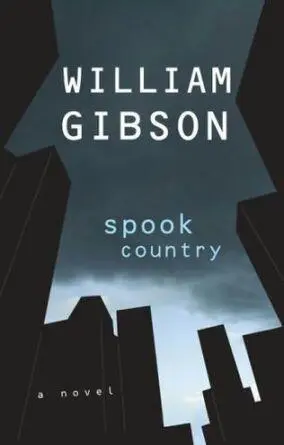
- Название:Spook Country
- Автор:
- Издательство:G. P. PUTNAM’S SONS
- Жанр:
- Год:2007
- Город:NEW YORK
- ISBN:нет данных
- Рейтинг книги:4 / 5. Голосов: 1
-
Избранное:Добавить в избранное
- Отзывы:
-
Ваша оценка:
Spook Country: краткое содержание, описание и аннотация
Предлагаем к чтению аннотацию, описание, краткое содержание или предисловие (зависит от того, что написал сам автор книги «Spook Country»). Если вы не нашли необходимую информацию о книге — напишите в комментариях, мы постараемся отыскать её.
, the challenge of writing about the present-day world drove him to create perhaps his best novel yet, and in
he remains at the top of his game. It's a stripped-down thriller that reads like the best DeLillo (or the best Gibson), with the lives of a half-dozen evocative characters connected by a tightly converging plot and by the general senses of unease and wonder in our networked, post-9/11 time.
Spook Country — читать онлайн бесплатно полную книгу (весь текст) целиком
Ниже представлен текст книги, разбитый по страницам. Система сохранения места последней прочитанной страницы, позволяет с удобством читать онлайн бесплатно книгу «Spook Country», без необходимости каждый раз заново искать на чём Вы остановились. Поставьте закладку, и сможете в любой момент перейти на страницу, на которой закончили чтение.
Интервал:
Закладка:
“Hello,” said Hollis, taking the girl’s hand, “I’m Hollis Henry.”
“Sarah Ferguson.”
Hollis was pulling up a wrought-iron chair, wondering whether she’d missed her chance to have Odile put visiting the local locative artists on hold, when the French curator said, “Fer-gus-son.”
“Oh,” said Hollis.
“Sarah is Bobby’s sister.” Odile was wearing a narrow pair of black-framed sunglasses.
“Yes,” said Sarah, with what Hollis took to be a possible lack of enthusiasm. “Odile tells me you met Bobby in Los Angeles.”
“I did,” said Hollis. “I’m doing a piece on locative art for Node, and your brother seems to be a key player.”
“Node?”
“It’s new,” said Hollis. Could Bigend, or Rausch, have known that Odile knew Bobby’s sister? “I didn’t know he had a sister.” She looked at Odile. “Are you an artist, Sarah?”
“No,” said Sarah, “I work for a gallery. Not this one.”
Hollis looked up at this retrofitted bank or government building. Saw public art, the statue of a ship, mounted where a roof started.
“We must go inside, for the food,” said Odile.
Inside, an upscale cafeteria line that for some reason made Hollis feel they were in Copenhagen. The people ahead of them looked as though they could each identify a dozen classic modern chairs by the designer’s name. They chose sandwiches, salads, and drinks; Hollis used her credit card, telling Sarah lunch was on Node. When she put her wallet back in her purse, she saw the envelope with Jimmy’s five thousand dollars. She’d almost left it in the electronic safe in the room at the Mondrian.
Sarah resembled Bobby, Hollis thought, as they settled at their table, but it looked better on a girl. She had darker hair, nicely cut, and was dressed for work in a gallery that sold art to people who expected a certain seriousness of demeanor. Mixed grays and black, good shoes.
“I had no idea you knew Bobby’s sister,” Hollis said to Odile, picking up her sandwich.
“We’ve only just met,” said Sarah, picking up her fork. “We have an ex in common, it turns out.” She smiled.
“Claude,” said Odile, “in Paris. I told you, Ollis, he knew Bobby.”
“Yes, you did.”
“I phone him,” said Odile. “He gives me Sarah’s number.”
“Not the first call from a stranger I’ve had about Bobby, in the past twenty-four hours,” said Sarah, “but at least there’s the connection through Claude. And you weren’t angry.”
“Have the others been angry?” Hollis asked.
“Some of them, yes. Others simply impatient.”
“Why? If you don’t mind my asking.”
“Because he’s a fuckup,” said Sarah.
“Artists in L.A.,” said Odile. “They try to find Bobby. His geohacks are down. Their art is gone. E-mail bounces.”
“I’ve had half a dozen calls. Someone down there must’ve known he has a sister here, and I’m in the book.”
“I know one of the artists who works with him,” Hollis said. “He was quite upset.”
“Who?”
“Alberto Corrales.”
“Did he cry?”
“No.”
“He cried on the phone,” said Sarah, spearing a slice of avocado. “Kept saying he’d lost his river.”
“But you don’t know where your brother is?”
“He’s here,” said Sarah. “My friend Alice saw him on Commercial Drive, this morning. She’s known him since high school. She called me. As a matter of fact, she called me about twenty minutes before you did,” she said to Odile. “She said hello. He couldn’t dodge her; he knew she knew it was him. Of course she had no idea people in L.A. are looking for him. He told her he was in town to talk with a label, about releasing a CD. Of course that was the first I knew of him being here.”
“Are you close?”
“Does it sound like it?”
“Sorry,” said Hollis.
“No, I’m sorry,” said Sarah. “It’s just that he’s so annoying, so irresponsible. He’s as self-centered now as he was when he was fifteen. It isn’t easy, having a monster of giftedness for a brother.”
“Gifted how?” Hollis asked.
“Mathematically. Software. You know he named himself after a piece of software developed at Lawrence Berkeley National Labs? Chombo.”
“What does Chombo…do?”
“It implements finite difference methods for the solution of partial differential equations, on block-structured, adaptively refined rectangular grids.” Sarah made a brief and probably unconscious face.
“Could you explain that?”
“Not a word of it. But I work in a gallery of contemporary art. Chombo is Bobby’s favorite thing. He says nobody else really appreciates Chombo, understands Chombo, the way he does. He talks about it like it’s a dog, one he’s been able to train to do things no one’s ever thought of training a dog to do. Fetch things. Roll over.” She shrugged. “You’re looking for him too, aren’t you?”
“I am,” said Hollis, putting down her sandwich.
“Why?”
“Because I’m a journalist, and I’m writing about locative art. And he seems to be at the center of it, and certainly he’s at the center of his sudden absence, and the upset it’s caused.”
“You used to be in that band,” said Sarah. “I remember it. With that English guitarist.”
“The Curfew,” Hollis said.
“And you’re a writer, now?”
“I’m trying to be. I thought I’d be in L.A. for a few weeks, researching this. Then Alberto Corrales introduced me to Bobby. Then Bobby vanished.”
“‘Vanished’ is a little dramatic,” said Sarah, “particularly if you know Bobby. ‘Flaked off,’ my father calls it. Would Bobby want to see you, do you think?”
Hollis considered. “No,” she said. “He was unhappy with Alberto for bringing me to his place in L.A. His studio. I didn’t think he’d want to see me again.”
“He liked your records,” said Sarah.
“That was what Alberto said,” said Hollis, “but he really didn’t like visitors.”
“In that case,” said Sarah, and paused, looking from Hollis to Odile, then back, “I’ll tell you where he is.”
“You know?”
“He has a place on the east side. Space in a building that used to be an upholstery factory. Someone lives there, when he’s away, and I run into her occasionally, so I know he still has it. If he’s here, and not there, I’d be very surprised. Off Clark Drive.”
“Clark?”
“I’ll give you the address,” said Sarah.
Hollis got out her pen.
63. SURVIVAL, EVASION, RESISTANCE, AND ESCAPE
T ito watched the old man fold the copy of the New York Times he’d been reading. They were sitting in an open Jeep, its hood dotted with red rust through dull-gray paint that had been applied with a brush. Tito could see the Pacific, this new ocean. The pilot had flown them here from the mainland, and gone, having said a long, private goodbye to the old man. Tito had seen them clasp hands, the grip held hard.
He’d watched the Cessna become a dot, then vanish.
“I remember seeing proofs of a CIA interrogation manual, something we’d been sent unofficially, for comment,” the old man said. “The first chapter laid out the ways in which torture is fundamentally counterproductive to intelligence. The argument had nothing to do with ethics, everything to do with quality of product, with not squandering potential assets.” He removed his steel-rimmed glasses. “If the man who keeps returning to question you avoids behaving as if he were your enemy, you begin to lose your sense of who you are. Gradually, in the crisis of self that your captivity becomes, he guides you in your discovery of who you are becoming.”
“Did you interrogate people?” asked Garreth, the black Pelican case under his feet.
Читать дальшеИнтервал:
Закладка:
Похожие книги на «Spook Country»
Представляем Вашему вниманию похожие книги на «Spook Country» списком для выбора. Мы отобрали схожую по названию и смыслу литературу в надежде предоставить читателям больше вариантов отыскать новые, интересные, ещё непрочитанные произведения.

Обсуждение, отзывы о книге «Spook Country» и просто собственные мнения читателей. Оставьте ваши комментарии, напишите, что Вы думаете о произведении, его смысле или главных героях. Укажите что конкретно понравилось, а что нет, и почему Вы так считаете.