William Gibson - Spook Country
Здесь есть возможность читать онлайн «William Gibson - Spook Country» весь текст электронной книги совершенно бесплатно (целиком полную версию без сокращений). В некоторых случаях можно слушать аудио, скачать через торрент в формате fb2 и присутствует краткое содержание. Город: NEW YORK, Год выпуска: 2007, Издательство: G. P. PUTNAM’S SONS, Жанр: Современная проза, на английском языке. Описание произведения, (предисловие) а так же отзывы посетителей доступны на портале библиотеки ЛибКат.
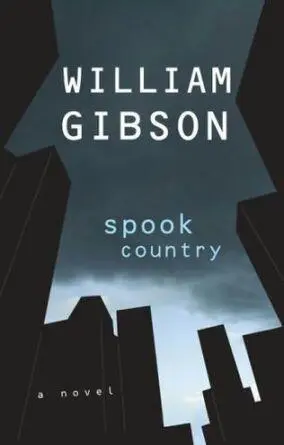
- Название:Spook Country
- Автор:
- Издательство:G. P. PUTNAM’S SONS
- Жанр:
- Год:2007
- Город:NEW YORK
- ISBN:нет данных
- Рейтинг книги:4 / 5. Голосов: 1
-
Избранное:Добавить в избранное
- Отзывы:
-
Ваша оценка:
Spook Country: краткое содержание, описание и аннотация
Предлагаем к чтению аннотацию, описание, краткое содержание или предисловие (зависит от того, что написал сам автор книги «Spook Country»). Если вы не нашли необходимую информацию о книге — напишите в комментариях, мы постараемся отыскать её.
, the challenge of writing about the present-day world drove him to create perhaps his best novel yet, and in
he remains at the top of his game. It's a stripped-down thriller that reads like the best DeLillo (or the best Gibson), with the lives of a half-dozen evocative characters connected by a tightly converging plot and by the general senses of unease and wonder in our networked, post-9/11 time.
Spook Country — читать онлайн бесплатно полную книгу (весь текст) целиком
Ниже представлен текст книги, разбитый по страницам. Система сохранения места последней прочитанной страницы, позволяет с удобством читать онлайн бесплатно книгу «Spook Country», без необходимости каждый раз заново искать на чём Вы остановились. Поставьте закладку, и сможете в любой момент перейти на страницу, на которой закончили чтение.
Интервал:
Закладка:
Odile opted for shotgun, which seemed to please him, and soon they were on their way, something half-remembered scratching fitfully in Hollis’s head. They cruised past large, airport-related buildings, like toys on some giant’s tidy, sparsely detailed hobby layout.
“You’re going to be the fourth-ever residents in our flat,” he said. “The Sultan of Dubai’s public relations team were there, last month. They had their own business here, but wanted to meet with Hubertus, so we put them up there, and Hubertus came up. Before that, twice, we had people in from our London office.”
“It’s not Hubertus’s place, then?”
“I suppose it is,” he said, changing lanes for the approach to a bridge, “but one of many. The view’s extraordinary.”
Hollis saw uncomfortably bright lights on tall poles, beyond the bridge’s railings, overlooking a visual clutter of industry. Her cell rang. “Excuse me,” she said. “Yes?”
“Where are you?” said Inchmale.
“In Vancouver.”
“I, however, am in the lobby of your achingly pretentious hotel.”
“I’m sorry. They sent me up here. I tried to reach you, but your cell wasn’t answering, and your hotel said you were gone.”
“Hotbed of locative art?”
“I don’t know yet. Just got here.”
“Where are you staying?”
“In a flat that Blue Ant has.”
“You should insist on serious hotels.”
“Well,” she said, glancing at Ollie, who was listening to Odile, “I’m told we’ll like it.”
“Is that the royal ‘we’?”
“A curator from Paris, who specializes in locative art. They brought her to Los Angeles for the piece. She’ll be very helpful, up here. Has contacts.”
“When are you back here?”
“I don’t know. Shouldn’t be long. How long are you there?”
“As long as it takes to produce the Bollards. Tomorrow we’re having a first look at the studio.”
“Which one?”
“Place on West Pico. After our time. Much is.”
“Is what?”
“After our time. Why, for instance, are there these types with Star Wars helmets, standing at the foot of the Marmont’s driveway, staring as if transfixed? I saw them earlier, when I checked in.”
“They’re viewing a monument to Helmut Newton. I know the artist, Alberto Corrales.”
“But there’s nothing there.”
“You need the helmet,” she explained.
“Dear God.”
“You’re at the Marmont?”
“I will be, when I’ve gotten back across Sunset.”
“I’ll call you, Reg. I should go.”
“Bye, then.”
Long past the first bridge, and still on the wide street they’d turned onto, they drove through a stretch of carefully styled shops and restaurants. Jimmy Carlyle, who’d spent two years playing bass with a band in Toronto, before joining the Curfew, had told her that Canadian cities looked the way American cities did on television. But American cities didn’t have this many galleries, she decided, after counting five in a few blocks, and then they were on another bridge.
Her phone rang again. “Sorry,” she said. “Hello?”
“Hello,” said Bigend. “Where are you?”
“In the car, with Ollie and Odile, going to your flat.”
“Pamela told me you’d taken her along. Why?”
“She knows someone who knows our friend,” she said. “Speaking of whom, why didn’t you tell me he was Canadian?”
“It didn’t seem important,” said Bigend.
“But now I’m here. Is he here?”
“Not quite. Doing paperwork with a customs broker in Washington State, we’re guessing. GPS matches up to a broker’s address.”
“Still. You know what I told you about being honest with me.”
“Being Canadian,” said Bigend, “even in today’s fraught world, isn’t always the first thing I’d mention about someone. When we were discussing him, initially, I had no idea he’d be headed that way. Later, I suppose it slipped my mind.”
“Do you think he’s bailing out?” She watched their driver.
“No. I think something’s up, up there.”
“What?”
“What the pirates saw,” he said.
They came off the bridge into a sudden low canyon of much more downscale nightlife. She imagined Bobby’s luminous wireframe cargo container suspended above the street, more enigmatic than any neon-skinned giant squid.
“But we’ll find a better way to discuss it, shall we?”
He doesn’t trust phones either, she thought. “Right.”
“Do you have any piercings?” he asked.
They took a right.
“Excuse me?”
“Piercings. If you do, I must warn you about the bed in the master bedroom. The top floor.”
“The bed.”
“Yes. Apparently you don’t want to crawl under it if you have any magnetic bits. Steel, iron. Or a pacemaker. Or a mechanical watch. The designers never mentioned that, when they showed me the plans. It’s entirely about the space underneath, visually. Magnetic levitation. But now I have to warn each guest in turn. Sorry.”
“I’m entirely as God made me, so far,” she told him. “And I don’t wear a watch.”
“Not to worry, then,” he said, cheerfully.
“I think we’re here,” she told them, as Ollie turned off a street where everything seemed to have been built the week before.
“Very good,” he said, and hung up.
The Volkswagen rolled down a ramp as a gate rose. They entered a parking garage, brilliantly lit with sun-toned halogens above a pale, glassy concrete floor devoid of the least oil stain. The car’s tires squeaked as Ollie pulled in beside another oversized Volkswagen in pearly white.
When she got out, she could smell the fresh concrete.
They got their things out of the truck and Ollie gave them each a pair of white unmarked magstrip cards. “This one’s for the elevator,” he said, taking Hollis’s and swiping it beside doors of brushed stainless, “and access to the penthouse levels.” Inside, he swiped it again, and they rose, swiftly and silently.
“I suppose I don’t want to get this under the bed,” Hollis said, visibly puzzling Odile, as he handed it back to her.
“No,” he said, as the elevator stopped and its doors opened, “nor your credit cards.”
They followed him along a short, carpeted hallway that a van could have been driven through. “Use the other card,” he told her. She shifted the carton to her left arm and swiped the second card. He opened the very large ebony door, which she saw was a good four inches thick, and they stepped into a space that might have been the central concourse in the national airport of some tiny, hyperwealthy European nation, a pocket Liechtenstein founded on the manufacture of the most expensive minimalist light fixtures ever made.
“The flat,” she said, looking up.
“Yes indeed,” said Ollie Sleight.
Odile dropped her bag and started walking toward a curtain of glass wider than an old-fashioned theater screen. Uprights broke the view at intervals of fifteen feet or so. Beyond it, from where Hollis stood, there was only an undifferentiated gray-pink glow, with a few distant points of red light.
“Formidable,” exclaimed Odile.
“Good, isn’t it?” He turned to Hollis. “You’re in the master bedroom. I’ll show you.” He took the carton, and led her up two flights of giddily suspended stairs, each tread a two-inch slab of frosted glass.
Bigend’s bed was a perfect black square, ten feet on a side, floating three feet above the ebony floor. She walked over to it and saw that it was tethered, against whatever force supported it, with thin, braided cables of black metal.
“I think I might make something up on the floor,” she said.
“Everyone says that,” he said. “Then they try it.”
Читать дальшеИнтервал:
Закладка:
Похожие книги на «Spook Country»
Представляем Вашему вниманию похожие книги на «Spook Country» списком для выбора. Мы отобрали схожую по названию и смыслу литературу в надежде предоставить читателям больше вариантов отыскать новые, интересные, ещё непрочитанные произведения.



Обсуждение, отзывы о книге «Spook Country» и просто собственные мнения читателей. Оставьте ваши комментарии, напишите, что Вы думаете о произведении, его смысле или главных героях. Укажите что конкретно понравилось, а что нет, и почему Вы так считаете.