William Gibson - Spook Country
Здесь есть возможность читать онлайн «William Gibson - Spook Country» весь текст электронной книги совершенно бесплатно (целиком полную версию без сокращений). В некоторых случаях можно слушать аудио, скачать через торрент в формате fb2 и присутствует краткое содержание. Город: NEW YORK, Год выпуска: 2007, Издательство: G. P. PUTNAM’S SONS, Жанр: Современная проза, на английском языке. Описание произведения, (предисловие) а так же отзывы посетителей доступны на портале библиотеки ЛибКат.
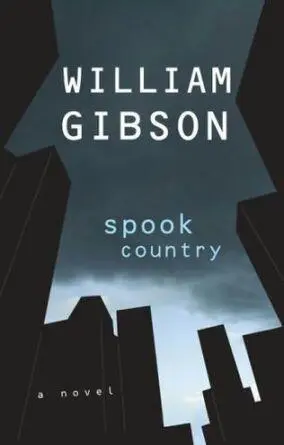
- Название:Spook Country
- Автор:
- Издательство:G. P. PUTNAM’S SONS
- Жанр:
- Год:2007
- Город:NEW YORK
- ISBN:нет данных
- Рейтинг книги:4 / 5. Голосов: 1
-
Избранное:Добавить в избранное
- Отзывы:
-
Ваша оценка:
Spook Country: краткое содержание, описание и аннотация
Предлагаем к чтению аннотацию, описание, краткое содержание или предисловие (зависит от того, что написал сам автор книги «Spook Country»). Если вы не нашли необходимую информацию о книге — напишите в комментариях, мы постараемся отыскать её.
, the challenge of writing about the present-day world drove him to create perhaps his best novel yet, and in
he remains at the top of his game. It's a stripped-down thriller that reads like the best DeLillo (or the best Gibson), with the lives of a half-dozen evocative characters connected by a tightly converging plot and by the general senses of unease and wonder in our networked, post-9/11 time.
Spook Country — читать онлайн бесплатно полную книгу (весь текст) целиком
Ниже представлен текст книги, разбитый по страницам. Система сохранения места последней прочитанной страницы, позволяет с удобством читать онлайн бесплатно книгу «Spook Country», без необходимости каждый раз заново искать на чём Вы остановились. Поставьте закладку, и сможете в любой момент перейти на страницу, на которой закончили чтение.
Интервал:
Закладка:
Though his eyes were closed, he knew that Brown had just now come to the connecting door, which stood open.
“A nation,” he heard himself say, “consists of its laws. A nation does not consist of its situation at a given time. If an individual’s morals are situational, that individual is without morals. If a nation’s laws are situational, that nation has no laws, and soon isn’t a nation.” He opened his eyes and confirmed Brown there, his partially disassembled pistol in his hand. The cleaning, lubrication, and examination of the gun’s inner workings was ritual, conducted every few nights, though as far as Milgrim knew, Brown hadn’t fired the gun since they’d been together.
“What did you say?”
“Are you really so scared of terrorists that you’ll dismantle the structures that made America what it is?” Milgrim heard himself ask this with a sense of deep wonder. He was saying these things without consciously having thought them, or at least not in such succinct terms, and they seemed inarguable.
“The fuck—”
“If you are, you let the terrorist win. Because that is exactly, specifically, his goal, his only goal: to frighten you into surrendering the rule of law. That’s why they call him ‘terrorist.’ He uses terrifying threats to induce you to degrade your own society.”
Brown opened his mouth. Closed it.
“It’s based on the same glitch in human psychology that allows people to believe they can win the lottery. Statistically, almost nobody ever wins the lottery. Statistically, terrorist attacks almost never happen.”
There was a look on Brown’s face that Milgrim hadn’t seen there before. Now Brown tossed a fresh bubble-pack down on the bedspread.
“Good night,” Milgrim heard himself say, still insulated by the silver membrane.
Brown turned, walking silently back into his own room in his stocking feet, the partial pistol in his hand.
Milgrim raised his right arm toward the ceiling, straight up, index finger extended and thumb cocked. He brought the thumb down, firing an imaginary shot, then lowered his arm, having no idea at all what to make of whatever it was that had just happened.
30. FOOTPRINT
S he drove to Malibu with the Blue Ant helmet in its carton beside her. It was sunny through Beverly Hills, but by the time she reached the sea something monochrome and saline had insinuated itself.
She went to Gladstone’s, took the carton in with her, and stood it on the massive timber bench opposite her own, while she topped up her hyper-healthy hotel breakfast with a small chowder and a large Coke. The light on the beach was like a sinus headache.
Things were different today, she assured herself. She was working for Node, and her expenses would be covered. She had decided to look at it that way, and not think of herself as Bigend’s employee, or Blue Ant’s. There had, after all, been no real change in her formal situation; she was a freelancer, on assignment to Node to write seven thousand words on locative computing and the arts. That was the situation today and she could deal with it. The Bigend version, she was less certain of. Pirates, their boats, CIA maritime units, tramp freighters, the traffic in and hunt for weapons of mass destruction, a shipping container that spoke to Bobby Chombo—she wasn’t certain of any of that.
As she was paying, she remembered Jimmy’s money, back at the Mondrian, locked in the little keypad safe in her room, coded to open on “CARLYLE.” She didn’t know what else to do with it. Inchmale said he could tell her whether any of it was counterfeit. She’d take him up on that, she thought, then go on from there.
The thought of seeing him again woke an old ambivalence. While it had never been true, as the magazines had often had it, that she and Inchmale had been a couple, in any carnal or otherwise ordinary sense, they had nonetheless been married in some profound if sexless way; co-creatives, the live wires of the Curfew, held down and variously together by Jimmy and Heidi. She was grateful, ordinarily, to whatever fates might be, for Inchmale having found the excellent Angelina and Argentina, thereby to be translated, for the most part, out of her world. It was better that way for everyone, though she’d have had a hard time explaining that to anyone other than Inchmale. And Inchmale, never blind to the background radiation of his own singularity, would have been all too ready to agree.
When she got back to the car, she put the carton on the unopened trunk and got the helmet out, fumbling with the unfamiliar controls. She put the thing on, curious as to whether anyone had been locatively creative in the immediate vicinity.
A cartoonishly smooth Statue of Liberty hand, holding a torch a good three stories high, loomed above her, blotting out the hurtful glow of the salt-metal sky. Its wrist, emerging from the Malibu sand, would’ve had roughly the footprint of a basketball court. It was far bigger than the real thing, it was blatant copying to have it emerging from the beach this way, and still it managed to be more melancholy than ridiculous. Would it all be like this, in Alberto’s new world of the locative? Would it mean that the untagged, unscripted world would gradually fill with virtual things, as beautiful or ugly or banal as anything one encountered on the web already? Was there any reason to expect it to be any better than that, any worse? The Liberty hand and its torch looked as though they had been cast from the stuff they made beige Tupperware out of. She remembered how Alberto had described his labors in the creation of skins, textures. She remembered the microskirted Aztec princesses on his Volkswagen. She wondered where the wifi for this piece was coming from.
She took the helmet off and put it back in its carton.
Driving back, as the sun gradually found its way out again, she decided to try to find Bobby’s factory, if only to put him on her map in a different way. It shouldn’t be hard. Her body, she was finding, remembered Los Angeles much more thoroughly than her head did.
Eventually she found herself back on Romaine, looking for the turn Alberto had taken. For those white-painted walls. She found it, turned, and saw something big and bright and whiter still, just pulling away. She slowed, pulled over. Watched the long white truck turn, swinging right, out of sight at the far corner. She didn’t know trucks, but she guessed this one was as long as they got without having the back end become a separate trailer. But big enough to move the contents of a two-bedroom house. Unmarked, shiny, white. And gone.
“Shit,” she said, pulling up where Alberto had pulled up. She could see the green-painted metal door they’d entered through. She didn’t like the diagonal of shadow across it now. The sun was high, and that diagonal meant the door was open, three inches or more. For the first time she saw the long, white-painted, horizontally corrugated doors of a loading bay. Back a truck up to that and take out anything you wanted.
She popped the trunk, getting out with her PowerBook over her shoulder and the carton in her arms. She put these in the trunk and closed it, retrieved her purse, clicked the transponder to lock the car, then squared her shoulders and walked over to the green door. As she’d assumed, it was standing open a few inches. On darkness, she decided, tipping her head to squint inside, over her sunglasses.
She dug through the smaller objects at the bottom of her purse, coming up with a flat little LED-light on a key ring whose only keys were for a commercial mailbox she no longer rented, and for a Club to secure a car she no longer owned. She squeezed the light between thumb and forefinger, expecting its battery to be dead, but no, it was working. Feeling stupid, she gave the green door a rap, hurting her knuckles. It was heavy, and didn’t move when knocked on. “Bobby? Hello? It’s Hollis Henry, Bobby…” She put her left hand flat on the door and pushed. It swung smoothly, but very slowly. With the LED in her right hand, she pulled off her sunglasses with the other and stepped into darkness.
Читать дальшеИнтервал:
Закладка:
Похожие книги на «Spook Country»
Представляем Вашему вниманию похожие книги на «Spook Country» списком для выбора. Мы отобрали схожую по названию и смыслу литературу в надежде предоставить читателям больше вариантов отыскать новые, интересные, ещё непрочитанные произведения.

Обсуждение, отзывы о книге «Spook Country» и просто собственные мнения читателей. Оставьте ваши комментарии, напишите, что Вы думаете о произведении, его смысле или главных героях. Укажите что конкретно понравилось, а что нет, и почему Вы так считаете.