Iain Banks - Walking on Glass
Здесь есть возможность читать онлайн «Iain Banks - Walking on Glass» весь текст электронной книги совершенно бесплатно (целиком полную версию без сокращений). В некоторых случаях можно слушать аудио, скачать через торрент в формате fb2 и присутствует краткое содержание. Год выпуска: 1985, ISBN: 1985, Издательство: ABACUS FICTION, Жанр: Современная проза, на английском языке. Описание произведения, (предисловие) а так же отзывы посетителей доступны на портале библиотеки ЛибКат.
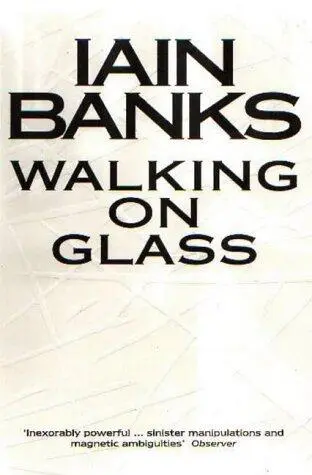
- Название:Walking on Glass
- Автор:
- Издательство:ABACUS FICTION
- Жанр:
- Год:1985
- ISBN:0-349-10178-7
- Рейтинг книги:4 / 5. Голосов: 1
-
Избранное:Добавить в избранное
- Отзывы:
-
Ваша оценка:
Walking on Glass: краткое содержание, описание и аннотация
Предлагаем к чтению аннотацию, описание, краткое содержание или предисловие (зависит от того, что написал сам автор книги «Walking on Glass»). Если вы не нашли необходимую информацию о книге — напишите в комментариях, мы постараемся отыскать её.
Park, Grout, Quiss - no trio could be further apart. But their separate courses are set for collision...
"A feast of horrors, variously spiced with incest, conspiracy, and cheerful descriptions of torture... fine writing" The Times
"The author's powerful imagination is displayed again here every bit as vividly as in his debut" Financial Times
"Establishes beyond doubt that lain Banks is a novelist of remarkable talents" Daily Telegraph
Walking on Glass — читать онлайн бесплатно полную книгу (весь текст) целиком
Ниже представлен текст книги, разбитый по страницам. Система сохранения места последней прочитанной страницы, позволяет с удобством читать онлайн бесплатно книгу «Walking on Glass», без необходимости каждый раз заново искать на чём Вы остановились. Поставьте закладку, и сможете в любой момент перейти на страницу, на которой закончили чтение.
Интервал:
Закладка:
As far as Quiss could make out in the grey gloom, from the vats large overhead buckets scooped up grey, viscous fluid, which was poured into moulds on conveyor belts which disappeared into long, hissing machines; at the far end of the machines the moulds were stripped off the grey sculptures which were then minion-handled or trolleyed to another conveyor belt which led into the pounding machine in the centre of the room...
"What in hell's name is this ?" Quiss said incredulously, choking on the dust.
"This is dee pee," the attendant said primly, standing in front of him, arms folded. "This is the nerve centre of the entire castle. Without us, the whole place would simply grind to a halt." It sounded proud.
"Are you sure?" Quiss said, coughing. The minion stiffened.
"Have you any other questions?" it said coldly. Quiss was looking at the objects which he thought of as sculptures as they moved steadily along the conveyor belt to their destruction. They were funny shapes: 5, 9, 2, 3,4...
"Yes," he said, pointing at the shapes, "what are those meant to be?"
"Those are ," the attendant said pointedly, "numbers."
"Don't look like numbers to me," Quiss said.
"Well, they are," the minion said impatiently. That's the whole point."
"The whole point of what ?" Quiss said, laughing and choking in almost equal parts. He could see he was annoying the small minion, and thought this was good fun. He'd certainly never seen numbers that shape before, but of course they could easily be numbers in some alien language or system. Ajayi might even have recognised them.
"The whole point of what we're doing here," the attendant said, as though trying to be more patient than it really felt. "This is the number-crunching room. Those are numbers," it said, enunciating clearly as though for some small and wilfully obtuse child, and motioning behind it to the conveyor belt with one arm, "and this is where we crunch them. That machine is a number-cruncher ."
"You're crazy," Quiss said into the fur over his mouth.
"What?" the attendant said, stiffening still further and then jolting forward, drawing itself up to its full - if still modest - height. Quiss coughed.
"Nothing. What do you make the numbers out of? What's that grey stuff?"
"Plaster of Salt Lake City," the minion said, as though only an idiot would ask such a question. Quiss frowned.
"What the hell's that?"
"It's like Plaster of Paris, except duller," the minion said, then turned and stamped off through the drifts of grey powder. Quiss shook his head, coughed, then let the plastic doors swing to.
Ajayi was still looking at the board and her two remaining tiles, staring from one to the other. Then she put her elbows on her knees, her chin in her hands, and closed her eyes, looking thoughtful.
The snow collected in the thin grey hairs of her head, but she still did not notice it was snowing. Her expression of concentration intensified. They were nearly finished.
Chinese Scrabble was played on a gridded board, a little like an infinitely small square section of the Go board they had played on hundreds of days ago, but in Chinese Scrabble one placed small tiles with pictograms on them into the squares formed by the grid of lines, not small stones on the interstices. They hadn't needed to come up with any complicated things like infinitely long pieces this time, but the problem had been the choice of pictograms they had been saddled with at the start of the game. Apart from anything else, they had had to learn a language called Chinese.
That alone had taken them over seven hundred days. Quiss had nearly given in several times, but Ajayi kept him going somehow; the new language excited her. It was a key, she said. Now she read even more.
Ajayi opened her eyes and studied the board again.
The meanings and possibilities of the pictograms in front of her filled her mind as she tried to fit the last two tiles somewhere into the network of skewed pathways she and Quiss had created on the small board.
Chinese was a difficult language, even more difficult than the one she had started studying, the one called English, but they were both worth all the effort. They were even worth the effort of having to drag Quiss along the same educative road. She had helped and cajoled and prompted and shouted and insulted until he could get by in the language they had to play the game in, and even once he had just about grasped the basics she still had to keep helping him along; she'd been able to work out roughly what tiles he still had on his side as the game had entered its final, most difficult, stage, and had deliberately left him easy openings so that his imperfect grasp of the language would not prevent him getting rid of the last of his tiles. The result was that now she was stuck, unable to see where she could put the last two pictograms she had left. If she couldn't place them somewhere, make one or two or more new meanings, they would have to start again. The next game wouldn't take as long as this one, which had lasted thirty days so far, but she was worried that Quiss would get impatient. He had already grumbled several times that she hadn't taught him the language properly.
But the language had been a marvellous, magical gift for her. To enable them to play the game properly, they of course had to understand Chinese, a language from the castle's Subject place, the still un-named planet all the books appeared to originate from. The seneschal had therefore provided them with a dictionary which gave Chinese pictograms and their equivalent in one of the languages common to both sides in the Therapeutic Wars, an ancient, long-deciphered battle-code so elegant its utility as a language had ensured its survival after its secrecy had evaporated.
With that key Ajayi could unlock any of the languages original to the un-named globe. It had taken her only a few days to find a Chinese-English dictionary, and after that she could read the books she found far more easily. She learned Chinese, for the game, and English, for her own reading, alongside each other, becoming relatively fluent in the Indo-European system long before the more tricky Oriental tongue.
It had been as if the whole, massive crumbling ruin of the castle suddenly became transparent; now there were so many more books she could find and take and read and enjoy; a whole culture and entire civilisation was spread out before her, for her to study as she wished. She was already learning French, German, Russian and Latin. Soon Greek, and from the Latin, Italian shouldn't be too big a step (her English was already helping her with the ancient Roman language). The castle was no longer the prison it had seemed before; it was a library, a museum of literature, of literacy, of language. The only thing which still worried her was that she could not find any way to translate the markings on the slates. Those cryptic, buried symbols still meant nothing. She had scoured wall after wall of books but never found a single mention of the strange, simple markings somehow etched inside the grained rock.
But that was a small worry in comparison to the immense satisfaction she felt with her discovery of the key to the castle's original tongues. She had started methodically to read all the classics of the un-named planet's past, having discovered long before a book which acted as a guide to the literature of that world. Apart from the occasional foray further forward in time - to whet her appetite - she was being quite strict with herself in keeping to a chronological exploration of the books she had discovered and stored in her rooms. She was now, at the end of this first and - she hoped - last game of Chinese Scrabble, just starting the age of the Elizabethan dramatists in England, and was already starting to get excited about reading Shakespeare, desperately hoping he hadn't been over-praised in the later critical works she had already encountered.
Читать дальшеИнтервал:
Закладка:
Похожие книги на «Walking on Glass»
Представляем Вашему вниманию похожие книги на «Walking on Glass» списком для выбора. Мы отобрали схожую по названию и смыслу литературу в надежде предоставить читателям больше вариантов отыскать новые, интересные, ещё непрочитанные произведения.


Обсуждение, отзывы о книге «Walking on Glass» и просто собственные мнения читателей. Оставьте ваши комментарии, напишите, что Вы думаете о произведении, его смысле или главных героях. Укажите что конкретно понравилось, а что нет, и почему Вы так считаете.