Iain Banks - Walking on Glass
Здесь есть возможность читать онлайн «Iain Banks - Walking on Glass» весь текст электронной книги совершенно бесплатно (целиком полную версию без сокращений). В некоторых случаях можно слушать аудио, скачать через торрент в формате fb2 и присутствует краткое содержание. Год выпуска: 1985, ISBN: 1985, Издательство: ABACUS FICTION, Жанр: Современная проза, на английском языке. Описание произведения, (предисловие) а так же отзывы посетителей доступны на портале библиотеки ЛибКат.
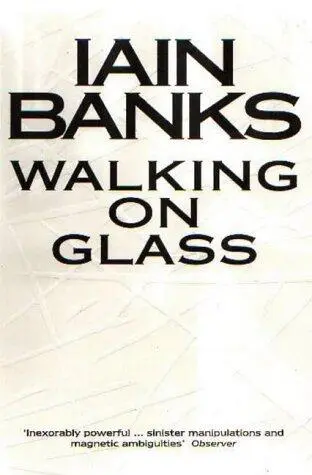
- Название:Walking on Glass
- Автор:
- Издательство:ABACUS FICTION
- Жанр:
- Год:1985
- ISBN:0-349-10178-7
- Рейтинг книги:4 / 5. Голосов: 1
-
Избранное:Добавить в избранное
- Отзывы:
-
Ваша оценка:
Walking on Glass: краткое содержание, описание и аннотация
Предлагаем к чтению аннотацию, описание, краткое содержание или предисловие (зависит от того, что написал сам автор книги «Walking on Glass»). Если вы не нашли необходимую информацию о книге — напишите в комментариях, мы постараемся отыскать её.
Park, Grout, Quiss - no trio could be further apart. But their separate courses are set for collision...
"A feast of horrors, variously spiced with incest, conspiracy, and cheerful descriptions of torture... fine writing" The Times
"The author's powerful imagination is displayed again here every bit as vividly as in his debut" Financial Times
"Establishes beyond doubt that lain Banks is a novelist of remarkable talents" Daily Telegraph
Walking on Glass — читать онлайн бесплатно полную книгу (весь текст) целиком
Ниже представлен текст книги, разбитый по страницам. Система сохранения места последней прочитанной страницы, позволяет с удобством читать онлайн бесплатно книгу «Walking on Glass», без необходимости каждый раз заново искать на чём Вы остановились. Поставьте закладку, и сможете в любой момент перейти на страницу, на которой закончили чтение.
Интервал:
Закладка:
"You lookin" for yer frand, muster?" My God! This one was Irish! Where were all the English people? Why didn't they send some of this lot back where they came from?
"Yes, I am looking for my friend," Steven said coldly, carefully. The Irishman nodded towards the apex of the small triangle of park, towards the bus-stops on the far, north-bound side of Upper Street.
"He wen" up that way. Took all yur stuff," the Irishman said.
Grout was puzzled. "Why? When?" He scratched his head again.
The Irishman shook his head. "I dunno, muster. He just up "an wen" as soon as you wen" down to the toilets; I thought you'd had an argument or somethin', so I did."
"But my hat..." Grout said, still unable to fathom why Mr Sharpe would do such a thing.
"That blue thing?" the Irish tramp said. "He put that in huz bag."
"I don't..." Grout said, his voice trailing off as he walked slowly up in the direction the Irishman had pointed.
He left the small park, waited for the traffic to clear, then crossed the road, over to the other side of Upper Street, keeping down by the roadside rather than going up the stepped curb onto the raised section of pavement, because he was afraid of things falling off buildings and he didn't have his hat. A horrible knotted feeling, a pain, started to eat at his guts; he felt the way he had in the home, when all the children he'd befriended were adopted or sent away, and he wasn't; the way he had when he got lost down by the sea at Bournemouth, on an outing. This can't happen to me, not on my birthday, he kept thinking. Not on my birthday.
He went down the side of the street, round the parked cars nose-in to the slanted curb, down to the bus-stops, looking all the time for Mr Sharpe. For some reason he kept thinking that Mr Sharpe would be wearing the blue hat, and he found himself looking for that all the time instead of Mr Sharpe, who, he now realised, he probably couldn't have described very well if a policeman had asked him to. He wandered down, the terrible feeling growing in his guts like a live thing, wringing him, squeezing him. People mobbed about him, on the pavement, by the bus-stops, down ramps and out of buses; blacks and whites and Asians, men and women, people with shopping trolleys or bags of tools, women with children in push-chairs or dragged along from one hand.
Older children ran by, screaming and shouting. People ate hamburgers from polystyrene boxes, chips from bags, they carried shopping or parcels, they were old and young and fat and thin and tall and little, dull and gaudy; he started to feel dizzy, as though the alcohol or the sultry air was dissolving him, as though the pain inside was wringing him out like a wet towel, twisted and squeezed. He staggered, pushed past people, looking for the blue helmet. He could feel himself being dissolved, his identity sapped from him, lost in this siege of faces. He got to the side of the curb, made sure there were no buses coming, then stepped out on to the in-set bus lane, turned round and started to head back the way he had come, further out from the crowd now, staggering and swaying his way back. He looked over his shoulder, but there were still no buses coming, ready to swing into the bus-stop lane and crush him, only traffic from the lights further down charging up the street, engines roaring. He heard a bike engine, revving, coughing. He kept going, heading back for the park; maybe Mr Sharpe would have come back. The holes he had repaired were around about here...
Rough, screaming engine noises shouted at him. He ignored them. A bike engine, spluttering, a diesel engine, revving. He felt suddenly dizzy and disoriented for a moment, filled both with a sudden panic and an unsteadying conviction he had been here before, seen this all before. He glanced up at the sky for a second, and felt himself stagger. His head cleared and he did not fall into the stream of traffic, but it had been close. He heard a great thundering noise then, a noise like a car hitting something, but probably just the sound empty lorries or trucks make when they go over those speed-ramp things, or holes in the road, too fast. He turned round slowly, still feeling strange, to see if it was one of the holes Dan Ashton and the squad had done. He bet it was.
A woman screamed from the pavement.
He looked up again, into the blue, blue sky, and saw something sailing out of it, like a reflection sliding over a globed, shiny blue surface.
A spinning cylinder.
A bike and a flat-bed truck flashed by on one side. He stood, transfixed, thinking; my hat... my hat...
The tumbling aluminium beer barrel hit him right on the top of his head.
CHINESE SCRABBLE
They sat, covered in their furs, in a small open area near the summit of the Castle of Bequest.
A few decrepit towers and decaying fractions of floors with rooms and chambers rose into the shining grey sky to one side of them, but most of the apartments were empty and useless, only good for rookeries. Stones, great slabs of slate, lay tumbled all around the small cleared area where they sat. A few stunted trees and bushes, little more than overgrown weeds, poked out from the mass of fallen, fractured masonry. Ruins of arches and columns lay about them, and while they played Chinese Scrabble, it started to snow.
Quiss looked up slowly, in surprise. He couldn't recall it snowing for... a long time. He blew some of the small, dry flakes off the surface of the board. Ajayi hadn't even noticed; she was still studying the two small remaining plastic tiles balanced on the little bit of wood in front of her. They were very nearly finished.
Nearby, perched on a pitted, flaking column, the red crow sat, puffing on the green stump of a fat cigar. It had taken up smoking at about the same time they had started playing Chinese Scrabble. "I can see this is going to take some time," it had said. "I'd better find some other interests. Maybe I can contract lung cancer."
Quiss had asked it, casually, where it got the good cigars from. He should have known better, he told himself later: Tuck off," the red crow had said.
"I liked that other game you played," the red crow announced suddenly, between puffs, from the column. Quiss didn't deign to look at it. The red crow balanced on one leg and took the short stump of the cigar out of its beak with the other foot. It looked pensively at the glowing end of the cigar. A flake of the quietly falling snow landed on it and hissed. The red crow cocked its head, looking up accusingly at the sky, then went on, stuffing the cigar back into its beak (so that its words came out oddly distorted). "Yes, that Open-Plan Go was all right. I liked that board, the way it seemed to stretch for ever in all directions. You two looked proper twats, I can tell you, standing in the middle of an infinite board, cut off at the waist. Real dickheads you looked. Those dominoes were just stupid. Even this is pretty boring. Why don't you just admit defeat? You aren't going to get the answer. Throw yourself off the edge over there. Doesn't take a second. Dammit, at your age you'll probably die of shock before you hit the fucking ground."
"Hmm," Ajayi said, and Quiss wondered if she had been listening to the bird. But she was still frowning deeply at the tiles on her little ledge of wood. Talking to them, or herself.
In a few days, if Quiss had counted correctly, they would have been together in the castle for two thousand days. Of course, he recalled proudly, he had been there longer than she had.
It was good, counting up the days, working out the anniversaries so that they could celebrate them. He had started working them out in different number-bases. Base five, base six, seven, eight, of course, nine, ten, twelve and sixteen. So two thousand days would be a quadruple celebration, as it was divisible by five and eight and ten and sixteen. It was just a pity Ajayi didn't share this enthusiasm.
Читать дальшеИнтервал:
Закладка:
Похожие книги на «Walking on Glass»
Представляем Вашему вниманию похожие книги на «Walking on Glass» списком для выбора. Мы отобрали схожую по названию и смыслу литературу в надежде предоставить читателям больше вариантов отыскать новые, интересные, ещё непрочитанные произведения.

Обсуждение, отзывы о книге «Walking on Glass» и просто собственные мнения читателей. Оставьте ваши комментарии, напишите, что Вы думаете о произведении, его смысле или главных героях. Укажите что конкретно понравилось, а что нет, и почему Вы так считаете.