Marina Lewycka - Two Caravans
Здесь есть возможность читать онлайн «Marina Lewycka - Two Caravans» весь текст электронной книги совершенно бесплатно (целиком полную версию без сокращений). В некоторых случаях можно слушать аудио, скачать через торрент в формате fb2 и присутствует краткое содержание. Жанр: Современная проза, на английском языке. Описание произведения, (предисловие) а так же отзывы посетителей доступны на портале библиотеки ЛибКат.
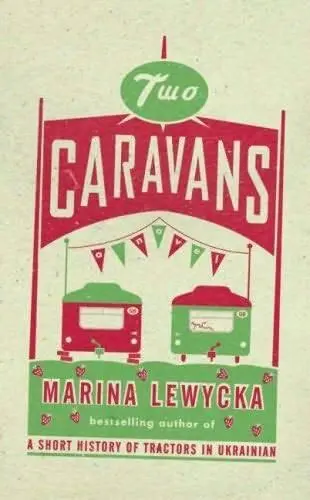
- Название:Two Caravans
- Автор:
- Жанр:
- Год:неизвестен
- ISBN:нет данных
- Рейтинг книги:3 / 5. Голосов: 1
-
Избранное:Добавить в избранное
- Отзывы:
-
Ваша оценка:
Two Caravans: краткое содержание, описание и аннотация
Предлагаем к чтению аннотацию, описание, краткое содержание или предисловие (зависит от того, что написал сам автор книги «Two Caravans»). Если вы не нашли необходимую информацию о книге — напишите в комментариях, мы постараемся отыскать её.
Somewhere in the heart of the green and pleasant land called England is a valley filled with strawberries. A group of migrant workers, who hail from Eastern Europe, China, and Africa have come here to harvest them for delivery to British supermarkets, and end up living in two small trailer homes, a men’s trailer and a woman’s trailer. They are all seeking a better life (and in their different ways they are also, of course, looking for love) and they’ve come to England, some legally, some illegally, to find it. They are supervised-some would say exploited-by Farmer Leaping, a red-faced Englishman who treats everyone equally except for the Polish woman named Yola, the boss of the crew, who favors him with her charms in exchange for something a little extra on the side. But the two are discreet, and all is harmonious in this cozy vale-until the evening when Farmer Leaping’s wife comes upon him and Yola and does what any woman would do in this situation: She runs him down in her red sports car. By the time the police arrive the migrant workers have piled into one of the trailer homes and hightailed it out of their little arcadia, thus setting off one of the most enchanting, merry, and moving picaresque journeys across the length and breadth of England since Chaucer’s pilgrims set off to Canterbury.
Along the way, the workers’ fantasies about England keep rudely bumping into the ignominious, brutal, and sometimes dangerous realities of life on the margins for Ĺ˝migrĹ˝s in the new globalized labor market. Some of them meet terrible ends, some give up and go back home, but for those who manage to hang in for the full course of this madcap ride, the rewards-like the strawberries-prove awfully sweet-especially for the young Ukrainians from opposite sides of the tracks, Andriy and Irina, whose initial mutual irritation blossoms into love.
Two Caravans — читать онлайн бесплатно полную книгу (весь текст) целиком
Ниже представлен текст книги, разбитый по страницам. Система сохранения места последней прочитанной страницы, позволяет с удобством читать онлайн бесплатно книгу «Two Caravans», без необходимости каждый раз заново искать на чём Вы остановились. Поставьте закладку, и сможете в любой момент перейти на страницу, на которой закончили чтение.
Интервал:
Закладка:
Although it was early morning the sun was already hot, and the air had a bad smell of burning oil and warm asphalt. Despite the torrent of cars, it was almost an hour before one stopped to give us a lift. The driver was an old man, almost bald, with thick-lensed glasses. His car was also very old, with patches of rust on the doors. The seat cushions were squares of foam with raggy knitted covers. I could see the disappointment on Andriy’s face.
It didn’t take us long to realise that his driving was very strange. He kept swerving from lane to lane, overtaking on either side. When he accelerated, his car groaned and juddered as though the wheels were coming off. Andriy was hanging onto his seat belt with both hands. Even Dog looked alarmed. Sometimes when we overtook the old man thumped his horn Beep! Beep! Beep! and cried out, “That’s another Gerry shot down in flames!”
“Why is he shouting at those cars?” I whispered to Andriy in Ukrainian.
“German car,” said Andriy in a low voice. “Volkswagen. Bee-em-vay.”
In my opinion, his driving licence should be confiscated.
The man asked us where we were from and when I said Ukraine, he said Ukrainians are fine people, and great allies, and shook my hand as if I personally had won the war, the car veering from side to side. Then he passed a Toyota, and he beep-beeped his horn and shouted, “Little yellow bastard!” which was strange, because the car was red.
“I wonder what he’ll do when he passes a Ferrari,” I whispered to Andriy, but Andriy said it wasn’t possible.
Then quite unexpectedly we took an exit off the motorway, whizzed round a roundabout, made a left turn, and suddenly we were threading our way along little country roads.
“Is this the way to Sheffield?” I asked.
“Yes, yes. Near Luton. It’s on your way.”
In front of us, an old blue Volkswagen Polo was driving along quite slowly. Our driver pulled up behind and started to beep his horn and flash his lights. The car in front kept going. Our driver revved up and pulled out to overtake. Andriy and I held our breath. The road was far too twisting to see what lay ahead. We had just started to pass the Polo when, out of a bend in the road, a large grey car appeared coming towards us, travelling fast. Our driver braked. Then he changed his mind and accelerated. The car jerked forward past the Polo and he cut in sharply. There was a double screech of brakes. The Polo veered to avoid a collision and two wheels went in the ditch. The grey car skidded into the opposite verge. Our driver drove on.
“Got him!” he said with a look of satisfaction on his face.
I glanced back at Andriy. He had gone very white.
“We must get out of here,” he muttered.
“Excuse me, please stop,” I yelled to the driver. “I need a toilet. Urgent.”
The driver stopped. Andriy and Dog jumped out of the back with our bags and I jumped out of the front and we ran back down the road as fast as we could, until the car was out of sight. Then we sat at the roadside until we’d stopped shaking and got our breath back.
Now we were stranded on this small road going to nowhere, and there were no cars passing. Andriy said we should get back to the motorway, so we started to walk, thinking we would wave our thumbs if a car passed, but none did.
We must have walked almost a kilometre when we came across the blue Volkswagen Polo we had overtaken, still stuck with two wheels in the ditch, and the driver, a young black woman, standing beside it, looking extremely annoyed.
“You need some help, madam?” said Andriy.
He sounded so gallant, quite like Mr Brown. I was thinking to myself, that’s good, soon we will have a display of sun-bronzed manly musculature. And we did. The woman got into the driving seat, and he went round to the front and pushed, and the muscles in his arms bulged like…well, like something very bulgy. And slowly slowly the car moved back onto the road. Mmm. I can’t imagine Mr Brown doing that.
The young woman offered us a lift. She said she was going to Peterborough, and even though it was the wrong direction I said yes, because I didn’t want to walk all the way back to the motorway. She said she could drop us off on the Ai, which is a major road going north, and that was good enough for me. Andriy and Dog went in the back again, and I sat in the front, next to her. She had a sweet turned-up nose and hair done in tight plaits all over her head that looked like neat miniature vegetable rows in a garden. I was very curious to touch it, but I didn’t want to offend her. Her name was Yateka, she said, and she was a trainee nurse in an old people’s home.
When he heard this, Andriy got very excited. “Do you have a brother called Emanuel?”
We explained that our friend from Malawi has a sister who is a nurse but he has lost contact with her.
“ England is full of African nurses,” she laughed. “More in England than in Africa. And I am from Zambia, not Malawi, which is the next-door country.” Then, seeing the disappointed look on Andriy’s face, she added, “But there is one Malawian nurse at my place. Maybe she will know something, because Malawians tend to keep together.”
So it was agreed we would go with her to Peterborough and meet this Malawian nurse. All this time we were driving along slowly-in my opinion women are much better drivers than men-and we had plenty of time for conversation, which was good, because Yateka was very talkative. It turned out she was not really a trainee, for in Zambia she had already been running a health centre for six years, but to work in England she has to do a special adaptation training. She explained that there is a new rule that the National Health Service is not allowed to recruit nurses from Africa, so she must do her adaptation training in a private nursing home.
“This is a good rule for Africa, but a bad rule for us nurses,” she said, “because my adaptation job pays only the minimum wage, not a proper nurse’s salary. Then they make deductions. Tax. Food. Accommodation. Uniform. Training fee. Agency fee. At the end of the week I have nothing left.”
“I know about these deductions,” I said. “We are strawberry-pickers. Accommodation, food, transport; everything comes out of our wages. You know, I had not expected such meanness in England.”
“Worst thing is the agency fee,” said Yateka. “Nine hundred pounds I must pay for arranging this training place.”
“Nine hundred!” exclaimed Andriy from the back seat. “This is more than we pay for phoney work paper. These are bloodsuckers!”
“Nightingale Human Solutions. They are vultures, not nightingales.”
“But is it worth it?” I asked.
“When I am in the National Health Service I will be able to earn fifty times more in England than in Zambia. This is a problem for Africa, because every African nurse wants to come in England, and there are not enough nurses to look after all our sick people at home.”
“Same for us. Wages for strawberry-picker in England is higher than for teacher or nurse in Ukraine.” Andriy furrowed his brows together in a very thoughtful and intellectual-type way, which is actually quite sexy in a man. “This global economic is serious business.”
You see? He is quite intelligent, despite being uneducated.
“You come from Ukraine?”
“Yes of course. Do you know some Ukrainian people?” I asked.
Yateka told us that one of the old men in her nursing home was Ukrainian, and he was always causing a lot of bother with his peculiarities.
“I wish you would talk to him. Maybe he would listen if someone talked to him in Ukrainian.”
“Of course,” I said. “We would be happy to talk to him.” I was curious about these Ukrainian peculiarities.
Читать дальшеИнтервал:
Закладка:
Похожие книги на «Two Caravans»
Представляем Вашему вниманию похожие книги на «Two Caravans» списком для выбора. Мы отобрали схожую по названию и смыслу литературу в надежде предоставить читателям больше вариантов отыскать новые, интересные, ещё непрочитанные произведения.





Обсуждение, отзывы о книге «Two Caravans» и просто собственные мнения читателей. Оставьте ваши комментарии, напишите, что Вы думаете о произведении, его смысле или главных героях. Укажите что конкретно понравилось, а что нет, и почему Вы так считаете.