Xhenet Aliu - Brass
Здесь есть возможность читать онлайн «Xhenet Aliu - Brass» весь текст электронной книги совершенно бесплатно (целиком полную версию без сокращений). В некоторых случаях можно слушать аудио, скачать через торрент в формате fb2 и присутствует краткое содержание. Город: NYC, Год выпуска: 2018, ISBN: 2018, Издательство: Random House Publishing Group, Жанр: Современная проза, на английском языке. Описание произведения, (предисловие) а так же отзывы посетителей доступны на портале библиотеки ЛибКат.
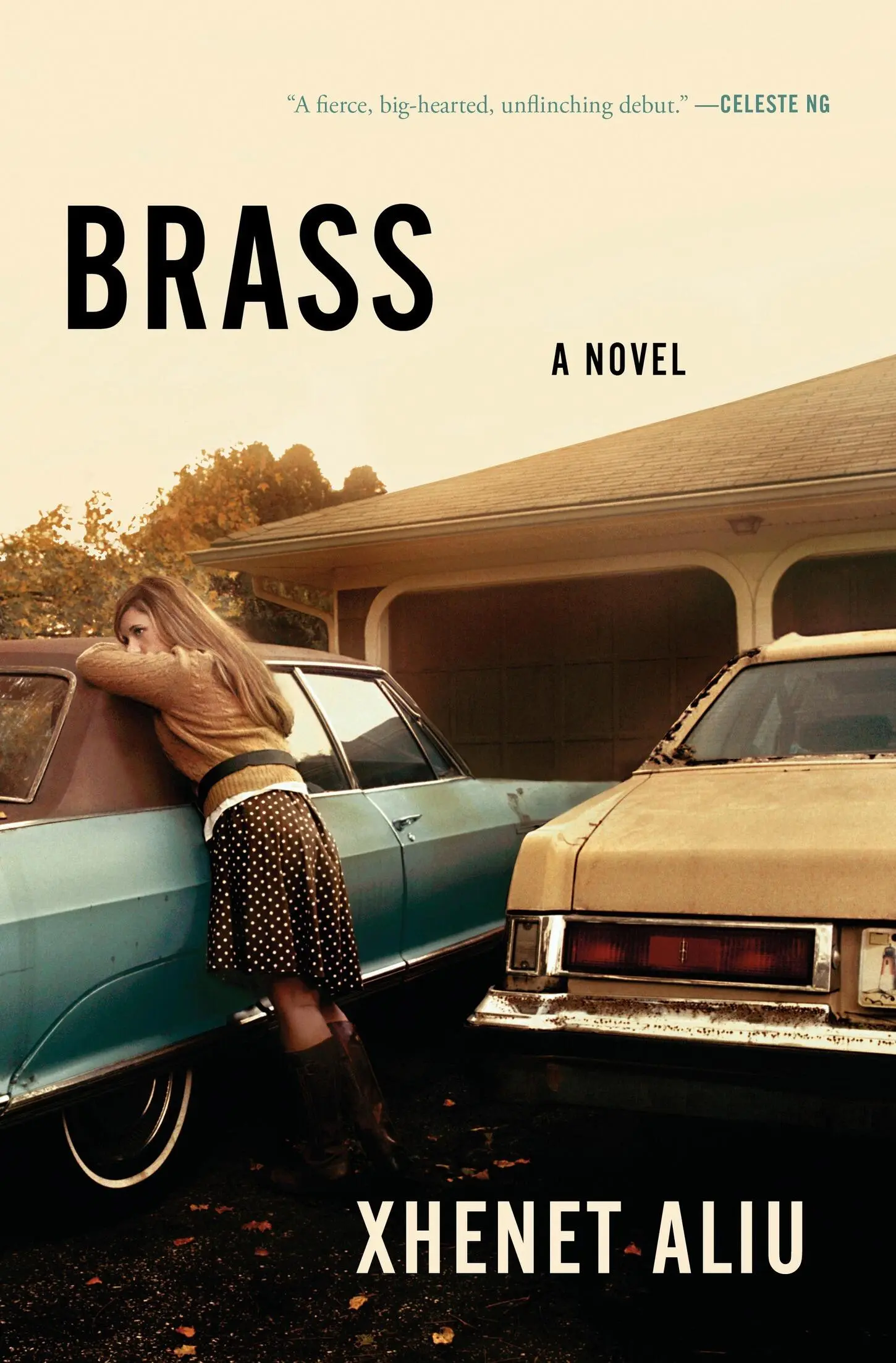
- Название:Brass
- Автор:
- Издательство:Random House Publishing Group
- Жанр:
- Год:2018
- Город:NYC
- ISBN:9780399590252
- Рейтинг книги:3 / 5. Голосов: 1
-
Избранное:Добавить в избранное
- Отзывы:
-
Ваша оценка:
Brass: краткое содержание, описание и аннотация
Предлагаем к чтению аннотацию, описание, краткое содержание или предисловие (зависит от того, что написал сам автор книги «Brass»). Если вы не нашли необходимую информацию о книге — напишите в комментариях, мы постараемся отыскать её.
A waitress at the Betsy Ross Diner, Elsie hopes her nickel-and-dime tips will add up to a new life. Then she meets Bashkim, who is at once both worldly and naïve, a married man who left Albania to chase his dreams—and wound up working as a line cook in Waterbury, Connecticut. Back when the brass mills were still open, this bustling factory town drew one wave of immigrants after another. Now it’s the place they can’t seem to leave. Elsie, herself the granddaughter of Lithuanian immigrants, falls in love quickly, but when she learns that she’s pregnant, Elsie can’t help wondering where Bashkim’s heart really lies, and what he’ll do about the wife he left behind.
Seventeen years later, headstrong and independent Luljeta receives a rejection letter from NYU and her first-ever suspension from school on the same day. Instead of striking out on her own in Manhattan, she’s stuck in Connecticut with her mother, Elsie—a fate she refuses to accept. Wondering if the key to her future is unlocking the secrets of the past, Lulu decides to find out what exactly her mother has been hiding about the father she never knew. As she soon discovers, the truth is closer than she ever imagined.
Told in equally gripping parallel narratives with biting wit and grace, Brass announces a fearless new voice with a timely, tender, and quintessentially American story.
Brass — читать онлайн бесплатно полную книгу (весь текст) целиком
Ниже представлен текст книги, разбитый по страницам. Система сохранения места последней прочитанной страницы, позволяет с удобством читать онлайн бесплатно книгу «Brass», без необходимости каждый раз заново искать на чём Вы остановились. Поставьте закладку, и сможете в любой момент перейти на страницу, на которой закончили чтение.
Интервал:
Закладка:
“But I want to know that life,” you say. “Or at least know about it.”
Yllka takes your hand and kisses it. “I know, darling, and you will learn. I am so happy you’re here.”
“I am, too,” you say, and god, it’s embarrassing to talk like that, all gushy and goo-goo-eyed, to be called darling, which you thought was a word used only by old ladies to describe white waffle-knit capris from Talbots. Mamie would never call you darling. Mamie possibly doesn’t even know the word.
“Of course, then we leave Albania and we find out we’re no enemy to the world,” she says, opening the next album. “We’re not number one, we’re nothing, just some strange backward Communist country. Nobody cares about us at all. It’s almost worse, right, to just be nothing?”
“I don’t think anything’s worse than nothing,” you agree, which seems to confuse Yllka.
“Well, who knows what’s worse. I shouldn’t say that. Anyway, it all turned out okay for us Hasanis in the end. Better than we dreamed back then, anyway. Mostly. Of course there have been some stumbles. It’s never going to be perfect, not even in America.”
“But it’s better? Like, it gets better?”
“Usually. It depends, you know, if you want it to be better. It was hard for some of the people who came over, because they thought you land here, boom, life is wonderful. They didn’t know you still had to work for it.” She shrugs. “Mostly everybody figured it out, but it’s hard at first. It’s hard to be a stranger anywhere, I guess.”
“So the Hasanis are all here now?”
“Oh, no, the Hasanis are everywhere. We’re here, obviously, Gjonni and I. Your aunts are in Switzerland with their husbands, you have one uncle in Turkey, one in Greece. Cousins everywhere, my god, everywhere —New Jersey, someone’s on a fishing boat in Alaska. A couple of them not much older than you are in Tirana running a bar that caters to tourists. Tourists! Can you imagine, tourists in Tirana?” She laughs and shakes her head, and you laugh, too, not wanting to let on that you have no idea what’s funny about that.
“And, um,” you say, and she keeps shaking her head but stops laughing.
“I was waiting for this,” she says and pulls out the last album. “I’m not sure why I was waiting. It wasn’t fair of me, to make you wait longer. I wasn’t trying to be mean, I swear to you. I just…” She looks at you, and then takes a deep breath, as if she’s about to drop underwater and has to rely on that single lungful for a while. “I’m just still not sure what to tell you.”
The album opens to the kind of boy you see in documentaries on PBS, in shorts, unsmiling, the kind of boy who looks like he’s already broken horses and sold brothers and sisters into indentured servitude. The picture, in both quality and content, should have been taken a hundred years ago instead of in the seventies. It looks like it’s from a time before cameras were invented, before anyone was supposed to have had a happy childhood.
“Your father, when he was little,” Yllka says.
She lets you be in charge of turning the pages, and you do it slowly, so your father grows up just a little bit at a time, a flip-book in slow motion. There’s a big chunk of him missing, though. He goes from boy to man in the flip of a page, from wrinkled soiled cotton standing in a field of rocky dirt to a wrinkled soiled apron in a sea of stainless steel, obviously the kitchen of the Betsy Ross.
“We didn’t see him for a long time,” Yllka says. “Between when we left home and when he came here.”
On the last page is the only picture of him smiling, the only one where he isn’t posing like the star of a low-budget action flick about a play-by-his-own-rules ex-cop with nothing left to lose. He’s leaning back dangerously in a folding chair, surrounded by guys who all kind of resemble him. Playing cards and beer bottles and loose cigarettes are scattered over the table, the detritus densest in the semicircle he’s claimed for himself.
“It was a party for you, to celebrate when your mother was pregnant.”
You’d have thought Yllka was lying if you weren’t seeing it for yourself. All of the other pictures in the photo album matched perfectly the idea of your father you’d had since you were capable of abstract thought: stony-faced, too hard to give a shit even about the things everyone’s supposed to give a shit about, one’s own offspring, for example, something that even most wild animals manage to be capable of. And yet there’s your father in two dimensions, smiling in a way that’s impossible to fake for the camera.
“He was drunk,” you say.
“What? No, he was happy, that’s all.”
“Happy about what?”
“Happy about you,” she says.
“That makes no sense. People aren’t happy about things they don’t want. People don’t celebrate, like, having cockroaches in their house.”
“Oh, Luljeta,” she says.
“What? It’s the truth.”
“No, no, that’s not the truth. That wasn’t it at all.”
“So then what is the truth?”
She looks at you, then looks away, as if she suddenly doesn’t speak your language anymore, or maybe the words to explain it don’t exist in English. She exhales long and slow, and then starts to say something, but she stops before the first syllable is out. She tries again, and fails again, and then she says, finally, “I still don’t understand it all myself, and I can’t apologize for your father or your mother.”
“You don’t have to apologize for my mother. She’s the one who stuck around.”
“Yes, but she also…”
“Also what?”
Yllka closes her eyes a second, hits reset, and lets out a deep whistling exhale from her nostrils. “Never mind, never mind. It’s not for me to say. But I understand that you are angry with him, and you have a right to be angry, but you also should know the story, and that he wasn’t a terrible person. He was a very hurt and confused and scared person, and, you know, he left Albania but everything he tried to leave came with him anyway, do you understand?”
“No,” you say.
She nods. “I know. I hope you can understand one day, though. I don’t want to make excuses for him. He was stupid, there is no denying that. But I think he thought he was doing the right thing at the time. Both of them did, your mother and father. You know what they say, the road to hell and good intentions and all.”
“So that’s where he ended up? Hell?”
She shakes her head. “No. Texas. Eventually, anyway, after Albania. Houston. His wife’s brother lives there.”
You regret the fried dough now. It’s so close to coming back up, and you have to work so hard to keep it down that you can barely talk. “He came back?”
“Yes,” she says.
“And he never even tried to see me?”
Yllka looks embarrassed. “I guess he thought you wouldn’t want that,” she says.
“I was a kid. What would it matter what I wanted?”
“Well, your mother wouldn’t want it.”
“So it’s her fault?”
“It’s nobody’s fault, Luljeta. It’s not a fault. It’s just mistakes. Or, I don’t know, not mistakes, just decisions that led to other decisions, and on and on, and in the end the first decision seemed too far buried to get back to and change.”
You think for a moment about the first Christmas you were old enough to remember. It was back in the Toys for Tots days, the Play-Doh-workshop-courtesy-of-the-U.S.-Marines days, the days when charitable strangers had to do the work that those charged with caring for you could not. Even then, the magic of new Play-Doh could not entirely compensate for the desertion you felt not by your family but by Santa Claus, that bastard, who you believed had forsaken you, because that was easier to explain to a child than the true source of neglect. “We don’t have a chimney, Lulu, what can we do?” your mother had said when you asked why Santa skipped over your apartment, her eyes welled with tears as if she was the one who’d failed, and man, you hated that fat man in red for making her feel like that. But it’s occurring to you just now: what if there had been an answer to that question all along? Lulu, what can we do? What if the answer was: Let your father do the job he apparently was open to doing, instead of waiting for another mythical white man to do the providing?
Читать дальшеИнтервал:
Закладка:
Похожие книги на «Brass»
Представляем Вашему вниманию похожие книги на «Brass» списком для выбора. Мы отобрали схожую по названию и смыслу литературу в надежде предоставить читателям больше вариантов отыскать новые, интересные, ещё непрочитанные произведения.



Обсуждение, отзывы о книге «Brass» и просто собственные мнения читателей. Оставьте ваши комментарии, напишите, что Вы думаете о произведении, его смысле или главных героях. Укажите что конкретно понравилось, а что нет, и почему Вы так считаете.