Xhenet Aliu - Brass
Здесь есть возможность читать онлайн «Xhenet Aliu - Brass» весь текст электронной книги совершенно бесплатно (целиком полную версию без сокращений). В некоторых случаях можно слушать аудио, скачать через торрент в формате fb2 и присутствует краткое содержание. Город: NYC, Год выпуска: 2018, ISBN: 2018, Издательство: Random House Publishing Group, Жанр: Современная проза, на английском языке. Описание произведения, (предисловие) а так же отзывы посетителей доступны на портале библиотеки ЛибКат.
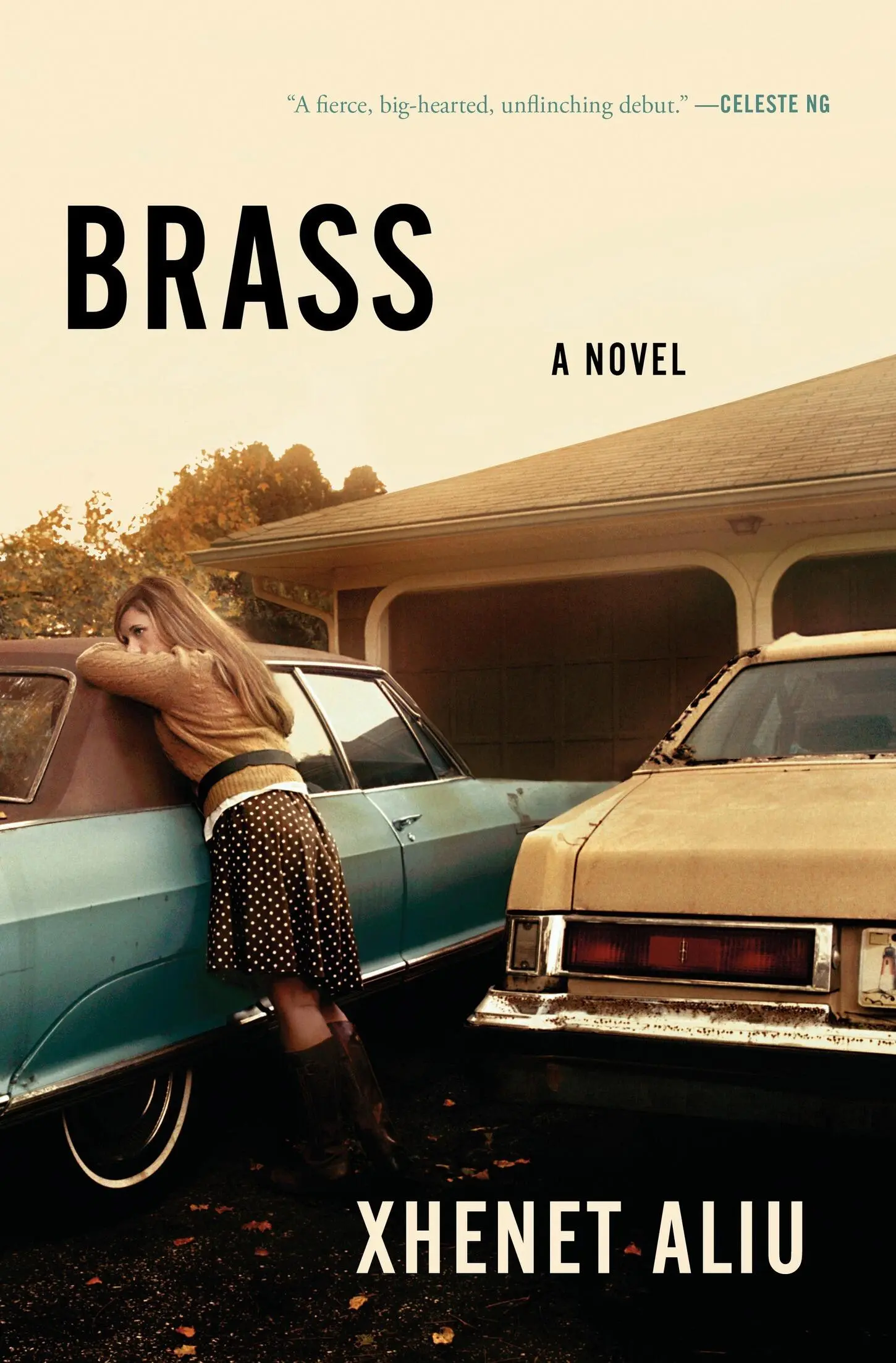
- Название:Brass
- Автор:
- Издательство:Random House Publishing Group
- Жанр:
- Год:2018
- Город:NYC
- ISBN:9780399590252
- Рейтинг книги:3 / 5. Голосов: 1
-
Избранное:Добавить в избранное
- Отзывы:
-
Ваша оценка:
Brass: краткое содержание, описание и аннотация
Предлагаем к чтению аннотацию, описание, краткое содержание или предисловие (зависит от того, что написал сам автор книги «Brass»). Если вы не нашли необходимую информацию о книге — напишите в комментариях, мы постараемся отыскать её.
A waitress at the Betsy Ross Diner, Elsie hopes her nickel-and-dime tips will add up to a new life. Then she meets Bashkim, who is at once both worldly and naïve, a married man who left Albania to chase his dreams—and wound up working as a line cook in Waterbury, Connecticut. Back when the brass mills were still open, this bustling factory town drew one wave of immigrants after another. Now it’s the place they can’t seem to leave. Elsie, herself the granddaughter of Lithuanian immigrants, falls in love quickly, but when she learns that she’s pregnant, Elsie can’t help wondering where Bashkim’s heart really lies, and what he’ll do about the wife he left behind.
Seventeen years later, headstrong and independent Luljeta receives a rejection letter from NYU and her first-ever suspension from school on the same day. Instead of striking out on her own in Manhattan, she’s stuck in Connecticut with her mother, Elsie—a fate she refuses to accept. Wondering if the key to her future is unlocking the secrets of the past, Lulu decides to find out what exactly her mother has been hiding about the father she never knew. As she soon discovers, the truth is closer than she ever imagined.
Told in equally gripping parallel narratives with biting wit and grace, Brass announces a fearless new voice with a timely, tender, and quintessentially American story.
Brass — читать онлайн бесплатно полную книгу (весь текст) целиком
Ниже представлен текст книги, разбитый по страницам. Система сохранения места последней прочитанной страницы, позволяет с удобством читать онлайн бесплатно книгу «Brass», без необходимости каждый раз заново искать на чём Вы остановились. Поставьте закладку, и сможете в любой момент перейти на страницу, на которой закончили чтение.
Интервал:
Закладка:
Yllka sits you down and places a serving platter in front of you, the thin pieces of fried dough it holds stacked six inches high and drizzled with honey. You normally don’t like to eat in front of strangers, because you think they’re glancing down at your farm-girl haunches and silently questioning whether you really need the calories, but you also realize that you can’t be expected to talk with a mouth full of food, and now that you’re in front of her, you realize you have no idea at all what to say. So you take a bite, and it gives you something to say.
“Oh my god, that’s really good,” you choke out—choke because your mouth is still too full of sweet mush to really attempt speaking, but the words come out involuntarily. There has to be something in those fried dough squares besides flour and water and sugar. Nothing can taste that good without the use of black magic and/or generous amounts of bacon fat, neither of which you think a Muslim with angels on the wall would be allowed to use.
Yllka looks relieved, like she’s just advanced to the next round in Iron Chef . Then she pours you coffee and brings out cheese and bread and you spend the next two minutes convincing her that you really, really don’t want or need anything else to eat, and that you really, really aren’t too skinny like your mother always was.
“I’m good, I’m fine, I’m full, I promise,” you say, and eventually she sighs and sits down across from you at the table, petting your hair as if you were a runaway dog she’d retrieved from the shelter.
“Gjonni couldn’t be here, unfortunately,” she says finally, but she doesn’t really look sorry about it. She’s so grabby, and the way she stares, it’s like she’s greedy for you. You’ve never been looked at like that before, not even by Ahmet back in the car—and he was much more circumspect about his desire. It’s strange, and not entirely comfortable, and yet not entirely awful, either. Yllka had told you last night that she’s your great-aunt, which is family, a word that doesn’t quite seem to fit but absolutely does. What other word is there, other than an Albanian one that you don’t know?
“Who’s Gjonni?” you ask, and immediately Yllka looks ready to cry.
“My god, do you know nothing?” she asks. You don’t shake your head, but of course you know nothing, and of course you’re embarrassed about that, as if you’d been caught neglecting your duties. How are you supposed to know about these things? Is there some Wiki you don’t know about that could have unraveled all the mysteries of your own life? “Gjonni is my husband, your uncle,” she says, and you mouth the word uncle, something you’d had few occasions to say, other than crying it when Margarita pinned your arm against your back once in third grade. Your mother has never mentioned the names Yllka and Gjonni to you. She’s never mentioned that these people whose blood you share live in an adjacent zip code to you and not on a different continent. You could practically forget your own father’s name, your mother has said it aloud so few times to you. When it comes up at all, it’s to assign blame for something, and his name then becomes Your Father, pronounced with a detached, clinical tone that makes it sound like a medical condition. As in: I don’t know where your frizzy hair/eczema/cat allergy comes from, must be from Your Father .
“So you’re a Hasani?” you ask, excited by the prospect of your name having a history. For the first time, your name doesn’t seem to you like some random collection of letters put together by a spambot. You’re glad your mother has never followed through on her lifelong promise to legally change your name to Kuzavinas, something even more unpronounceable and somehow equally unsuitable.
“I was, before I was married a hundred years ago. Now I am Shehu, Yllka Shehu,” she says, and once again you are alone on an island of Hasani. “But you can call me Teto. It means ‘auntie.’ ” She pauses. “You don’t know that, do you? You don’t even know the words for your own family?”
“No,” you say.
She shakes her head and strokes yours. “You poor thing, i dashur. So lost from what you are.”
It takes a minute for that to sink in, and then you’re fully convinced that this woman is not a human trafficker or a run-of-the-mill weirdo after all. She’s a genius. She’d had you pinned as the hungry, stray animal you’d always felt like from the moment you walked in the door.
Yllka brings out a photograph, a black-and-white shot of a man with eyes as wrinkled as his shirt staring into the camera from under a white knit cap. He looks like he’s deciding what kind of punishment to dish out to whatever asshole is trying to steal his soul with that little plastic box in their hands, his face veiled with smoke from a cigarette that didn’t make it into the frame. He is ghostly, and you have no doubt he was the kind of man whose spirit would have hung around long after he died from consumption or a mule kick, the kind of man who isn’t about to let a thing like death keep him from getting his work done, whatever his work is. From the looks of him, it’s farming or arms dealing.
“That’s my brother. Your babagjysh,” Yllka says. “I know, the picture looks terrible. We just had cheap Chinese cameras in those days. Toys, really.”
“Babagjysh,” you repeat.
“It means ‘grandfather,’ ” Yllka says.
“I know,” you say. “I figured that out. I just never knew I had one.”
“Of course you had one. He’s gone now, rest his soul, but you had one. Everybody has one, silly.” She takes a wisp of your hair and pushes it aside and looks at you like you’re much younger than you are, a toddler that the whole world has to be explained to. “Let me show you more people from back home,” she says and scatters the photo albums across the table.
Home, she says, like it’s yours, too.
“There are no Hasanis left in the village,” she says, after you make it through the first album, more black-and-white shots of more people who looked like they were allergic to good times, which you hope isn’t genetic. “Except for the dead ones, I mean. Lots and lots of dead ones. We were there forever, hundreds and hundreds of years. And now, poof, all gone.”
“How come? What happened?” you ask.
“Oh, Luljeta, it became a terrible place. You must have heard about how terrible Albania was under Hoxha.”
You can’t get yourself to admit that you haven’t. You don’t even know what a Hoxha is.
“We weren’t allowed to even feed ourselves. Hoxha would rather us starve than to grow food that wasn’t for the State. His own people he did this to. We were the cattle, why would we need to raise our own? And so many people put in the prisons and the camps, and so many people put to death, and so many lies that we believed, that Albania was the most powerful country in the world, and every nation was an enemy, everybody wanted to get us. Do you know what it’s like to feel so alone like that, like the whole world, even your own people, wish you not to live?”
You try to come up with a good answer to that before you realize it’s a rhetorical question.
“Of course you don’t,” she says. “Thank God you never knew that life.”
Yes, thank god, except that there is a secret part of you that is thrilled to be only a degree or two away from that kind of suffering, the same ugly part of you that, when you were little, sometimes secretly wished for type 1 diabetes like your classmate Aisha, who got to wear a cool medical bracelet and received endless attention from her parents and teachers. Sure, she almost died twice a year and would probably eventually go blind and might not make it to fifty; what was fifty to you other than some diffuse, faraway threat, like purgatory? Aisha, at eight, understood suffering and mortality. It made her serious and above reproach. You’d had a couple of stomach bugs and a respiratory illness once, and that was about as close as you came to Aisha’s innate stoicism. You’d never even gotten the chicken pox, even after your daycare closed for two weeks when it swept through and infected just about every other child in a half-mile radius. You are hearty, almost ridiculously so, but maybe that’s because you’ve inherited the gene for overcoming adversity, which means that you are tuned in to adversity in a way that your schoolmates are not. After all, look at what your uncle and aunt had lived through. Your father. Your babagjysh.
Читать дальшеИнтервал:
Закладка:
Похожие книги на «Brass»
Представляем Вашему вниманию похожие книги на «Brass» списком для выбора. Мы отобрали схожую по названию и смыслу литературу в надежде предоставить читателям больше вариантов отыскать новые, интересные, ещё непрочитанные произведения.



Обсуждение, отзывы о книге «Brass» и просто собственные мнения читателей. Оставьте ваши комментарии, напишите, что Вы думаете о произведении, его смысле или главных героях. Укажите что конкретно понравилось, а что нет, и почему Вы так считаете.