Ken Auletta - Googled - The End of the World as We Know It
Здесь есть возможность читать онлайн «Ken Auletta - Googled - The End of the World as We Know It» весь текст электронной книги совершенно бесплатно (целиком полную версию без сокращений). В некоторых случаях можно слушать аудио, скачать через торрент в формате fb2 и присутствует краткое содержание. Жанр: Современная проза, на английском языке. Описание произведения, (предисловие) а так же отзывы посетителей доступны на портале библиотеки ЛибКат.
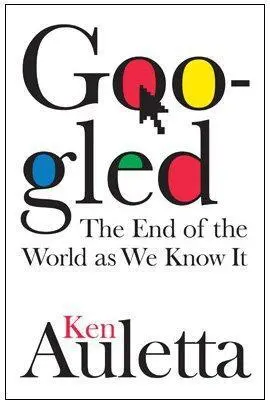
- Название:Googled: The End of the World as We Know It
- Автор:
- Жанр:
- Год:неизвестен
- ISBN:нет данных
- Рейтинг книги:4 / 5. Голосов: 1
-
Избранное:Добавить в избранное
- Отзывы:
-
Ваша оценка:
Googled: The End of the World as We Know It: краткое содержание, описание и аннотация
Предлагаем к чтению аннотацию, описание, краткое содержание или предисловие (зависит от того, что написал сам автор книги «Googled: The End of the World as We Know It»). Если вы не нашли необходимую информацию о книге — напишите в комментариях, мы постараемся отыскать её.
Inside the Google campus, Auletta finds a culture driven by brilliant engineers in which even the most basic ways of doing things are questioned. His reporting shines light on how Google has been so hugely successful-and why it could slip. On one hand, Auletta reveals how the company has innovated, from Gmail, Google Maps, and Google Earth to YouTube, search, and other seminal programs. On the other, he charts its conflicts: the tension between massive growth and its mandate of “Don’t be evil”; the limitations of a belief that mathematical algorithms always provide correct answers; and the collisions of Google engineers who want more data with citizens worried about privacy.
More than a comprehensive study of media’s most powerful digital company, Googled is also a lesson in new media truths. Pairing Auletta’s unmatched analysis with vivid details and rich anecdotes, it shows how the Google wave grew, how it threatens to drown media institutions once considered impregnable-and where it is now taking us all.
Googled: The End of the World as We Know It — читать онлайн бесплатно полную книгу (весь текст) целиком
Ниже представлен текст книги, разбитый по страницам. Система сохранения места последней прочитанной страницы, позволяет с удобством читать онлайн бесплатно книгу «Googled: The End of the World as We Know It», без необходимости каждый раз заново искать на чём Вы остановились. Поставьте закладку, и сможете в любой момент перейти на страницу, на которой закончили чтение.
Интервал:
Закладка:
During the 2007 Zeitgeist Conference, a prominent media executive in attendance whispered a question to me. He was clear, he said, about the immense value Google was producing for itself. What he said he didn’t understand was this: What value was Google producing for society, other than shifting money from the pockets of traditional media to Google’s? During a long interview with Sergey Brin that day, I relayed the question. Brin had an easy answer if he wanted it; on the front page of that day’s San Jose Mercury News was a story about the jobs his company had created and the auxiliary businesses that benefited from what the headline called “The Google Effect.” But Brin chose to make a broader point: “It’s very simple. People with the right information make better decisions for themselves. People presented with the right commercial opportunities will buy things suited to them.”
By way of illustration, Brin described a trip he and his wife had made to Africa. With sophisticated digital cameras in hand, the two of them often jump on the private, customized Boeing 767-200 or 757 that Brin and Page purchased and that transports them to different continents. “One day in Zambia the driver was telling me how he was trying to get all the parts to a computer,” Brin said. The driver couldn’t locate some parts he needed, and those he could find were five times as expensive as they were in the United States. “He was trying to get a DVD-Rom drive. I said, ‘In the U.S. they cost about thirty dollars.’ He said, ‘What?’ He was about to spend two hundred dollars on a DVD-Rom. Imagine if there was information there? He would have been able to get that DVD-Rom drive for forty bucks. He’d be more efficient at his job, and it would help communities as a whole. I certainly believe that information creates value, rather than displaces it.”
Google search is of enormous benefit to other companies as well. Referring to the Internet as “a magic box where whatever you want to do, it’s all there,” Marc Andreessen credited Google with making the box “more magical. Google makes the world a much better place because it makes everything findable. Many companies spend a lot of time and effort to make their stuff more findable on Google. It’s a huge source of traffic and income. Facebook used to be closed off from Google-you had to be logged into Facebook to see people’s profiles. But then Facebook started publishing public profiles so that when you search on Google for someone, their Facebook profile pops up in the search results. That generates additional incoming traffic and therefore money for Facebook.” Web site owners report that Google search often sends them 80 to 90 percent of their vistors. With Google as the Internet’s prime navigator, there still remains the question Nicholas G. Carr asked in a 2008 blog post: “Is the company an exemplar or a freak?”
Itay Talgam did not mean to address this question when he appeared at Google’s 2008 Zeitgeist Conference, but he inadvertently offered an answer. Talgam, a renowned Israeli orchestra conductor, stood on a small semicircular stage wearing a wrinkled cotton polo shirt with a sweater draped over his shoulders, his sparse hair shooting in several directions. For a half hour, his presentation of how conducting could be a metaphor for transformational management hushed the audience. Music is “noise,” he began, and what the conductor does is “make a large group of people work in harmony.”
Scanning a century’s worth of conductors, he chose to discuss five. Each was outstanding, he said, but only two were transformational. The lights went down and on a large screen appeared a video clip of the autocratic Riccardo Muti, whose stern face and robotic baton movements brought forth from his orchestra no “joy,” and suppressed the development of individual artists. Muti’s “expression never changes,” Talgam said. “He tells everyone what to do. He is a micromanager.” The second conductor was Richard Strauss, who seemed to be in another place as he mechanically moved his arms, granting his orchestra more freedom but imposing no authority and offering no inspiration. The third was Herbert von Karajan, who never looked at his orchestra and also failed to inspire. The fourth was Carlos Kleiber, whose face was filled with rapture as he conducted and who, Talgam said, “creates a process” and “a feeling of freedom” while also conveying “authority.” Notice, he said, the way Kleiber shot a disapproving glance at a soloist.
Talgam saved his favorite conductor for last. With the fifth clip, we were treated to a video of Leonard Bernstein welcoming an orchestra of high school students from around the world who had been granted one week under his direction to perform Stravinsky’s The Rite of Spring. The first day of practice, the makeshift orchestra was discordant. But Bernstein did not wield a baton as a symbol of his “authority,” Talgam noted. Instead, he stopped the music and spoke of the feelings Stravinsky sought to evoke, of the smell of spring grass, of waking animals. “He empowers people,” Talgam said, “by telling them that their world is larger than they think.” Cut to a week later, and the high school orchestra sat attentively before Bernstein, who looked on with obvious satisfaction as an assembly of young strangers achieved musical harmony. Without a baton, arms folded, Bernstein conducted only with facial expressions-a curled lip and lowered head for the basses, a raised eyebrow for the higher strings, a nod to the horns, an extravagant smile for the finale. Talgam did not need to tell the audience what they had seen. It was a sublime management seminar demonstrating how unusual leaders liberate those who follow. Bernstein was the boss, but he was not an autocrat. He managed to coax the best out of his orchestra, to make them part of a community.
It was no accident that Google invited Talgam. This sense of being connected to something larger is central to its culture. Employees share offices and work in teams. Google strives to make employees feel that they are part of a network. When Patrick Pichette became CFO, he relied on a wisdom-of-crowds approach to cost cutting. He set up a Web page and invited employees to make suggestions to eliminate waste, which he said unearthed many of the best ideas. Google uses a variant of this network approach when it test-markets whether its users like blue or yellow, one beta product or another. Of course, this faith in quantification is what drove some designers to leave the company and to blog about their frustrations.
These forms of communication are characteristic of what Anne-Marie Slaughter, the former dean of the Woodrow Wilson School of Public and International Affairs at Princeton, has described as “the networked world,” a world that Google has been instrumental in advancing. Diplomacy requires “mobilizing international networks of public and private actors”; CEOs are acutely aware of “the shift from the vertical world of hierarchy to the horizontal world of networks”; the media increasingly is composed of “online blogs and other forms of participatory media” that “create a vast, networked conversation.” Society itself is networked, with “the world of MySpace” creating “a global world of ‘OurSpace,’ linking hundreds of millions of individuals across continents.” This world is one where a more open America, and a more open company, has distinct advantages.
Google has devised a management system that liberates its employees. The “Googly” way, said Laszlo Bock, Google’s vice president of people operations, is simply to treat employees better. “Google is a platform to say, ‘You can trust your folks.’ We want to be an example to other companies. The key is the 20 percent time, not the free food. There is a feeling here of intellectual freedom.” Even though there was some grumbling from Googlers in 2008-about costly child care, the closing of the Phoenix office-most recognized their work life was charmed. How many companies gifted its employees with new stock options to replace those that had become worthless? Asked what impact Google’s employment policies have had on other companies, Page said, modestly, “It’s hard for me to know. I’ve never worked anywhere else. But I feel that we have had an impact. We certainly got a lot of attention for the things we do for employees, and that’s positive.” It also means, he added, “Our competitors have to be competitive on some of these things.”
Читать дальшеИнтервал:
Закладка:
Похожие книги на «Googled: The End of the World as We Know It»
Представляем Вашему вниманию похожие книги на «Googled: The End of the World as We Know It» списком для выбора. Мы отобрали схожую по названию и смыслу литературу в надежде предоставить читателям больше вариантов отыскать новые, интересные, ещё непрочитанные произведения.






Обсуждение, отзывы о книге «Googled: The End of the World as We Know It» и просто собственные мнения читателей. Оставьте ваши комментарии, напишите, что Вы думаете о произведении, его смысле или главных героях. Укажите что конкретно понравилось, а что нет, и почему Вы так считаете.