Malcolm Bradbury - Doctor Criminale
Здесь есть возможность читать онлайн «Malcolm Bradbury - Doctor Criminale» весь текст электронной книги совершенно бесплатно (целиком полную версию без сокращений). В некоторых случаях можно слушать аудио, скачать через торрент в формате fb2 и присутствует краткое содержание. Город: London, Год выпуска: 2000, ISBN: 2000, Издательство: Picador, Жанр: Современная проза, на английском языке. Описание произведения, (предисловие) а так же отзывы посетителей доступны на портале библиотеки ЛибКат.
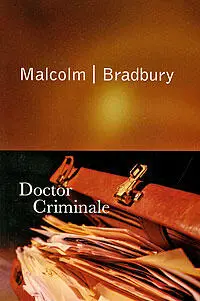
- Название:Doctor Criminale
- Автор:
- Издательство:Picador
- Жанр:
- Год:2000
- Город:London
- ISBN:978-0330390347
- Рейтинг книги:5 / 5. Голосов: 1
-
Избранное:Добавить в избранное
- Отзывы:
-
Ваша оценка:
Doctor Criminale: краткое содержание, описание и аннотация
Предлагаем к чтению аннотацию, описание, краткое содержание или предисловие (зависит от того, что написал сам автор книги «Doctor Criminale»). Если вы не нашли необходимую информацию о книге — напишите в комментариях, мы постараемся отыскать её.
Doctor Criminale — читать онлайн бесплатно полную книгу (весь текст) целиком
Ниже представлен текст книги, разбитый по страницам. Система сохранения места последней прочитанной страницы, позволяет с удобством читать онлайн бесплатно книгу «Doctor Criminale», без необходимости каждый раз заново искать на чём Вы остановились. Поставьте закладку, и сможете в любой момент перейти на страницу, на которой закончили чтение.
Интервал:
Закладка:
In the morning, when I checked at the desk, Criminale’s luggage had still not been traced. He would not be leaving quickly, I had enough for my article, and now I could not keep on avoiding him. I left Schlossburg that morning and flew off home. I wrote my Po-Mo piece, which appeared in the Po-Mo supplement, which is why in their cottages in Provence everyone chatted Postmodernism over the Piat d’Or that summer. Then I thought again about whether I should write about Criminale. I had said I would remain silent, but what I had in mind now was not exactly about Criminale at all. The Schlossburg conversation half changed my mind. He had said his story was, perhaps, not so very far away from being my own story, though of course his story seemed to stop more or less where mine started; that was what I thought about.
And Bazlo Criminale’s story did stop, just about a week after the end of the Schlossburg seminar. For, back in Santa Barbara, California, where he had returned, Criminale died – knocked over by a helmeted bicyclist in a Sony Walkman, so engrossed in some orgasmic peak of the latest Madonna hit that he failed to notice the great philosopher abstractedly crossing the green campus path in front of him. Criminale was struck in the temple by the rim of the cyclist’s safety helmet; they took him to the finest of hospitals, but he never regained consciousness. The best that can be said about it is that he died with his lapel badge on – for he was, of course, attending a conference, on ‘Does Philosophy Have a Future?’, which was at once abandoned as a mark of respect for a great late modern thinker.
You may well remember the obituaries, which were plentiful and generally very respectful. The usual confusions surrounding him survived; several quite different dates and places of birth were given, and his career, fame, and his political views and ideological attitude explained in quite contradictory ways. His public celebrity was, well, celebrated, and much was said about the greatness of his literary work. Less was said about the philosophy, except that it was both advanced and obscure. ‘The Philosopher King Is Dead: Who Is the King?’ asked one piece, speculating about the succession. Very little was said about his personal life, except in very general terms. And nothing at all was said directly about any feet of clay. Even so, there was a general note of caution, as if there might be worse things to come out.
Someone who knew him better than most wrote the piece in the London Times . ‘His birthplace was Bulgaria, his passport was Austrian, his bank account Swiss, and his loyalty perhaps was to nowhere,’ it said – pointedly, I thought, There is no doubt he was a great man, amongst the leading European philosophers of the postwar era, but at times a flawed one. He was a thinker of genius and a pillager of women. He was loved by many for his charm and presence, and made friends in high places everywhere in the world – a friendship he sometimes exploited, in a familiar Mitteleuropean way, though those who knew him best well understood how to forget and forgive. He once famously described philosophy itself as “a form of irony”, and that quality is what we will continue to find in his quite probably enduring work.’ These were the only real hints, if they really were hints, of trouble to come. However in various small American papers there were a few rumours that his death was not entirely accidental, that reactionary Eastern European forces had decided he was a liability. But, as you know, we live an an age of conspiracy theories, some people preferring to believe that nothing is ever what it is but an elaborate plot by powers elsewhere.
A week after that came the attempted coup against Gorbachev and reform in the Soviet Union; three days, as the press said, that shook the late modern world. The hands of the coup leader, Gennady Yanayev, visibly shook on the television screens as he announced the taking of emergency powers and the ‘illness’ of Mikhail Gorbachev, isolated at his holiday dacha in the Crimea. It was not only Yanayev’s hands that shivered; a whole era, a whole epochal direction of history (my history, by the way – yours too, perhaps), a whole set of promises and half-curdled hopes, seemed to be shaking too. Even some of those who had taken the brave step beyond the old imprisoning world began to fear and doubt, as they saw the age turning backwards again. The rules of blame and confession, of guilt and betrayal, seemed once again to go into reverse.
Three days later, it was the coup itself that died – of courage and determined human spirit, of incompetence and contradiction. So did two of its leaders, and more followed after. Then came the obscure days of defiance and confession, as those arrested proclaimed their error, their deception by others, their absence on the day, their historical mistake. To me, as they were filmed, talking, it seemed, without coercion, they all seemed strangely innocent, people from a simpler world. Nobody had told them to blame their parents, discrimination, PMT or passive smoking for what had gone wrong. They said I as if they meant it; they said they did it. They had made an error and they announced it. Then as they fell, as others did after them, the statues of the long century once more began to tumble. Tall, black, phallic Felix Dzherzhinsky came down from his slim pedestal outside the Lubyanka. Stalin toppled, Lenin was swung upside-down, the bust of squat-headed Karl Marx came off the stand.
Three weeks after that, I attended yet another conference: in Norwich, England, ‘a fine city’, as the signs said as you drove in (and so it had better be, after you’ve struggled for hours across heath, fen, and breckland to reach it). This was the summer’s big one: 650 teachers of English from universities across Europe were gathering in the University of East Anglia’s Sixties concrete bunkers to found a truly European association. Most came from the European Community; some were from Eastern Europe, highly relieved to be there at all. George Steiner spoke, and Frank Kermode. Seamus Heaney read from his poems, and three British novelists read sections from their novels in progress, new stories whose ends they seemed not to know. And this time I spoke myself, in the small section on ‘The Writer as Philosopher’. I had been invited along to make my address at the very last moment. My topic, topical of course because of his death, was Bazlo Criminale.
Quite honestly I had no wish at all to turn up at the event. As you know, I’d been to far too many of that kind of thing lately, and, whatever the impression you might have, I have never been all that keen on solemn gatherings of studious specialists. In fact I had firmly decided to refuse the invitation of the organizers when a slightly disconcerting thing occurred. A few days before the congress began, an odd little letter came through the post. It had a Hungarian stamp on it, and was stuffed with newspaper cuttings. Of course I could not read these, since they were in Hungarian, which really is one of the world’s more obscure languages, but it was clear enough from the headlines and the photographs that they were the Budapest obituaries of Bazlo Criminale. With them was a brief handwritten letter. It said: ‘So he has gone now, our great philosopher. I hope it will make you like to write something about him. You know about him – perhaps not such a big lot, but more than most of those in the West. And now I hear you will go to this big Norwich congress to speak of him. I hope you speak well. Remember, he was a good man, of course a little bit flexible like I told you, but he did always his best. I am going to come there too. I like very much to see you again, and I think in Norwich they do not have goulasch. Are you still just a little bit Hungarian? I hope so. I tried hard to show you how. Love + kisses from Ildiko H.’
Читать дальшеИнтервал:
Закладка:
Похожие книги на «Doctor Criminale»
Представляем Вашему вниманию похожие книги на «Doctor Criminale» списком для выбора. Мы отобрали схожую по названию и смыслу литературу в надежде предоставить читателям больше вариантов отыскать новые, интересные, ещё непрочитанные произведения.



Обсуждение, отзывы о книге «Doctor Criminale» и просто собственные мнения читателей. Оставьте ваши комментарии, напишите, что Вы думаете о произведении, его смысле или главных героях. Укажите что конкретно понравилось, а что нет, и почему Вы так считаете.