Peter Matthiessen - Shadow Country
Здесь есть возможность читать онлайн «Peter Matthiessen - Shadow Country» весь текст электронной книги совершенно бесплатно (целиком полную версию без сокращений). В некоторых случаях можно слушать аудио, скачать через торрент в формате fb2 и присутствует краткое содержание. Жанр: Современная проза, на английском языке. Описание произведения, (предисловие) а так же отзывы посетителей доступны на портале библиотеки ЛибКат.
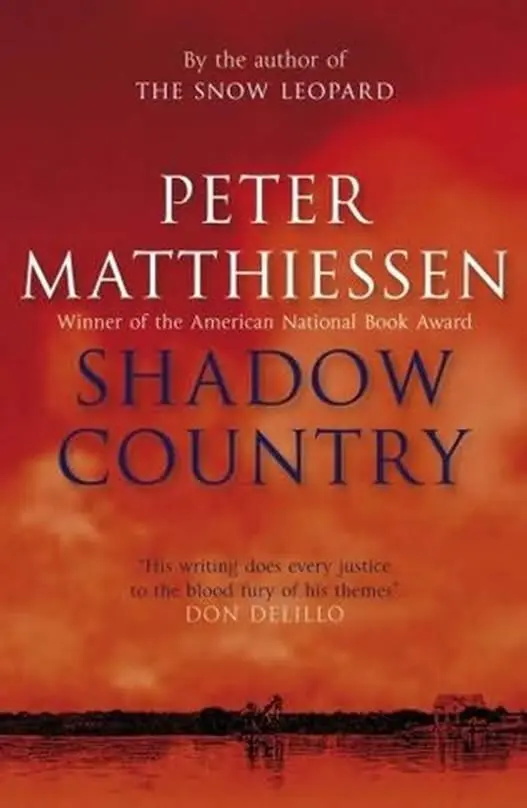
- Название:Shadow Country
- Автор:
- Жанр:
- Год:неизвестен
- ISBN:нет данных
- Рейтинг книги:3 / 5. Голосов: 1
-
Избранное:Добавить в избранное
- Отзывы:
-
Ваша оценка:
Shadow Country: краткое содержание, описание и аннотация
Предлагаем к чтению аннотацию, описание, краткое содержание или предисловие (зависит от того, что написал сам автор книги «Shadow Country»). Если вы не нашли необходимую информацию о книге — напишите в комментариях, мы постараемся отыскать её.
Peter Matthiessen's great American epic-Killing Mister Watson, Lost Man's River, and Bone by Bone-was conceived as one vast mysterious novel, but because of its length it was originally broken up into three books. In this bold new rendering, Matthiessen has cut nearly a third of the overall text and collapsed the time frame while deepening the insights and motivations of his characters with brilliant rewriting throughout. In Shadow Country, he has marvelously distilled a monumental work, realizing his original vision.
Inspired by a near-mythic event of the wild Florida frontier at the turn of the twentieth century, Shadow Country reimagines the legend of the inspired Everglades sugar planter and notorious outlaw E. J. Watson, who drives himself relentlessly toward his own violent end at the hands of neighbors who mostly admired him, in a killing that obsessed his favorite son.
Shadow Country traverses strange landscapes and frontier hinterlands inhabited by Americans of every provenance and color, including the black and Indian inheritors of the archaic racism that, as Watson's wife observed, "still casts its shadow over the nation."
Peter Matthiessen's lyrical and illuminating work in the Watson narrative has been praised highly by such contemporaries as Saul Bellow, William Styron, and W. S. Merwin. Joseph Heller said "I read it in great gulps, up each night later than I wanted to be, in my hungry impatience to find out more and more."
Shadow Country — читать онлайн бесплатно полную книгу (весь текст) целиком
Ниже представлен текст книги, разбитый по страницам. Система сохранения места последней прочитанной страницы, позволяет с удобством читать онлайн бесплатно книгу «Shadow Country», без необходимости каждый раз заново искать на чём Вы остановились. Поставьте закладку, и сможете в любой момент перейти на страницу, на которой закончили чтение.
Интервал:
Закладка:
Arbie reached for his clipping, grinning foxily when Lucius appeared loath to give it up. “This Herlong feller knew all about Edgar Watson’s checkered past,” Arbie assured him, “because Herlongs lived less than a mile from Watsons in both Edgefield and Fort White. Got some Herlongs in those Fort White woods even today.” Arbie was transcendent with self-satisfaction, all the more so when Lucius referred to him slyly as “a historian of record” and promised to acknowledge “the Arbie Collins Archive” in his bibliography and notes.
Intrigued by the Herlong clipping, Lucius wondered if he should not return to Fort White for further research. His chances of finding significant new material by poking through old county records seemed remote, but after all these years of family silence, a kinsman ready to talk about Uncle Edgar might be located, and even perhaps a few old-timers who knew something about the fate of Leslie Cox.
Unfortunately the university press would underwrite no further research: his teaching salary was negligible, he was nearly broke. However, Watt Dyer soon phoned to say that his client United Sugar Associates stood ready to underwrite the author’s travel and would also sponsor a series of paid lectures to educate the public about Planter E. J. Watson, sugarcane pioneer, controversial frontier figure, and confidant to the late Governor Broward. And because U.S.A. had a powerful lobby in the statehouse, the attorney’s politician clients could be prevailed upon to endorse the Watson land claim and perhaps the preservation of the Watson house as a state monument.
Although delighted, Lucius was aware of a recent news report that the U.S.A. corporation was notorious for the dreadful living conditions and near-slavery of its field workers and also that its massive use of chemical fertilizers was a serious threat to the future of the Everglades. Even so, as a reward to their “Big Sugar” campaign donors, another writer claimed, the federal government was abetting the state in its wasteful draining of the Glades for agriculture and development, including the construction of huge concrete canals to shunt away into the sea the pristine water flowing gradually south from Lake Okeechobee as the Shark River watershed.
“Oh for God’s sake!” Dyer’s derisive mirth had a hard edge of anger. “Can’t we leave all that negative stuff to those left-wing whiners in the papers?” Things were moving! he said. Court hearings on the Watson claim were scheduled for the following week at Homestead, and the first of several public events designed to organize local support would be sponsored by the Historical Society at Naples, which would offer an evening with the distinguished historian Professor L. Watson Collins.
“That name won’t work in Naples. Sorry,” Lucius said. “Too many people know me on this coast.”
Emitting that curious hard bark, Dyer simply hung up, leaving the question unresolved.
MURDER IN THE INDIAN COUNTRY
Rob Watson’s carton contained notes on his long-ago wanderings to Arkansas and Oklahoma to investigate what lay behind the legend of his father’s career in the Indian Nations. From these, Lucius put together a brief survey of that obscure period in his subject’s life.
Edgar Watson fled Fort White in north Florida in late 1886 or early 1887 under circumstances still disputed in that community. Although there is no clear record of his movements, it appears that in the spring and summer of 1887, he sharecropped in Franklin County, Arkansas, continuing westward after the crop was in and settling near Whitefield, in the Indian Territory, in early January of 1888.
The period in Mr. Watson’s life between January 1888 and March 1889 is relatively well documented, due to the part he was alleged to have played in the death ( on February 3, 1889 ) of Mrs. Maybelle Shirley Reed, whose multicolored legend as Belle Starr, Queen of the Outlaws, has generated endless articles and books, poems, plays, and films, to the present day.
Hell on the Border, a grim compendium of Indian Country malfeasance published in 1895, was the first book to suggest that Belle Starr’s slayer was a man named Watson; this name appears in the closing pages of most of her numerous biographies, despite widespread dispute as to her real slayer’s identity. Was the culprit one of those shadowy assassins who intervene in famous destinies only to vanish in the long echo of history? Or would the same man reappear as the notorious desperado shot down by his neighbors on the coast of southwest Florida in 1910?
In the federal archives at Fort Worth, Texas, is a lengthy transcript of the hearings held in U.S. Court at Fort Smith, Arkansas, in late February and early March of 1889, to determine if evidence of his guilt was sufficient to bring one “Edgar A. Watson” before a grand jury on a murder charge. From this transcript, together with reports from the local newspapers and some speculative testimony winnowed from the literature on the life and death of Maybelle Shirley Reed, one may assume that the “E. A. Watson” accused in Oklahoma was none other than the “E. J. Watson” gunned down in Florida two decades later. Whether or not he was guilty of Belle Starr’s death may never be known, but it should be noted that many if not most of her acquaintances disliked the victim and that almost as many were suspected of her death by her various authors.
What can we conclude about his years on the frontier apart from the widespread allegation that Watson was “the Man Who Killed Belle Starr”? At least three of Mrs. Starr’s biographers declare that after his departure from Oklahoma, Watson was convicted of horse theft in Arkansas and sentenced to fifteen years in the penitentiary and that he was killed while resisting capture after an escape. (Here as elsewhere they follow the lead of Hell on the Border, published within six years of Belle Starr’s death and considerably more accurate than many of the subsequent accounts, despite its premature report of Watson’s end.)
Watson’s destination after his escape from the Arkansas penitientary remains unknown, though he later related that he headed west to Oregon, where he was set upon by enemies in a night raid on his cabin. Obliged to take a life, possibly two, he fled back east. Another account states that on his way to Oklahoma, Ed Watson passed through Georgia, where he killed three men in a fracas. Like the many false rumors from South Carolina and Florida, these seem to be “tall tales” unsupported by separate testimony or even anecdotes within the family.
Ed Watson reappears in Florida in the early nineties, in a shooting at Arcadia in DeSoto County in which, by his own account, he slew a “bad actor” named Quinn Bass. In the rough frontier justice of that region, our subject was permitted to pay his way out of his difficulties, according to one of Belle Starr’s hagiographers, who asserts that “a mob stormed the jail, determined to have Watson, but the sheriff beat them off.” In a different account, outlaws Watson and Bass disputed the spoils of a marauding expedition whereupon Bass was shot dead through the neck.
Though E. J. Watson (as a fugitive, he appears to have changed his middle initial) is rarely identified as an outlaw, it should be noted that in the nineties, range wars, cattle rustling, and general mayhem were rife in De Soto County, and gunmen and bushwhackers from the West found steady work. It is also true that Watson turned up at Chokoloskee Bay not long thereafter with enough cash to buy a schooner, despite his reported recompense to the Bass family for the loss of Quinn. Considering that he was penniless when sent to the penitentiary and without known income or employment after his escape, one can only speculate where that cash might have come from.
Читать дальшеИнтервал:
Закладка:
Похожие книги на «Shadow Country»
Представляем Вашему вниманию похожие книги на «Shadow Country» списком для выбора. Мы отобрали схожую по названию и смыслу литературу в надежде предоставить читателям больше вариантов отыскать новые, интересные, ещё непрочитанные произведения.





Обсуждение, отзывы о книге «Shadow Country» и просто собственные мнения читателей. Оставьте ваши комментарии, напишите, что Вы думаете о произведении, его смысле или главных героях. Укажите что конкретно понравилось, а что нет, и почему Вы так считаете.