Peter Matthiessen - Shadow Country
Здесь есть возможность читать онлайн «Peter Matthiessen - Shadow Country» весь текст электронной книги совершенно бесплатно (целиком полную версию без сокращений). В некоторых случаях можно слушать аудио, скачать через торрент в формате fb2 и присутствует краткое содержание. Жанр: Современная проза, на английском языке. Описание произведения, (предисловие) а так же отзывы посетителей доступны на портале библиотеки ЛибКат.
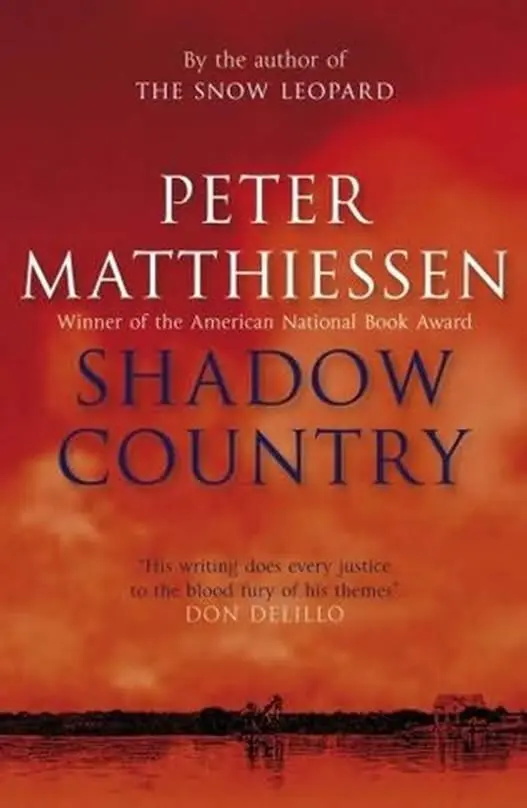
- Название:Shadow Country
- Автор:
- Жанр:
- Год:неизвестен
- ISBN:нет данных
- Рейтинг книги:3 / 5. Голосов: 1
-
Избранное:Добавить в избранное
- Отзывы:
-
Ваша оценка:
Shadow Country: краткое содержание, описание и аннотация
Предлагаем к чтению аннотацию, описание, краткое содержание или предисловие (зависит от того, что написал сам автор книги «Shadow Country»). Если вы не нашли необходимую информацию о книге — напишите в комментариях, мы постараемся отыскать её.
Peter Matthiessen's great American epic-Killing Mister Watson, Lost Man's River, and Bone by Bone-was conceived as one vast mysterious novel, but because of its length it was originally broken up into three books. In this bold new rendering, Matthiessen has cut nearly a third of the overall text and collapsed the time frame while deepening the insights and motivations of his characters with brilliant rewriting throughout. In Shadow Country, he has marvelously distilled a monumental work, realizing his original vision.
Inspired by a near-mythic event of the wild Florida frontier at the turn of the twentieth century, Shadow Country reimagines the legend of the inspired Everglades sugar planter and notorious outlaw E. J. Watson, who drives himself relentlessly toward his own violent end at the hands of neighbors who mostly admired him, in a killing that obsessed his favorite son.
Shadow Country traverses strange landscapes and frontier hinterlands inhabited by Americans of every provenance and color, including the black and Indian inheritors of the archaic racism that, as Watson's wife observed, "still casts its shadow over the nation."
Peter Matthiessen's lyrical and illuminating work in the Watson narrative has been praised highly by such contemporaries as Saul Bellow, William Styron, and W. S. Merwin. Joseph Heller said "I read it in great gulps, up each night later than I wanted to be, in my hungry impatience to find out more and more."
Shadow Country — читать онлайн бесплатно полную книгу (весь текст) целиком
Ниже представлен текст книги, разбитый по страницам. Система сохранения места последней прочитанной страницы, позволяет с удобством читать онлайн бесплатно книгу «Shadow Country», без необходимости каждый раз заново искать на чём Вы остановились. Поставьте закладку, и сможете в любой момент перейти на страницу, на которой закончили чтение.
Интервал:
Закладка:
“Nope,” said Collins, adding sourly, “Only mistake that feller never made.”
For his arrival in Caxambas, the erstwhile Chicken had perked up his worn amorphous clothes with a bright red rag around his throat; Lucius had to admire this flare of color, this small gallantry. Despite his long hair and scraggy beard, Arbie Collins reminded him of his Collins cousins-black hair, fair skin, slight, wiry, and volatile. “Look,” he said, “are we related in some way?”
“By marriage, I reckon. I’m kin to Rob on his Collins side.” Raising the manuscript, he resumed his careless reading, dropping pages, creasing them, flicking ash on them, until finally Lucius stood up and crossed the deck and snapped his notes off the man’s stomach, exposing the navel hair that sprouted between slack button holes of a soiled thin shirt of discolored plaid.
“I’m fussy about strangers rooting through my notes without permission-”
“Found ’em inside,” Arbie explained cheerfully. “Look to me like notes for a damn whitewash. Notes on the Family Skeleton!- how’s that for a title?” He sat up with a grunt, swung his broken boots onto the deck, and dragged his big loose weary carton within Lucius’s reach. “Official Robert Watson archive,” he announced. “Better read it, son. Might learn something.”
Expecting no surprises, finding none, Lucius leafed politely through the carton. Dog-eared folders full of yellowed clippings mixed with scrawled notes copied from magazines and books-sensational exposйs, inventions, lies, and brimstone editorials from the tabloids, dating all the way back to newspaper reports from October 1910-the usual “Bloody Watson” trash, of far less interest than the provenance of this collection.
Anticipating questions, Collins related how he’d helped Cousin Rob Watson sell his father’s schooner and escape on a freighter out of Key West after Watson’s murders back in 1901; he was the only relative, he said, with whom the grateful Rob had stayed in touch throughout his life.
“ Alleged murders. Nobody was ever charged, far less convicted.”
“Never charged?!” Collins winged his cigar butt at a swallow coursing the salt grass for mosquitoes. “Is that all that matters to L. Watson Fucking Collins, Ph.D.?!” The man’s dark eyes glowed in repressed fury.
Lucius persisted. “Did Rob tell you what actually happened that day?”
“Of course. I know the whole damned story.”
“Tell me,” Lucius said, after a moment’s hesitation which the other noticed.
“Maybe. I’ll think about it.” Arbie shifted, irritable. “That was kind of long ago.”
Lucius set the urn on a white cloth on the small table inside, placing beside it a small pot of red geraniums grown on his cabin roof. He poured two whiskeys and they drank in silence, considering the writhings of the urn in the play of light and water from the creek. That this garish canister enclosed all that was left of handsome Rob filled Lucius with sadness. The family would have to be notified about his death but who would care?
“Rob came to find me a few years ago but I never saw him,” he muttered finally. “I haven’t laid eyes on my own brother since I was eleven.”
Collins picked up the urn and turned it in his hands. “Well, you might not care to lay eyes on him now ’cause he don’t look like much.” He shifted his hands to the top and bottom of the canister and shook it. “Hear him rattling in there? People talk about ashes but it’s mostly bits and pieces of brown bone, like busted dog biscuits.” To prove it, he shook the urn again.
“Don’t do that, dammit!” When Lucius took it and returned it to the table, Arbie Collins cackled. “He won’t mind,” he said. And Lucius said, “ I mind. It’s disrespectful.”
In the next days, Arbie sorted his yellowed scraps. “I been updating Rob’s archives, Professor,” he might say, picking up one of Lucius’s pipes and pointing the pipestem at its owner before clearing his throat and quoting from his clips. “ ‘Bad Man of the Islands.’ ‘Red-bearded Knife Artist.’ How’s that for data?” Slyly he would frown and harrumph, weighing his words in what he supposed was an academic manner. “Speaking strictly as an archivist, L. Watson, that man’s beard was not what a real scholar would call red. It was more auburn, sir, more the color of dried blood.”
“Color of dried blood, yes, indeed.” The archivist’s colleague frowned judiciously in turn. “Doubtless a consequence of his well-known habit of dipping his beard in the lifeblood of his victims, don’t you agree, sir?”
“Precisely, sir. Point well taken, sir.”
It was soon clear (though they had not spoken of it) that Arbie Collins had quit Gator Hook for good and made the barge his home. For the moment, this was agreeable to his host, who enjoyed his company and was waiting to be told Rob’s account of the Tucker story.
Arbie Collins was infuriated by any perceived defense of Edgar Watson. In an attempt to soften his savage prejudice (based largely, it seemed, on what Rob must have told him at Key West), Lucius read him a passage from his biography describing the violent circumstances of young Edgar’s upbringing in South Carolina.
According to his mother, Ellen Addison Watson, the boy had scavenged the family’s food throughout the Civil War while receiving only rudimentary schooling. Even after the War, jobs had been scarce, child labor cheap, and the family poor and desperate. Her son had toiled from dawn to dark at the mercy of a dirt farmer’s stick, an ordeal worsened by the return from the Civil War of his drunken distempered father.
Lucius raised his gaze to see how his colleague was receiving this. Arbie glowered, silent as a coal, but for once he held his tongue. “ ‘Surely the dark temper of Edgefield District,’ ” the Professor resumed, “ ‘blighted the spirit of an unfortunate boy who had been but six when the War began and reached young manhood in the famine-haunted days of Reconstruction.’ ”
“Dammit, these are just excuses!” Bristle-browed, hoarse from cigarettes, beset by strangled coughs, Arbie rummaged up a letter clipped from the Florida History page of the Miami Herald : its author, D. M. Herlong, “a pioneer physician in this state, “had known Edgar Watson as a boy in Edgefield County, South Carolina, and had later become a Watson neighbor in Fort White, Florida. After some strenuous throat hydraulics topped off with a salutary spit, Collins launched forth on a dramatic reading, which he shortly abandoned, turning the clip over to Lucius.
He inherited his savage nature from his father, Elijah Watson, who was widely known as a fighter. In one of these fights he was given a knife wound that almost encircled one eye, and was known thereafter as “Ring-Eye Lige.” At one time Elijah Watson was a warden at the state penitentiary. He married and two children were born to them, Edgar and Minnie. The woman had to leave Watson on account of his brutality and dissolute habits. She moved to Columbia County, Florida, where she had relatives.
Lucius read this to himself as Arbie, gleeful, watched his face. “Old stuff like that probably won’t interest serious historians like L. Watson Collins, Ph.D., correct?”
“You think Herlong has these details right? I mean, ‘Ring-Eye Lige’?” Just saying his grandfather’s name aloud made Lucius chuckle in astonishment: here was the first document of worth in Rob’s ragtag “archive,” the first real clue to those early years which Papa had scarcely mentioned. From the rest of Herlong’s letter he was able to deduce that Granny Ellen Watson and her two childen must have fled South Carolina not long after the 1870 census, when Edgar was fifteen; if his drunken father had abused his wife, it seemed reasonable to suppose that he’d beaten his son, too. The Florida relative who took them in had been Great-Aunt Tabitha Watson, who had accompanied her married daughter and her son-in-law to the Fort White region a few years earlier. By the mid-eighties, when Herlong’s father left Edgefield and moved south to that Fort White community, Elijah Watson back in South Carolina was already notorious as Ring-Eye Lige. The Herlong reminiscence was wonderfully complementary to an account of Watson’s later life by Papa’s friend Ted Smallwood which had turned up in a recent history of Chokoloskee Bay. These two narratives from different periods and regions were nowhere contradictory, therefore more dependable than any biographical material he had found to date.
Читать дальшеИнтервал:
Закладка:
Похожие книги на «Shadow Country»
Представляем Вашему вниманию похожие книги на «Shadow Country» списком для выбора. Мы отобрали схожую по названию и смыслу литературу в надежде предоставить читателям больше вариантов отыскать новые, интересные, ещё непрочитанные произведения.









Обсуждение, отзывы о книге «Shadow Country» и просто собственные мнения читателей. Оставьте ваши комментарии, напишите, что Вы думаете о произведении, его смысле или главных героях. Укажите что конкретно понравилось, а что нет, и почему Вы так считаете.