Peter Matthiessen - Shadow Country
Здесь есть возможность читать онлайн «Peter Matthiessen - Shadow Country» весь текст электронной книги совершенно бесплатно (целиком полную версию без сокращений). В некоторых случаях можно слушать аудио, скачать через торрент в формате fb2 и присутствует краткое содержание. Жанр: Современная проза, на английском языке. Описание произведения, (предисловие) а так же отзывы посетителей доступны на портале библиотеки ЛибКат.
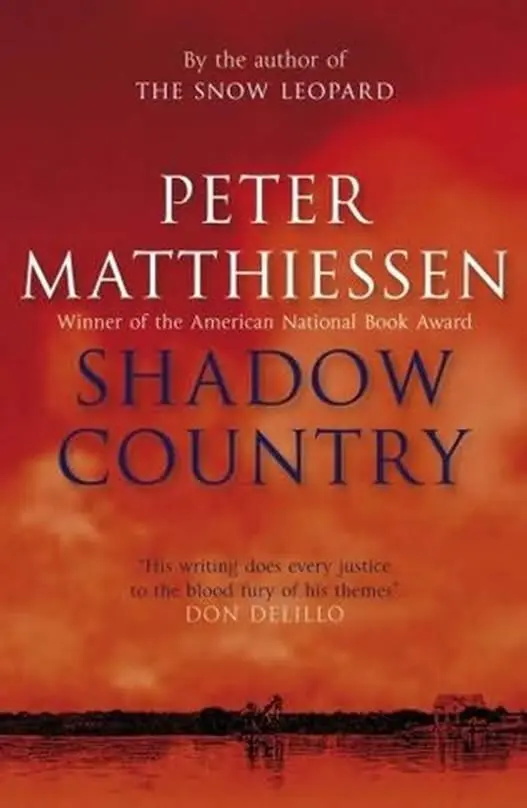
- Название:Shadow Country
- Автор:
- Жанр:
- Год:неизвестен
- ISBN:нет данных
- Рейтинг книги:3 / 5. Голосов: 1
-
Избранное:Добавить в избранное
- Отзывы:
-
Ваша оценка:
Shadow Country: краткое содержание, описание и аннотация
Предлагаем к чтению аннотацию, описание, краткое содержание или предисловие (зависит от того, что написал сам автор книги «Shadow Country»). Если вы не нашли необходимую информацию о книге — напишите в комментариях, мы постараемся отыскать её.
Peter Matthiessen's great American epic-Killing Mister Watson, Lost Man's River, and Bone by Bone-was conceived as one vast mysterious novel, but because of its length it was originally broken up into three books. In this bold new rendering, Matthiessen has cut nearly a third of the overall text and collapsed the time frame while deepening the insights and motivations of his characters with brilliant rewriting throughout. In Shadow Country, he has marvelously distilled a monumental work, realizing his original vision.
Inspired by a near-mythic event of the wild Florida frontier at the turn of the twentieth century, Shadow Country reimagines the legend of the inspired Everglades sugar planter and notorious outlaw E. J. Watson, who drives himself relentlessly toward his own violent end at the hands of neighbors who mostly admired him, in a killing that obsessed his favorite son.
Shadow Country traverses strange landscapes and frontier hinterlands inhabited by Americans of every provenance and color, including the black and Indian inheritors of the archaic racism that, as Watson's wife observed, "still casts its shadow over the nation."
Peter Matthiessen's lyrical and illuminating work in the Watson narrative has been praised highly by such contemporaries as Saul Bellow, William Styron, and W. S. Merwin. Joseph Heller said "I read it in great gulps, up each night later than I wanted to be, in my hungry impatience to find out more and more."
Shadow Country — читать онлайн бесплатно полную книгу (весь текст) целиком
Ниже представлен текст книги, разбитый по страницам. Система сохранения места последней прочитанной страницы, позволяет с удобством читать онлайн бесплатно книгу «Shadow Country», без необходимости каждый раз заново искать на чём Вы остановились. Поставьте закладку, и сможете в любой момент перейти на страницу, на которой закончили чтение.
Интервал:
Закладка:
Rarely caught in the cane field, Tant fished and hunted our wild food, harvesting wild duck in the creeks and sloughs and sometimes a few of those black pigeons that hurtled up and down the river in the early morning. He was a tall and lanky feller with a small head and a comical tuft for a mustache, and he made me laugh right from the start, distracting my attention from his natural traits of bone laziness and alcohol addiction. Tant understood long before I did that I would tolerate his flaws of character only so long as he kept me amused.
One day at Chokoloskee, knowing I was watching, this fellow snuck up on Adolphus Santini’s cow pen, causing a regular stampede by poking his head over the fence and ducking down, up and down, over and over, until those critters went crazy with suspense, galumphing around colliding with one another. I got laughing so hard I could hardly find my breath, even when Dolphus ran out hollering. Seeing me there, Old Man Dolphus folded his big arms like an old blue heron folding its big wings. Never said one word.
Another day we were out shooting white ibis for our supper, back over toward what is now called Watson Prairie. A big gator maybe twelve foot long was crossing some dry palmetto ground between two sloughs, and
S. S. Jenkins, drunk as usual, yells, “Look here, Mister Ed!” Ran across the clearing and jumped onto that reptile piggyback, threw an arm lock around the jaw, crossed his ankles under the belly, all the while whooping like an Injun. That big gator was so scared it hauled Tant all over the palmettos, you never heard such a racket in your life, and that fool never let go till he hit the water. “That’s the last time I will ever take a bath,” Tant told us when he crawled out on the bank. “Don’t see no sense to it.”
Tant had always been a bachelor and never so much as considered female companionship except when drunk. One evening he approached his half sister on his hands and knees, said, “Netta, I aim to go get me a bride! All you got to do is recommend me, Netta, and I’ll try to live up to it!” Netta just smiled. She loved Tant the way he was, never tried to change him and never tried to find him a wife, either, knowing how hopeless that would be. Like many a lovable, whimsical feller, Tant Jenkins was a very lonesome man.
In the breeding season, in late winter and early spring, we hunted the white egret rookeries, stripping the plumes. These we traded to young Louis and Guy Bradley of Flamingo, who had hunted this coast with the Frenchman back in the ’80s. In October, when the long chill nights would knock down the mosquitoes, Tant baited his old traps, using salt mullet, and set a trapline along creek banks for otter, coon, and possum, which all humped along the shoreline at low tide. The rest of the year, forswearing hard liquor, he’d journey up the creeks into the Glades, as far from honest toil as he could go, returning with wild turkey and deer meat and hides from the hammocks and pine islands. The venison and turkey breasts were salted overnight, then smoked for a few days on palmetto platforms over coals. That smoked meat would keep a good long while before it was soaked to remove the salt, then cooked and eaten. The deer hides were stretched on frames and dried; we sold them for credit at the trading posts, along with his gator hide and coon and otter pelts. Occasionally he brought in a big gopher tortoise or swamp rabbits or other varmints; roasted possum tasted almost like young pig if you tasted hard enough, and the white tail meat of a young gator was fine, too. Tant even ate rattlesnakes he’d skinned out-“Fit for a king!” he’d say. Might have tasted like chicken, as he claimed, but he had that snake meat mostly to himself.
Netta was always disappointed when Stephen, as she called him, failed to bring the small wild key limes and wild grapes. She doted on wild butter beans from the hammock edges and prickly pears dug out for making pie. Occasionally Tant brought palm hearts from the inland hammocks, also coontie root; this sold well in the trading posts as “Florida arrowroot,” a starch for cakes and puddings. However he detested the insect swatting and hard grubbing in hot windless woods that went into every barrel, and the washing and grinding of the pulp, the soaking, fermenting, and drying. For seven cents a pound, he said, that was too much common labor, and anyway, “I can’t abide the feel of sweat and never could.” So Netta mostly baked her dough using salt and boiling water and her bread came out like a loaf of hardtack cracker. Well, we told her, hardtack was better than the gray bread in C. G. McKinney’s trading post, which C. G. himself sold as “fresh wasp nest.”
Cash being scarce on the frontier, most trade was barter. I’d swap cane syrup for big oranges, two for a penny, or saltwater oysters, sixty cents a barrel. At Key West or Tampa Bay, such treats as coffee beans and olive oil and chocolate were available, and sacks of onions and potatoes from the North. On the Bend, we ate better and a whole lot more than I had ever eaten in my life, which made me worry about Mandy and the children.
In April of 1895, a baby daughter was delivered to Henrietta by Richard Harden. Her mother named her Minnie after my sister. Having wanted a son, I was ready to call her “Ninny” and be done with it but Netta would not hear of such a joke.
For a gentle person, Netta had some courage. One day when my old horse Job the Younger would not pull the plow no matter how hard I switched him, I lost my temper and grabbed up a length of two-by-four to knock some sense into his head. Netta called out through the window, “Mister Watson! Don’t you do that, Mister Watson!” I felt sheepish. “Sometimes I’m a damned fool, Netta,” I told her later. I was sorry she had scared herself so bad that she begged forgiveness.
CASTING ASPARAGUS ON A MAN’S HONOR
Netta’s mother had made Catholics out of her children and Netta’s sister had married Tino Santini, a Corsican from a Catholic family who saw no sin in rum-running but had no tolerance for common-law marriage, never mind bastards. That Santini gossip about Minnie’s parentage got started after my scrape with Tino’s brother at a produce auction in Key West. I was drunk, they tell me, and Adolphus, too. I meant to leave him a thin scar as a reminder to be more civil to Ed Watson, but unfortunately my knife blade nicked his jugular, splattered Corsican blood across baskets of asparagus, making me look like a bloodthirsty villain. Scurrilous remarks about my past were what had started it. (“Mr. Santini cast asparagus on a man’s honor,” said Tant Jenkins.) Dolphus wound up in the hospital with a sore throat while I was obliged to fork over what was left of my Arcadia earnings to settle the matter out of court.
Having pocketed my nine hundred dollars, Santini wrote to Governor Mitchell complaining that his assailant had never been brought before the bar of justice. I learned this from my drinking companion the U.S. Attorney at Key West, who kept me well-informed in legal matters. (When Dolphus learned that I knew about his letter, he lost his zeal for justice, sold his Chokoloskee house, and sailed away to the east coast at the Miami River.)
Sheriff Knight wanted to hold me in the Key West jail while he looked into Santini’s story that E. J. Watson was a desperado, wanted by the law somewhere out West. With his bald eye and sour nature, Knight had been after me ever since he coughed up the reward in the Will Raymond case. This time he sent away on his new telegraph to find out what he could but I left Key West before word came. The governor’s office sent a query to Sheriff Knight who sent a deputy to bring me in for questioning. Because this deputy, Clarence Till, planned to run for sheriff in the next election, he struck Knight as just the man to travel a hundred miles by sea to a wild river to arrest a dangerous fugitive single-handed. I got the drop on Clarence, took his guns away, and put him straight to work out in the cane. Had more guts than brains but a real nice young feller all the same. After two hard weeks I told him, “Clarence, let that be your lesson.” I put him back into his boat and waved good-bye. Deputy Till thought the world of me and waved back with a big grin. Disgusted with the sheriff, who had made no effort to send after him, he returned to Key West singing my praises as the only man of progress in that wilderness. In later years, Clarence did his best to look the other way when I cut up rough while seek-ing recreation in his city.
Читать дальшеИнтервал:
Закладка:
Похожие книги на «Shadow Country»
Представляем Вашему вниманию похожие книги на «Shadow Country» списком для выбора. Мы отобрали схожую по названию и смыслу литературу в надежде предоставить читателям больше вариантов отыскать новые, интересные, ещё непрочитанные произведения.









Обсуждение, отзывы о книге «Shadow Country» и просто собственные мнения читателей. Оставьте ваши комментарии, напишите, что Вы думаете о произведении, его смысле или главных героях. Укажите что конкретно понравилось, а что нет, и почему Вы так считаете.