Peter Matthiessen - Shadow Country
Здесь есть возможность читать онлайн «Peter Matthiessen - Shadow Country» весь текст электронной книги совершенно бесплатно (целиком полную версию без сокращений). В некоторых случаях можно слушать аудио, скачать через торрент в формате fb2 и присутствует краткое содержание. Жанр: Современная проза, на английском языке. Описание произведения, (предисловие) а так же отзывы посетителей доступны на портале библиотеки ЛибКат.
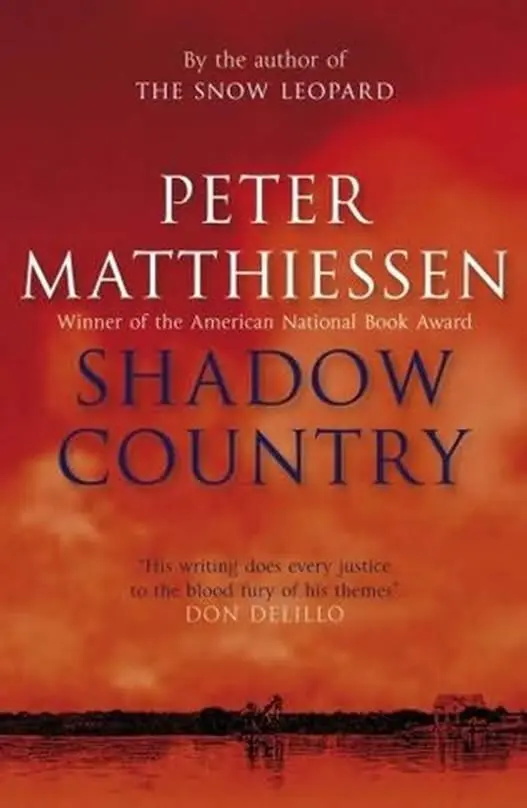
- Название:Shadow Country
- Автор:
- Жанр:
- Год:неизвестен
- ISBN:нет данных
- Рейтинг книги:3 / 5. Голосов: 1
-
Избранное:Добавить в избранное
- Отзывы:
-
Ваша оценка:
Shadow Country: краткое содержание, описание и аннотация
Предлагаем к чтению аннотацию, описание, краткое содержание или предисловие (зависит от того, что написал сам автор книги «Shadow Country»). Если вы не нашли необходимую информацию о книге — напишите в комментариях, мы постараемся отыскать её.
Peter Matthiessen's great American epic-Killing Mister Watson, Lost Man's River, and Bone by Bone-was conceived as one vast mysterious novel, but because of its length it was originally broken up into three books. In this bold new rendering, Matthiessen has cut nearly a third of the overall text and collapsed the time frame while deepening the insights and motivations of his characters with brilliant rewriting throughout. In Shadow Country, he has marvelously distilled a monumental work, realizing his original vision.
Inspired by a near-mythic event of the wild Florida frontier at the turn of the twentieth century, Shadow Country reimagines the legend of the inspired Everglades sugar planter and notorious outlaw E. J. Watson, who drives himself relentlessly toward his own violent end at the hands of neighbors who mostly admired him, in a killing that obsessed his favorite son.
Shadow Country traverses strange landscapes and frontier hinterlands inhabited by Americans of every provenance and color, including the black and Indian inheritors of the archaic racism that, as Watson's wife observed, "still casts its shadow over the nation."
Peter Matthiessen's lyrical and illuminating work in the Watson narrative has been praised highly by such contemporaries as Saul Bellow, William Styron, and W. S. Merwin. Joseph Heller said "I read it in great gulps, up each night later than I wanted to be, in my hungry impatience to find out more and more."
Shadow Country — читать онлайн бесплатно полную книгу (весь текст) целиком
Ниже представлен текст книги, разбитый по страницам. Система сохранения места последней прочитанной страницы, позволяет с удобством читать онлайн бесплатно книгу «Shadow Country», без необходимости каждый раз заново искать на чём Вы остановились. Поставьте закладку, и сможете в любой момент перейти на страницу, на которой закончили чтение.
Интервал:
Закладка:
Captain Penny and I were especially convivial since we shared a liking for hard drink and dark humor; he suggested that we might “do some business.” However, I had already perceived that Penny was only a small cog (a very large small cog) in the great engine of our nation’s progress. The very next day, introduced by Penny at the Catherine Street mansion of the cigar tycoon Teodoro Pйrez, I made the acquaintance of Napoleon Broward, Esq., who was already preparing for the dashing role in Cuban liberation which would get him elected governor of Florida a few years later. With Mr. Broward was the Cuban revolutionary Josй Martн, a pale small man, very thin and tense, with more hair in his long sad moustachios than on his pate: Josй Martн’s financial support in the fight for Cuban independence came mostly from these rich cigar manufacturers in Key West and Tampa.
Napoleon Broward was a bold sanguinary man of direct action, in the mold of Gould and Astor, Carnegie and Frick-in short, a man who could be counted on not to be squeamish about how the nation’s progress was achieved while never losing sight of his private interests, whether in politics or in industry and business. To the sweet chortling of redbirds, which our cultivated Spanish host displayed in small wicker cages like crimson canaries, Broward spoke admiringly of Hamilton Disston, who had pioneered the shipping canal connecting Lake Okeechobee to the Calusa Hatchee River and the Gulf, and I made bold to mention some of my own ideas about the drainage of the Everglades for large-scale agriculture and also the eventual development of the virgin southwest coast and the Ten Thousand Islands. Here Broward raised his beetled brows: “Hold on there, my friend.” Mistaking our host, Seсor Pйrez, for the butler, he snapped his fingers and commanded him to fetch Mr. Watson and himself another round of brandy and cigars.
Broward remarked that we had common interests and must by all means stay in touch. By the time we met again in the year following, I had studied all the Everglades reports, all the way back to the visionary schemes of Buckingham Smith, who had written the first drainage recommendation in the days of the Seminole Wars; I also furnished him the details of that 1850 Act of Congress which had patented this entire “swamp-and-overflowed wilderness” to the state of Florida. As early as the 1860s, a colonel of the Army Engineers had estimated that if Lake Okeechobee’s water level could be lowered by six feet, nine inches-the approximate fall from the lake to the Atlantic-the vast wetlands from the Kissimmee River south could be settled and cultivated without fear of annual overflow and flood.
“By God, Watson, you intrigue me!” Flushed and fulsome, Broward vowed that if he were ever to be elected governor as was his ambition, E. J. Watson would be summoned to the state capital at once to help set Glades development in motion. “You’re an up-and-coming feller, Ed,” Nap said warmly as we parted. “If I am elected, you can write your own damn ticket.” By God, I thought, it’s happening! I’m on my way!
ON CHATHAM BEND
Taking a Key West nigra and a mule, I went straight home to Chatham Bend. With some half-ass help from Erskine Thompson, who placed little value on hard labor, I got that high ground in production in a hurry since there was no real forest to contend with. The Calusa who had a village here before the Seminole Wars had kept the jungle down, and since then, a fisherman, Richard Harden, then the old plume hunter Jean Chevelier-the last occupant before the late Will Raymond-had burned it over every year to discourage jungle scrub. What settlers wanted around any dwelling was nice bare ground that provided no cover for bad snakes, not to mention the no-see-ums and mosquitoes. In regard to discomfort and disease, the most dangerous creature in the Glades by far was the mosquito, which had driven men cast away or stranded on this coast to madness, even death.
With the rains in spring and fall, the river became a broad and burly flood, sandy brown and heavy with Glades silt, leaving thick crusts on the marl behind the mangrove fringes. Because the river was brackish from the tides, what we drank (before my rain gutters and a cistern were put in) was dead water from a rain barrel, and very glad to have that, too, in this salt country. That first year I built a palmetto log house with palm thatch roof-two big rooms and an outside kitchen. Next came a small dock, then a big shed, then a pasture with limb fenceposts cut from the red gumbo-limbo tree, which will take root when stuck into the ground. By the end of the year, my horse Job, a mule, a milk cow, and five hogs cohabited the old Raymond shack-more livestock than any settler south of Chokoloskee. All that was missing now was Mandy and the children.
Clearing off that second growth was hot and wearisome, and turning over the black soil, packed hard with shell, was worse. That shell had to be chipped out with a pickax, though once it was reduced to soil, it was black and fertile. I started out with tomatoes and peppers, then peas, beets, radishes, and turnips. All sprouted fine, but by the time we got our produce to Key West, it looked old and limp, half-spoiled. We grew our kitchen vegetables, of course, and planted fruit trees-bananas, mangoes, guavas, papayas, citrus.
Chatham Bend was the first good ground I ever worked on my own behalf rather than leasing or sharecropping for someone else, but truck farming would never make my fortune in the Islands. The following year we cleared more ground and grew a crop of sugarcane on about ten acres. Cane is a cast-iron plant that can survive flood, fire, and brief freezing and does not spoil in the shipping like fresh produce. As a perennial, it yields four or five crops before new cuttings must be planted: I worked out how to double-crop with cow peas to restore the soil and planned to rest each section every few years, leaving it fallow. Learning quickly that cane stalks were too bulky to ship economically to a market eighty miles away, I increased crop acreage, brought a crew in for the harvest, and switched to the manufacture of cane syrup-the first planter in the Islands ever to try it. (I had already replaced the small Veatlis with a sixty-eight-foot schooner called the Gladiator. )
The cane harvest extended till late winter, early spring, when I got rid of all my crew except Erskine and my new housekeeper, Henrietta Daniels, Erskine’s mother. Though glad to have a roof over her head, Netta was terrified of the wild people, and hid back in the house at the first glimpse of a dugout-very strange, since many of her Daniels kin had Injun blood.
Netta Daniels had led an errant life, working as a tobacco stripper in the Key West cigar factories and marrying often. Despite her trials, she remained a fervent Catholic, never danced nor swore nor slept in the same bed with a man who had been drinking, as I discovered on the night of her arrival.
“Listen,” I told her the next day, “it’s not seemly for a lady to sleep in the same room with her son. That kind of behavior will not be tolerated on the Bend.” After that, she bunked with me, which is pretty much the way I’d planned it in the first place. She was a few years older than myself, with hazel-green eyes and light brown hair and small cupped ears that made her look kind of crestfallen when she was tired. Still, she was a pretty woman and a willing one. She would clean a little but not much, can our preserves and feed the chickens, do simple cooking and her bounden duty by her master, namely me.
Erskine mostly ran the boat and slopped the hogs and did a few odd jobs when we could find him. So did Netta’s half brother Stephen, who turned up not long thereafter. Mr. S. S. Jenkins, as he introduced himself, was more commonly called Tant. He was mostly famous for the moonshine or “white lightning” he manufactured from raw sugar and chicken feed (a half sack of corn and a half sack of sugar in a charred oak barrel: that oak barrel, which he lugged everywhere, was his trade secret). Ferment worked quickly in this climate, and the “buck,” as he called it, was ready to distill in about ten days, but Tant was tasting it for flavor long before that. “Comin along real nice, Mister Ed!” he’d whoop, to keep my hopes up, but by the time he got that shine distilled, he had drunk most of it and had to start all over. Sometimes all we got out of the deal were the checkered feed sacks from his corn that Netta saved to make our shirts. Although still a young man, Mr. S. S. Jenkins was twitching like the dickens, he had to fold his arms around his chest just to stay put in his chair.
Читать дальшеИнтервал:
Закладка:
Похожие книги на «Shadow Country»
Представляем Вашему вниманию похожие книги на «Shadow Country» списком для выбора. Мы отобрали схожую по названию и смыслу литературу в надежде предоставить читателям больше вариантов отыскать новые, интересные, ещё непрочитанные произведения.






Обсуждение, отзывы о книге «Shadow Country» и просто собственные мнения читателей. Оставьте ваши комментарии, напишите, что Вы думаете о произведении, его смысле или главных героях. Укажите что конкретно понравилось, а что нет, и почему Вы так считаете.