Чимаманда Адичи - Purple hibiscus
Здесь есть возможность читать онлайн «Чимаманда Адичи - Purple hibiscus» — ознакомительный отрывок электронной книги совершенно бесплатно, а после прочтения отрывка купить полную версию. В некоторых случаях можно слушать аудио, скачать через торрент в формате fb2 и присутствует краткое содержание. Год выпуска: 2003, ISBN: 2003, Издательство: Algonquin Books of Chapel Hill, Жанр: Современная проза, на английском языке. Описание произведения, (предисловие) а так же отзывы посетителей доступны на портале библиотеки ЛибКат.
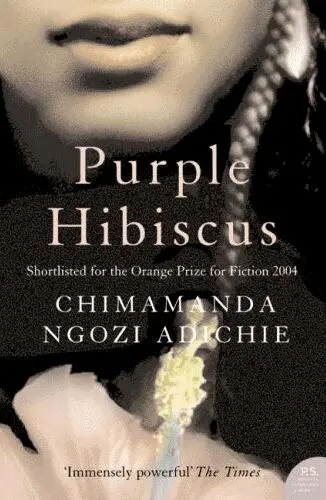
- Название:Purple hibiscus
- Автор:
- Издательство:Algonquin Books of Chapel Hill
- Жанр:
- Год:2003
- ISBN:1-56512-387-5
- Рейтинг книги:5 / 5. Голосов: 1
-
Избранное:Добавить в избранное
- Отзывы:
-
Ваша оценка:
Purple hibiscus: краткое содержание, описание и аннотация
Предлагаем к чтению аннотацию, описание, краткое содержание или предисловие (зависит от того, что написал сам автор книги «Purple hibiscus»). Если вы не нашли необходимую информацию о книге — напишите в комментариях, мы постараемся отыскать её.
Purple hibiscus — читать онлайн ознакомительный отрывок
Ниже представлен текст книги, разбитый по страницам. Система сохранения места последней прочитанной страницы, позволяет с удобством читать онлайн бесплатно книгу «Purple hibiscus», без необходимости каждый раз заново искать на чём Вы остановились. Поставьте закладку, и сможете в любой момент перейти на страницу, на которой закончили чтение.
Интервал:
Закладка:
Amaka made feeble attempts to pull her off. Obiora and Jaja dashed into the room. And I imagined our forebears a century ago, the ancestors Papa-Nnukwu prayed to, charging in to defend their hamlet, coming back with lolling heads on long sticks.
"What is it, Mom?" Obiora asked. The bottom of his trousers clung to his leg where water from the tap had splashed on it.
"Papa-Nnukwu is alive," Jaja said in English, with authority, as if doing so would make his words come true. The same tone God must have used when He said "Let there be Light." Jaja wore only the bottom of his pajamas, which was also splattered with water. For the first time, I noticed the sparse hair on his chest.
"Nna m o!" Aunty Ifeoma was still clutching Papa-Nnukwu.
Obiora started to breathe in a noisy, rasping way. He bent over Aunty Ifeoma and grasped her, slowly prying her away from Papa-Nnukwu's body. "O zugo, it is enough, Mom. He has joined the others." His voice had a strange timber. He helped Aunty Ifeoma up and led her to sit on the bed. She had the same blank look in her eyes that Amaka had, standing there, staring down at Papa-Nnukwu's form. "I will call Doctor Nduoma," Obiora said.
Jaja bent down and covered Papa-Nnukwu's body with the; wrapper, but he did not cover his face even though the wrapper was long enough. I wanted to go over and touch Papa-Nnukwu, touch the white tufts of hair that Amaka oiled, smooth the wrinkled skin of his chest. But I would not. Papa would be outraged. I closed my eyes then so that if Papa asked if I had seen Jaja touch the body of a heathen-it seemed more grievous, touching Papa-Nnukwu in death-I could truthfully say no, because I had not seen everything that Jaja did.
My eyes remained closed for a long time, and it seemed that my ears too, were closed, because although I could hear the sound of voices, I did not make out what they said. When I finally opened my eyes, Jaja sat on the floor, next to Papa-Nnukwu's sheathed frame. Obiora sat on the bed with Aunty Ifeoma, who was speaking. "Wake Chima up, so we can tell him before the people from the mortuary come."
Jaja stood up to go and wake Chima. He wiped at the tears that slid down his cheeks as he went. "I will clean where the ozu lay, Mom," Obiora said. He let out sporadic choking sounds, crying deep in his throat. I knew that the reason he did not cry out loud was because he was nwoke in the house, the man Aunty Ifeoma had by her side.
"No," Aunty Ifeoma said. "I will do it." She stood up then and hugged Obiora, and they held on to each other for a long time.
I went toward the bathroom, the word ozu ringing in my ears. Papa-Nnukwu was an ozu now, a corpse. The bathroom door did not give when I tried to open it, and I pushed harder to make sure it was really locked. Sometimes it got stuck because of the way the wood expanded and contracted. Then I heard Amaka's sobbing. It was loud and throaty; she laughed the way she cried. She had not learned the art of silent crying; she had not needed to. I wanted to turn and go away, to leave her with her grief. But my underwear already felt wet, and I had to move my weight from leg to leg to hold the urine back. "Amaka, please, I have to use the toilet," I whispered, and when she did not respond, I repeated it loudly. I did not want to knock; knocking would intrude rudely on her tears. Finally, Amaka unlocked the door and opened it. I urinated as quickly as I could because I knew she stood just outside, waiting to go back in and sob behind the locked door.
The two men who came with Doctor Nduoma carried Papa-Nnukwu's stiffening body in their hands, one holding his underarms and the other his ankles. They could not get the stretcher from the medical center because the medical administrative staff was on strike, too. Doctor Nduoma said "Ndo" to all of us, the smile still on his face. Obiora said he wanted to accompany the ozu to the mortuary; he wanted to see them put the ozu in the fridge. But Aunty Ifeoma said no, he did not have to see Papa-Nnukwu put in the fridge. The word fridge floated around in my head. I knew where they put corpses in the mortuary was different, yet I imagined Papa-Nnukwu's body being folded into a home refrigerator, the kind in our kitchen. Obiora agreed not to go to the mortuary, but he followed the men and watched closely as they loaded the ozu into the station wagon ambulance. He peered into the back of the car to make sure that there was a mat to lay the ozu on, that they would not just lay it down on the rusty floor.
After the ambulance drove off, followed by Doctor Nduoma in his car, I helped Aunty Ifeoma carry Papa-Nnukwu's mattress to the verandah. She scrubbed it thoroughly with Omo detergent and the same brush Amaka used to clean the bathtub. "Did you see your Papa-Nnukwu's face in death, Kambili?" Aunty Ifeoma asked, leaning the clean mattress against the metal railings to dry.
I shook my head. I had not looked at his face. "He was smiling," she said. "He was smiling."
I looked away so Aunty Ifeoma would not see the tears on my face and so I would not see the tears on hers. There was not much talking in the flat; the silence was heavy and brooding. Even Chima curled up in a corner for much of the morning, quietly drawing pictures. Aunty Ifeoma boiled some yam slices, and we ate them dipped in palm oil that had chopped red peppers floating in it.
Amaka came out of the bathroom hours after we had eaten, her eyes swollen, her voice hoarse. "Go and eat, Amaka. I boiled yam," Aunty Ifeoma said.
"I did not finish painting him. He said we would finish it today."
"Go and eat, inugo" Aunty Ifeoma repeated.
"He would be alive now if the medical center was not on strike," Amaka said.
"It was his time," Aunty Ifeoma said. "Do you hear me? It was simply his time."
Amaka stared at Aunty Ifeoma and then turned away. I wanted to hug her, to say "ebezi na" and wipe away her tears. I wanted to cry loudly, in front of her, with her. But I knew it might anger her. She was already angry enough. Besides, I did not have a right to mourn Papa-Nnukwu with her; he had been her Papa-Nnukwu more than mine. She had oiled his hair while I kept away and wondered what Papa would say if he knew.
Jaja put his arm around her and led her into the kitchen. She shook free of him, as if to prove she did not need support, but she walked close to him. I stared after them, wishing I had done that instead of Jaja.
"Somebody just parked in front of our flat," Obiora said. He had taken off his glasses to cry, but now he had them back on, and he pushed them up the bridge of his nose as he got up to look outside.
"Who is it?" Aunty Ifeoma asked, tiredly. She could not care less who it was.
"Uncle Eugene."
I froze on my seat, felt the skin of my arms melding and becoming one with the cane arms of the chair. Papa-Nnukwu's death had overshadowed everything, pushed Papa's face into a vague place. But that face had come alive now. It was at the door, looking down at Obiora. Those bushy eyebrows were not familiar; neither was that shade of brown skin. Perhaps if Obiora had not said, "Uncle Eugene," I would not have known that it was Papa, that the tall stranger in the well-tailored white tunic was Papa.
"Good afternoon, Papa," I said, mechanically.
"Kambili, how are you? Where is Jaja?"
Jaja came out of the kitchen then and stood staring at Papa. "Good afternoon, Papa," he finally said.
"Eugene, I asked you not to come," Aunty Ifeoma said, in the same tired tone of one who did not really care. "I told you I would bring them back tomorrow."
"I could not let them stay an extra day," Papa said, looking around the living room, toward the kitchen and then the hallway, as if waiting for Papa-Nnukwu to appear in a puff of heathen smoke.
Obiora took Chima by the hand and went out to the verandah. "Eugene, our father has fallen asleep," Aunty Ifeoma said.
Читать дальшеИнтервал:
Закладка:
Похожие книги на «Purple hibiscus»
Представляем Вашему вниманию похожие книги на «Purple hibiscus» списком для выбора. Мы отобрали схожую по названию и смыслу литературу в надежде предоставить читателям больше вариантов отыскать новые, интересные, ещё непрочитанные произведения.



![О Генри - Пурпурное платье [The Purple Dress]](/books/405339/o-genri-purpurnoe-plate-the-purple-dress-thumb.webp)






Обсуждение, отзывы о книге «Purple hibiscus» и просто собственные мнения читателей. Оставьте ваши комментарии, напишите, что Вы думаете о произведении, его смысле или главных героях. Укажите что конкретно понравилось, а что нет, и почему Вы так считаете.