Чимаманда Адичи - Purple hibiscus
Здесь есть возможность читать онлайн «Чимаманда Адичи - Purple hibiscus» — ознакомительный отрывок электронной книги совершенно бесплатно, а после прочтения отрывка купить полную версию. В некоторых случаях можно слушать аудио, скачать через торрент в формате fb2 и присутствует краткое содержание. Год выпуска: 2003, ISBN: 2003, Издательство: Algonquin Books of Chapel Hill, Жанр: Современная проза, на английском языке. Описание произведения, (предисловие) а так же отзывы посетителей доступны на портале библиотеки ЛибКат.
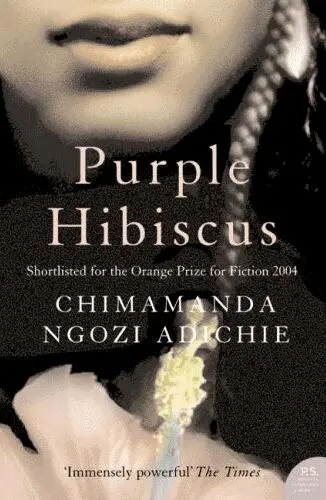
- Название:Purple hibiscus
- Автор:
- Издательство:Algonquin Books of Chapel Hill
- Жанр:
- Год:2003
- ISBN:1-56512-387-5
- Рейтинг книги:5 / 5. Голосов: 1
-
Избранное:Добавить в избранное
- Отзывы:
-
Ваша оценка:
Purple hibiscus: краткое содержание, описание и аннотация
Предлагаем к чтению аннотацию, описание, краткое содержание или предисловие (зависит от того, что написал сам автор книги «Purple hibiscus»). Если вы не нашли необходимую информацию о книге — напишите в комментариях, мы постараемся отыскать её.
Purple hibiscus — читать онлайн ознакомительный отрывок
Ниже представлен текст книги, разбитый по страницам. Система сохранения места последней прочитанной страницы, позволяет с удобством читать онлайн бесплатно книгу «Purple hibiscus», без необходимости каждый раз заново искать на чём Вы остановились. Поставьте закладку, и сможете в любой момент перейти на страницу, на которой закончили чтение.
Интервал:
Закладка:
Papa called Aunty Ifeoma two days later. Perhaps he would not have called her if we had not gone to confession that day. And perhaps then we would never have gone to Nsukka and everything would have remained the same. It was the feast of the Epiphany, a holy day of obligation, so Papa did not go to work. We went to morning Mass, and although we did not usually visit Father Benedict on holy days of obligation, we went to his house afterward.
Papa wanted Father Benedict to hear our confession. We had not gone in Abba because Papa did not like to make his confession in Igbo, and besides, Papa said that the parish priest in Abba was not spiritual enough. That was the problem with our people, Papa told us, our priorities were wrong; we cared too much about huge church buildings and mighty statues. You would never see white people doing that.
In Father Benedict's house, Mama and Jaja and I sat in the living room, reading the newspapers and magazines that were spread on the low, coffinlike table as if they were for sale, while Papa talked with Father Benedict in the adjoining study room. Papa emerged and asked us to prepare for confession; he would go first. Even though Papa shut the door firmly, I heard his voice, words flowing into each other in an endless rumble like a revving car engine. Mama went next, and the door remained open a crack, but I could not hear her. Jaja took the shortest time. When he came out, still crossing himself as if he had been in too much of a hurry to leave the room, I asked him with my eyes if he had remembered the lie to Papa-Nnukwu, and he nodded.
I went into the room, barely big enough to hold a desk and two chairs, and pushed the door to make sure it shut properly. "Bless me, Father, for I have sinned," I said, sitting on the very edge of the chair. I longed for a confessional, for the safety of the wood cubicle and the green curtain that separated priest and penitent. I wished I could kneel, and then I wished I could shield my face with a file from Father Benedict's desk. Face-to-face confessions made me think of Judgment Day come early, made me feel unprepared.
"Yes, Kambili," Father Benedict said. He sat upright on his chair, fingering the purple stole across his shoulders.
"It has been three weeks since my last confession," I said. I was staring fixedly at the wall, right below the framed photo of the Pope, which had a signature scrawled underneath. "Here are my sins. I lied two times. I broke the Eucharistic fast once. I lost concentration during the rosary three times. For all I have said and for all I have forgotten to say, I beg pardon from your hands and the hands of God."
Father Benedict shifted on his chair. "Go on, then. You know it's a sin against the Holy Spirit to willfully keep something back at confession."
"Yes, Father."
"Go on, then."
I looked away from the wall to glance at him. His eyes were the same green shade of a snake I had seen once, slithering across the yard near the hibiscus bushes. The gardener had said it was a harmless garden snake.
"Kambili, you must confess all your sins."
"Yes, Father. I have."
"It is wrong to hide from the Lord. I will give you a moment to think."
I nodded and stared back at the wall. Was there something I had done that Father Benedict knew about that I did not know? Had Papa told him something? "I spent more than fifteen minutes at my grandfather's house!" I said finally. "My grandfather is a pagan."
"Did you eat any of the native foods sacrificed to idols?"
"No. Father."
"Did you participate in any pagan rituals?"
"No, Father." I paused. "But we looked at mmuo. Masquerades."
"Did you enjoy that?"
I looked up at the photo on the wall and wondered if the Pope himself had actually signed it. "Yes, Father."
"You understand that it is wrong to take joy in pagan ritual, because it breaks the first commandment. Pagan rituals misinformed superstition, and they are the gateway to Hell. Do you understand that, then?"
"Yes, Father."
"For your penance say the Our Father ten times, Hail Mary six times, and the Apostles' Creed once. And you must make a conscious effort to convert everyone who enjoys the ways of heathens."
"Yes, Father."
"All right, then, make the Act of Contrition."
While I recited the Act of Contrition, Father Benedict murmured blessings and made the sign of the cross.
Papa and Mama were still sitting on the sofa, heads bent, when I came out. I sat next to Jaja, bent my head, and made my penance. As we drove home, Papa talked loudly, above the "Ave Maria." "I am spotless now, we are all spotless. If God calls us right now, we are going straight to Heaven. Straight to Heaven. We will not require the cleansing of Purgatory." He was smiling, his eyes bright, his hand gently drumming the steering wheel. And he was still smiling when he called Aunty Ifeoma soon after we got back home, before he had his tea. "I discussed it with Father Benedict, and he says the children can go on pilgrimage to Aokpe but you must make it clear that what is happening there has not been verified by the church." A pause. "My driver, Kevin, will take them." A pause. "Tomorrow is too soon. The day after." A long pause. "Oh, all right. God bless you and the children. Bye."
Papa put the phone down and turned to us. "You will leave tomorrow, so go up and pack your things. Pack for five days."
"Yes, Papa," Jaja and I said together.
"Maybe, anam asi," Mama said, "they should not visit Ifeoma's house empty-handed."
Papa stared at her as if surprised that she had spoken. "We will put some food in the car, of course, yams and rice," he said. "Ifeoma mentioned that gas cylinders were scarce in Nsukka."
"Gas cylinders?"
"Yes, cooking gas. She said she uses her old kerosene stove now. You remember the story of adulterated kerosene that was blowing up stoves and killing people? I thought maybe you might send one or two gas cylinders to her from the factory."
"Is that what you and Ifeoma planned?"
"Kpa, I am just making a suggestion. It is up to you to decide."
Papa examined Mama's face for a while. "Okay," he said. He turned back to Jaja and me. "Go up and pack your things. You can take twenty minutes from your study time."
We climbed the curving stairs slowly. I wondered if Jaja's stomach rumbled at the lower part like mine did. It was the first time in our lives that we would be sleeping outside home without Papa.
"Do you want to go to Nsukka?" I asked when we got to the landing.
"Yes," he said, and his eyes said that he knew I did, too. And I could not find the words in our eye language to tell him how my throat tightened at the thought of five days without Papa's voice, without his footsteps on the stairs.
THE NEXT MORNING, Kevin brought two full gas cylinders from Papa's factory and put them into the boot of the Volvo alongside bags of rice and beans, a few yams, bunches of green plantains, and pineapples. Jaja and I stood by the hibiscus bushes, waiting. The gardener was clipping away at the bougainvillea, taming the flowers that defiantly stuck out the leveled top. He had raked underneath the frangipani trees and dead leaves and pink flowers lay in piles, ready for the wheelbarrow. "Here are your schedules for the week you will stay in Nsukka," Papa said. The sheet of paper he thrust into my hand was similar to the schedule pasted above my study desk upstairs, except he had penciled in two hours of "time with your cousins" each day.
"The only day you are excused from that schedule is when you go to Aokpe with your aunt," Papa said. When he hugged Jaja and then me, his hands were shaking. "I have never been without you two for more than a day."
I did not know what to say, but Jaja nodded and said, "We will see you in a week."
"Kevin, drive carefully. Do you understand?" Papa asked, as we got in the car.
Читать дальшеИнтервал:
Закладка:
Похожие книги на «Purple hibiscus»
Представляем Вашему вниманию похожие книги на «Purple hibiscus» списком для выбора. Мы отобрали схожую по названию и смыслу литературу в надежде предоставить читателям больше вариантов отыскать новые, интересные, ещё непрочитанные произведения.




![О Генри - Пурпурное платье [The Purple Dress]](/books/405339/o-genri-purpurnoe-plate-the-purple-dress-thumb.webp)





Обсуждение, отзывы о книге «Purple hibiscus» и просто собственные мнения читателей. Оставьте ваши комментарии, напишите, что Вы думаете о произведении, его смысле или главных героях. Укажите что конкретно понравилось, а что нет, и почему Вы так считаете.