John Irving - Until I Find You
Здесь есть возможность читать онлайн «John Irving - Until I Find You» весь текст электронной книги совершенно бесплатно (целиком полную версию без сокращений). В некоторых случаях можно слушать аудио, скачать через торрент в формате fb2 и присутствует краткое содержание. Город: New York, Год выпуска: 2005, ISBN: 2005, Издательство: Random House, Жанр: Современная проза, на английском языке. Описание произведения, (предисловие) а так же отзывы посетителей доступны на портале библиотеки ЛибКат.
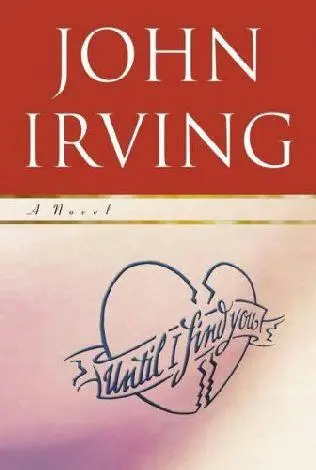
- Название:Until I Find You
- Автор:
- Издательство:Random House
- Жанр:
- Год:2005
- Город:New York
- ISBN:978-1400063833
- Рейтинг книги:5 / 5. Голосов: 1
-
Избранное:Добавить в избранное
- Отзывы:
-
Ваша оценка:
Until I Find You: краткое содержание, описание и аннотация
Предлагаем к чтению аннотацию, описание, краткое содержание или предисловие (зависит от того, что написал сам автор книги «Until I Find You»). Если вы не нашли необходимую информацию о книге — напишите в комментариях, мы постараемся отыскать её.
Alice and Jack abandon their quest, and Jack is educated at schools in Canada and New England — including, tellingly, a girls’ school in Toronto. His real education consists of his relationships with older women — from Emma Oastler, who initiates him into erotic life, to the girls of St. Hilda’s, with whom he first appears on stage, to the abusive Mrs. Machado, whom he first meets when sent to learn wrestling at a local gym.
Too much happens in this expansive, eventful novel to possibly summarize it all. Emma and Jack move to Los Angeles, where Emma becomes a successful novelist and Jack a promising actor. A host of eccentric minor characters memorably come and go, including Jack’s hilariously confused teacher the Wurtz; Michelle Maher, the girlfriend he will never forget; and a precocious child Jack finds in the back of an Audi in a restaurant parking lot. We learn about tattoo addiction and movie cross-dressing, “sleeping in the needles” and the cure for cauliflower ears. And John Irving renders his protagonist’s unusual rise through Hollywood with the same vivid detail and range of emotions he gives to the organ music Jack hears as a child in European churches. This is an absorbing and moving book about obsession and loss, truth and storytelling, the signs we carry on us and inside us, the traces we can’t get rid of.
Jack has always lived in the shadow of his absent father. But as he grows older — and when his mother dies — he starts to doubt the portrait of his father’s character she painted for him when he was a child. This is the cue for a second journey around Europe in search of his father, from Edinburgh to Switzerland, towards a conclusion of great emotional force.
A melancholy tale of deception,
is also a swaggering comic novel, a giant tapestry of life’s hopes. It is a masterpiece to compare with John Irving’s great novels, and restates the author’s claim to be considered the most glorious, comic, moving novelist at work today.
Until I Find You — читать онлайн бесплатно полную книгу (весь текст) целиком
Ниже представлен текст книги, разбитый по страницам. Система сохранения места последней прочитанной страницы, позволяет с удобством читать онлайн бесплатно книгу «Until I Find You», без необходимости каждый раз заново искать на чём Вы остановились. Поставьте закладку, и сможете в любой момент перейти на страницу, на которой закончили чтение.
Интервал:
Закладка:
Jack was reminded of Mrs. Oastler buying his clothes for Redding—later, for Exeter—and he commented to Emma that he felt remiss for never thanking her mother. Emma was spreading the gel through his hair with her hands, a little roughly. “ And she paid my tuition at both schools,” Jack added. “Your mom must think I’m ungrateful.”
“Please don’t thank her, honey pie.”
“Why not?” he asked.
“Just don’t, ” Emma said, yanking his hair.
It was evident that no one had dressed Myra Ascheim as attentively as Leslie Oastler and Emma had dressed Jack. He first mistook Myra for a homeless person who’d wandered east on Montana from that narrow strip of park on the Pacific side of Ocean Avenue. She was smoking a cigarette on the sidewalk in front of the Marmalade Café—a woman in her late sixties, maybe seventy, wearing dirty running shoes, baggy gray sweatpants, and a faded-pink, unlaundered sweatshirt. With her lank, dirty-white hair—in a ponytail that protruded from an Anaheim Angels baseball cap, from which the halo had fallen off the letter A— Myra bore no resemblance to her younger and far more stylish sister, Mildred.
She even toted an overstuffed shopping bag, in which she carried an old raincoat. Jack walked right by her. It wasn’t until Myra spoke to him that he recognized her, and then it was only because she had Milly’s porn-producer voice. “You should lose the stubble,” she said, “and go easy on the gel in your hair. You look like you’ve been sleeping under a car.”
“Ms. Ascheim?” he asked.
“What a bright boy you are, Jack Burns. And don’t listen to Lawrence—you’re not too pretty.”
“Lawrence said I was too pretty?” Jack asked, holding the door for her.
“Lawrence is a fink and a liar. You can’t be too pretty in this town,” Myra Ascheim said. “Or too successful.”
The issue of how successful, or not, Myra Ascheim had ever been was never made clear to Jack—or, to his knowledge, to anyone else. No one had either corroborated or repudiated the Hollywood legends attached to Myra, all of them stories about who she used to be. Was she once an agent whom I.C.M. wooed away from William Morris, or did C.A.A. woo her away from I.C.M.? Was she eventually fired from all three agencies, or did she go off on her own of her own volition? Did she once represent Julia Roberts? Was it Sharon Stone she was supposed to have “discovered,” or was that Demi Moore? And was Myra truly the first person to refer to Demi as Gimme Moore?
Jack later ran into Lawrence at the bar of Raffles L’Ermitage—not Jack’s favorite hotel in Beverly Hills, but a watering hole Lawrence loved. Lawrence told Jack that Demi Moore’s nickname of “Gimme” was his idea, not Myra’s. But Myra was right—Lawrence was a fink and a liar. And whether or not Myra Ascheim ever represented Julia Roberts, Myra had maintained her contacts with casting directors—almost all of whom liked her. Even if Myra no longer represented anyone, casting directors still returned her calls.
Bob Bookman, who was Emma’s agent at C.A.A. before he became Jack’s, told Jack a story about Myra’s identifying baseball cap. She wasn’t an Anaheim fan—she didn’t even like baseball. She liked the A on the hat, but she detested the halo. “It’s an A-list hat, but I’m no angel,” she liked to say.
According to Bob Bookman, Myra bought an Angels cap every year and removed the halo with a pair of fingernail clippers. “I saw her do it over lunch,” Bookman said. “Myra snipped off the halo while she was waiting for her Cobb salad.” The Cobb salad made the story ring true; aside from breakfast, a Cobb salad was all Jack ever saw Myra eat.
Alan Hergott—who became Jack’s entertainment lawyer—said that Myra always left the same message on his answering machine. “Call me back or I’ll sue your pants off.” That sounded like Myra.
“In this town, you get tired of hearing something you already know,” Alan told Jack. “You’re supposed to sound or at least look interested, but you know more about the story than the guy who’s telling you the story does. Myra’s different. She always knows something you don’t know. True or not—it doesn’t matter.”
In Hollywood, there were as many Myra Ascheim stories as there were stories about Milton Berle’s penis. And to think that Jack Burns met her because his schlong was small, or small ish— and only because he met her porn-producer sister, Milly, first! In fact, if it hadn’t been for Lawrence, Jack might never have met the Ascheim sisters, and he met Lawrence only because the fink wanted to bang Emma. (Knowing Emma, she probably had an instinct that steered her away from Lawrence—maybe his schlong was all wrong for her, or she knew that Lawrence would never relinquish the top position.)
“Actually, I’m no longer an agent,” Myra told Jack over their breakfast at Marmalade. They were sitting at a kind of picnic table—communal dining in Santa Monica. “My sister and I have created a talent-management company.” This information confused Jack, given his limited (albeit specific) knowledge of the other Ascheim. But he would make a point of never trying to grasp how the industry worked. From the beginning, Jack Burns realized that his job was getting a job. He already knew how to be an actor.
A man had spread a newspaper over one end of the picnic table; he sat on the bench beside Jack, muttering, as if he bore a lifelong grudge against the news. At the other end of the table, nearer to Myra than to Jack, was a family of four—a young, harried couple with two quarreling children.
Like Rottweiler, Myra Ascheim had plucked Bruno Litkins from Jack’s résumé. “The gay heron,” as Jack had called Bruno, was the only marketable name among Jack’s earliest supporters. “I don’t suppose you are a transvestite—you just know how to look like one,” Myra said.
“I just know how to look like one,” Jack concurred.
“I’ll let you know, Jack, when I sense a surfeit of transsexual roles.”
The children at Myra’s end of the table were bothering her. A little boy, maybe six or seven, had ordered the oatmeal with sliced bananas; then he picked all the bananas out. He wanted some of his older sister’s bacon instead, but she wouldn’t give him any. “If you wanted bacon, you should have ordered it,” the children’s mother kept telling him.
“You can have my bananas,” the boy told his sister, but the bacon was not negotiable—not for bananas.
“Look—there’s a lesson here,” Myra said crossly to the little boy. “You want her bacon, but you’ve got nothing she wants. That’s not how you make a deal.”
In the movie business, Jack was learning, meeting people was an audition. You didn’t even have to know which part you were auditioning for; you just picked a part and played it, any part. Jack looked at the little girl who had the bacon. She was nine or ten; she had three strips of bacon. She was his audience of one, for the moment, but Jack was auditioning for Myra Ascheim, and Myra knew it.
In Blade Runner, Rutger Hauer plays the blond android—the last to die. He holds Harrison Ford’s life in his hands, but Rutger is dying; he’d rather have someone to talk to than die alone. “I’ve seen things you people wouldn’t believe,” Rutger Hauer says. That was the moment Jack had in mind.
That was the tone of voice Jack adopted when he spoke to the girl about her bacon. “I have a younger brother,” Jack-as-Rutger-Hauer began. “He was always asking me for my stuff—he wanted my bacon, just like your brother wants yours. Maybe I should have given him the bacon, at least one strip.”
Читать дальшеИнтервал:
Закладка:
Похожие книги на «Until I Find You»
Представляем Вашему вниманию похожие книги на «Until I Find You» списком для выбора. Мы отобрали схожую по названию и смыслу литературу в надежде предоставить читателям больше вариантов отыскать новые, интересные, ещё непрочитанные произведения.




Обсуждение, отзывы о книге «Until I Find You» и просто собственные мнения читателей. Оставьте ваши комментарии, напишите, что Вы думаете о произведении, его смысле или главных героях. Укажите что конкретно понравилось, а что нет, и почему Вы так считаете.