Naguib Mahfouz - Palace Walk
Здесь есть возможность читать онлайн «Naguib Mahfouz - Palace Walk» весь текст электронной книги совершенно бесплатно (целиком полную версию без сокращений). В некоторых случаях можно слушать аудио, скачать через торрент в формате fb2 и присутствует краткое содержание. Жанр: Современная проза, на английском языке. Описание произведения, (предисловие) а так же отзывы посетителей доступны на портале библиотеки ЛибКат.
- Название:Palace Walk
- Автор:
- Жанр:
- Год:неизвестен
- ISBN:нет данных
- Рейтинг книги:5 / 5. Голосов: 1
-
Избранное:Добавить в избранное
- Отзывы:
-
Ваша оценка:
Palace Walk: краткое содержание, описание и аннотация
Предлагаем к чтению аннотацию, описание, краткое содержание или предисловие (зависит от того, что написал сам автор книги «Palace Walk»). Если вы не нашли необходимую информацию о книге — напишите в комментариях, мы постараемся отыскать её.
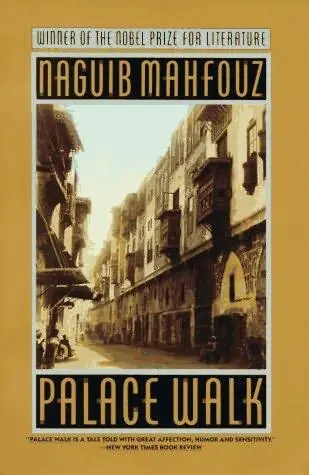
The novels of the Cairo Trilogy trace three generations of the family of tyrannical patriarch al-Sayyid Ahmad Abd al-Jawad, who rules his household with a strict hand while living a secret life of self-indulgence. Palace Walk introduces us to his gentle, oppressed wife, Amina, his cloistered daughters, Aisha and Khadija, and his three sons — the tragic and idealistic Fahmy, the dissolute hedonist Yasin, and the soul-searching intellectual Kamal. The family’s trials mirror those of their turbulent country during the years spanning the two world wars, as change comes to a society that has resisted it for centuries.
Palace Walk — читать онлайн бесплатно полную книгу (весь текст) целиком
Ниже представлен текст книги, разбитый по страницам. Система сохранения места последней прочитанной страницы, позволяет с удобством читать онлайн бесплатно книгу «Palace Walk», без необходимости каждый раз заново искать на чём Вы остановились. Поставьте закладку, и сможете в любой момент перейти на страницу, на которой закончили чтение.
Интервал:
Закладка:
While al-Sayyid Ahmad was recalling all of this, a saying came to his mind: "When your son grows up, make him your brother". Perhaps more than ever before he felt how complicated it is to be a father.
That same week, their mother announced Yasin’s engagement at the coffee hour. Fahmy had learned about it from Yasin himself. Khadija instinctively recognized that there was some relationship between the engagement and her father’s anger at Yasin. She suspected his anger had arisen from Yasin’s desire to get married, going on the analogy of what had happened between her father and Fahmy. She stated her opinion bluntly, but in the form of a question.
Glancing at their mother with shame and embarrassment, Yasin laughed and said, "The truth is that there’s a very strong link between the anger and the engagement".
In order to make a sarcastic joke, Khadija pretended to be skeptical. She said, "Papa can be excused for getting angry, because you won't do him much credit with a close friend like al-Sayyid Muhammad Iffat".
Yasin countered her sarcasm: "Father’s position will become even more difficult when the aforementioned personage learns the bridegroom has a sister like you".
Then Kamal asked, "Will you leave us, Yasin, the way Aisha did?"
His mother replied with a smile, "Of course not. A new sister, the bride, will join our household".
Kamal was relieved at this answer, which he had not been expecting. He was relieved because his storyteller was staying to entertain him with stories, anecdotes, and conviviality. But then he asked why Aisha had not stayed with them too.
His mother replied that it was customary for the bride to move to the bridegroom’s house and not vice versa. Kamal wondered who had established this custom. He dearly wished it had been the other way round, even if he had had to sacrifice Yasin and his droll stories. He was not able to state this desire openly, and so he expressed it with a look directed at his mother.
Fahmy was the only one saddened by the news. Although he was happy for Yasin, marriage had become a subject that awakened his emotions and stirred up his sorrows, just as talk of victory stirs up the sorrows of a mother who has lost her son in a triumphal battle.
43
The carriage set off to take the mother, Khadija and Kamal to Sugar Street. Was Aisha’s wedding the harbinger of a new era of freedom? Would they finally be able to see the world from time to time and breathe its fresh air? Amina had not let herself get her hopes up or become too optimistic. The man who had forbidden her to visit her mother, except on rare occasions, was equally capable of preventing her from calling on her daughter. She could not forget that many days had passed since her daughter’s wedding. Al-Sayyid Ahmad, Yasin, Fahmy, and even Umm Hanafi had visited Aisha, but he had not given her permission to go, and her courage had not been up to asking. She was wary about reminding him that she had a daughter on Sugar Street whom she needed to see. She remained silent, but the image of her little girl never left her mind. When the pain of waiting grew too great to bear, she summoned all her willpower to ask him, "Is my master planning to visit Aisha soon, God willing, so we can be sure she’s all right?"
Suspecting that her question was motivated by a hidden desire, al-Sayyid Ahmad got angry at her, but not because he had decided to prevent her visit. It was typical of him in such cases to wish to grant permission as a gift, without a prior request. He did not want her to think her request had had any influence on him. He assumed she was trying to remind him with this sly question. At an earlier time he had thought about this question apprehensively and had been annoyed to realize that such a visit was unavoidable. So he shouted at her furiously, "Aisha’s in her husband’s house and doesn't need any of us. Besides, I've visited her, and her brothers have too. Why are you anxious about her?"
In her despair and defeat, her heart sank and her throat felt dry. Al-Sayyid Ahmad had decided to punish her for what he considered her unforgivable cunning by remaining silent, as though the subject was closed. He ignored her for a long time, although he glanced stealthily at her sorrowful expression. When it was time for him to leave for work, he said tersely and gruffly, "Go visit her tomorrow".
Her face, which was incapable of hiding any emotion, immediately became radiant with joy. She looked as happy as a child. It did not take long for his anger to return. He shouted at her, "You'll never see her after that, unless her husband allows her to visit us".
She made no reply to this remark but did not forget a promise she had made to Khadija when they discussed bringing up the topic with him. Hesitantly and apprehensively she asked, "Will my master allow me to take Khadija?"
He shook his head as though to say, "God’s will be done… God’s will be done". Then he replied sharply, "Of course, of course! Since I've agreed to let my daughter get married, my family’s got to join the demimonde parading through the streets. Take her! May our Lord take all of you away".
Her joy was even more complete than she had thought possible. She paid no attention to the final curse, which she often heard when he was angry or pretending to be angry. She knew it came from his lips and not his heart, which felt quite the opposite way. He was like a mother cat which appears to be devouring her kittens when she is actually carrying them.
The wish was granted, and the vehicle started on its way to Sugar Street. Kamal seemed happiest of all, for three reasons. He was going to visit Aisha, he was on an excursion with his mother and sister, and he was riding in a carriage. As though he could not keep his joy a secret and wished to announce it to everyone or attract attention to himself sitting in the carriage between his mother and sister, he suddenly stood up and cried out, "Amm Hasanayn, look!" when the vehicle approached the barbershop. The man looked at him. Discovering that Kamal was not alone, he quickly lowered his eyes and smiled. The mother was terribly embarrassed and upset. She grabbed Kamal by the edge of his jacket, so he would not repeat his performance as they passed the other shops, and scolded him for the crazy thing he had done.
The house on Sugar Street appeared to be ancient, a relic. It looked quite different without its decorative wedding lights. The very age and mass of the building and the expensive furnishings all suggested power and prestige. The Shawkats were an old family, although not much was left of their former glory, except their name, especially since the family fortune had been divided up over the years by inheritance. The fact that they shunned modern education had not helped either. The bride had taken up residence on the second floor. Because of her age, Widow Shawkat had difficulty climbing the stairs and moved down to the first floor with her elder son, Ibrahim. The third floor remained vacant. They did not try to use it and refused to rent it out.
When the family entered Aisha’s apartment, Kamal wanted to rush off on his own, the way he would at home, in order to scout around until he found his sister all by himself. He looked forward to the pleasure of the surprise and pictured it to himself as he climbed up the stairs, but his mother would not let him escape from her grip, no matter how hard he tried. Before he knew what was happening, the servant had led them to the parlor and left them there alone. Kamal felt they were being treated like strangers or company. He was dejected and depressed and began to repeat with alarm, "Where’s Aisha?… Why are we waiting here?"
The only answer he received was "hush" and a warning that he would not be allowed to visit again if he raised his voice. His pain quickly left him once Aisha came running in, her face beaming with a smile of such brilliance it outshone her magnificent clothes and dazzling finery. Kamal ran to her and put his arms around her neck. He clung to her all the time she was exchanging greetings with her mother and sister.
Читать дальшеИнтервал:
Закладка:
Похожие книги на «Palace Walk»
Представляем Вашему вниманию похожие книги на «Palace Walk» списком для выбора. Мы отобрали схожую по названию и смыслу литературу в надежде предоставить читателям больше вариантов отыскать новые, интересные, ещё непрочитанные произведения.











Обсуждение, отзывы о книге «Palace Walk» и просто собственные мнения читателей. Оставьте ваши комментарии, напишите, что Вы думаете о произведении, его смысле или главных героях. Укажите что конкретно понравилось, а что нет, и почему Вы так считаете.