Hermann Hesse - The Glass Bead Game
Здесь есть возможность читать онлайн «Hermann Hesse - The Glass Bead Game» весь текст электронной книги совершенно бесплатно (целиком полную версию без сокращений). В некоторых случаях можно слушать аудио, скачать через торрент в формате fb2 и присутствует краткое содержание. Год выпуска: 1969, Жанр: Современная проза, Социально-психологическая фантастика, на английском языке. Описание произведения, (предисловие) а так же отзывы посетителей доступны на портале библиотеки ЛибКат.
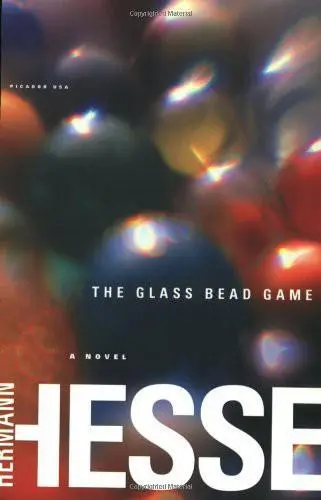
- Название:The Glass Bead Game
- Автор:
- Жанр:
- Год:1969
- ISBN:нет данных
- Рейтинг книги:4 / 5. Голосов: 2
-
Избранное:Добавить в избранное
- Отзывы:
-
Ваша оценка:
The Glass Bead Game: краткое содержание, описание и аннотация
Предлагаем к чтению аннотацию, описание, краткое содержание или предисловие (зависит от того, что написал сам автор книги «The Glass Bead Game»). Если вы не нашли необходимую информацию о книге — напишите в комментариях, мы постараемся отыскать её.
Something like chess but far more intricate, the game of Magister Ludi known as the Glass Bead Game is thought in its purest form, a synthesis through which philosophy, art, music and scientific law are appreciated simultaneously. The scholar-players are isolated within Castalia, an autonomous elite institution devoted wholly to the mind and the imagination…
The Glass Bead Game — читать онлайн бесплатно полную книгу (весь текст) целиком
Ниже представлен текст книги, разбитый по страницам. Система сохранения места последней прочитанной страницы, позволяет с удобством читать онлайн бесплатно книгу «The Glass Bead Game», без необходимости каждый раз заново искать на чём Вы остановились. Поставьте закладку, и сможете в любой момент перейти на страницу, на которой закончили чтение.
Интервал:
Закладка:
“I understand,” Master Alexander said. “But no matter how I regard it and no matter how you try to represent it, I come up against the same reason, for your singularities. You have an excessive sense of your own person, or dependence on it, which is far from the same thing as being a great personality. A man can be a star of the first magnitude in gifts, will-power, and endurance, but so well balanced that he turns with the system to which he belongs without any friction or waste of energy. Another may have the same great gifts, or even finer ones, but the axis does not pass precisely through the center and he squanders half his strength in eccentric movements which weaken him and disturb his surroundings. You evidently belong to this type. Only I must admit that you have contrived to conceal it remarkably. For that very reason the malady seems to be breaking out now with all the greater virulence. You spoke of St. Christopher, and I must say that although there is something grand and touching about this saint, he is not a model for a servant of our hierarchy. One who wishes to serve should abide by the master he has sworn to serve for good and ill, and not with the secret reservation that he will change as soon as he finds a more magnificent master. In assuming such an attitude the servant makes himself his master’s judge, and this indeed is what you are doing. You always want to serve the highest master, and are naive enough to decide for yourself the rank of the masters among whom you make your choice.”
Knecht had listened attentively, although a shadow of sadness passed across his face. Now he continued: “I respect your opinion, and could not have imagined that it would be any different. But let me go on with my story just a little longer. I became Magister Ludi and in fact was sure for a good while that I was serving the highest of all masters. At any rate my friend Designori, our patron in the Federal Council, once described to me in extremely vivid terms what an arrogant, conceited, blasé elitist and virtuoso of the Game I once was. But I must also tell you the meaning that the word ‘transcend’ has had for me since my student years and my ‘awakening.’ It came to me, I think, while reading a philosopher of the Enlightenment, and under the influence of Master Thomas von der Trave, and ever since then it has been a veritable magic word for me, like ‘awakening,’ an impetus, a consolation, and a promise. My life, I resolved, ought to be a perpetual transcending, a progression from stage to stage; I wanted it to pass through one area after the next, leaving each behind, as music moves on from theme to theme, from tempo to tempo, playing each out to the end, completing each and leaving it behind, never tiring, never sleeping, forever wakeful, forever in the present. In connection with the experiences of awakening, I had noticed that such stages and such areas exist, and that each successive period in one’s life bears within itself, as it is approaching its end, a note of fading and eagerness for death. That in turn leads to a shifting to a new area, to awakening and new beginnings. I am telling you about the significance to me of transcending in order to provide another clue which may help you interpret my life. The decision in favor of the Glass Bead Game was an important stage, as was the first time I took my place in the hierarchy by accepting an assignment. I have also experienced such movements from stage to stage in my office as Magister. The best thing the office has given me was the discovery that making music and playing the Glass Bead Game are not the only happy activities in life, that teaching and educating can be just as exhilarating. And I gradually discovered, furthermore, that teaching gave me all the more pleasure, the younger and more unspoiled by miseducation the pupils were. This too, like many other things, led me in the course of the years to desire younger and younger pupils, so that I would have liked most to have become a teacher in an elementary school. In short, at times my imagination dwelt on matters which in themselves lay outside my functions.”
He paused for a moment to rest. The President remarked: “You astonish me more and more, Magister. Here you are speaking about your own life, and you mention scarcely anything but subjective experiences, personal wishes, personal developments and decisions. I really had no idea that a Castalian of your rank could see himself and his life in such a light.”
His voice had a note between reproach and sorrow. It pained Knecht, but he remained equable and exclaimed merrily: “Esteemed Magister, we are not speaking about Castalia, about the Board and the hierarchy at the moment, but only about me, about the psychology of a man who unfortunately has been forced to cause you great inconvenience. It would be improper for me to speak of my conduct of office, the way I have met my obligations, my value or lack of it as a Castalian and Magister. My conduct of office lies open before you. You can easily look into it, as you can into the entire exterior of my life. You will not find much to censure. But what we are concerned with here is something wholly different. I am trying to show you the path I have trodden as an individual, which has led me out of Waldzell and will lead me out of Castalia tomorrow. Please, be so kind as to listen to me a little while longer.
“My consciousness of a world outside our little Province I owe not to my studies, in which this world occurred only as the remote past, but primarily to my fellow student Designori, who was a guest from outside, and later to my stay among the Benedictines, and to Father Jacobus. What I have seen of the world with my own eyes is very little, but Father Jacobus gave me an inkling of what is called history. And it may be that in acquiring that I was laying the groundwork for the isolation into which I stumbled after my return. I returned from the monastery into a land where history virtually didn’t exist, into a Province of scholars and Glass Bead Game players, a highly refined and extremely pleasant society, but one in which I seemed to stand entirely alone with my smattering of the world, my curiosity about that world, and my sympathy for it. To be sure, there was enough to compensate me here. There were several men I revered, so that I felt all at once abashed, delighted, and honored to work with them as their colleague, and there were a large number of well-bred and highly cultivated people. There was also work aplenty and a great many talented and lovable students. The trouble was that during my apprenticeship under Father Jacobus I had made the discovery that I was not only a Castalian, but also a man; that the world, the whole world, concerned me and exerted certain claims upon me. Needs, wishes, demands, and obligations arose out of this discovery, but I was in no position to meet any of them. Life in the world, as the Castalian sees it, is something backward and inferior, a life of disorder and crudity, of passions and distractions, devoid of all that is beautiful or desirable. But the world and its life was in fact infinitely vaster and richer than the notions a Castalian has of it; it was full of change, history, struggles, and eternally new beginnings. It might be chaotic, but it was the home and native soil of all destinies, all exaltations, all arts, all humanity; it had produced languages, peoples, governments, cultures; it had also produced us and our Castalia and would see all these things perish again, and yet survive. My teacher Jacobus had kindled in me a love for this world which was forever growing and seeking nourishment. But in Castalia there was nothing to nourish it. Here we were outside of the world; we ourselves were a small, perfect world, but one no longer changing, no longer growing.”
He took a deep breath and fell silent for a while. Since the president made no reply, and only looked expectantly at him, he gave a pensive nod and continued: “For me, this meant bearing two burdens, and I did so for a good many years. I had to administer an important office and meet its responsibilities, and I had to deal with this love for the world. My office, I realized from the outside, must not suffer because of this love. On the contrary, I thought it ought to benefit. I hoped to carry out my duties as thoroughly and irreproachably as a Magister is expected to; but if I should fall short in these, I nevertheless knew that inwardly I was more alert and alive than a good many of my more punctilious colleagues, and that I had something to give to my students and associates. I regarded it as my mission to expand Castalian life and thought slowly and gently without breaking with tradition, to add to its warmth, to infuse it with new blood from the world and from history. By the happy workings of Providence, at the same time, outside in our country, a man of the world had precisely the same thought. He dreamed of a rapprochement and interpenetration of Castalia and the world. That man was Plinio Designori.”
Читать дальшеИнтервал:
Закладка:
Похожие книги на «The Glass Bead Game»
Представляем Вашему вниманию похожие книги на «The Glass Bead Game» списком для выбора. Мы отобрали схожую по названию и смыслу литературу в надежде предоставить читателям больше вариантов отыскать новые, интересные, ещё непрочитанные произведения.








Обсуждение, отзывы о книге «The Glass Bead Game» и просто собственные мнения читателей. Оставьте ваши комментарии, напишите, что Вы думаете о произведении, его смысле или главных героях. Укажите что конкретно понравилось, а что нет, и почему Вы так считаете.