Hermann Hesse - The Glass Bead Game
Здесь есть возможность читать онлайн «Hermann Hesse - The Glass Bead Game» весь текст электронной книги совершенно бесплатно (целиком полную версию без сокращений). В некоторых случаях можно слушать аудио, скачать через торрент в формате fb2 и присутствует краткое содержание. Год выпуска: 1969, Жанр: Современная проза, Социально-психологическая фантастика, на английском языке. Описание произведения, (предисловие) а так же отзывы посетителей доступны на портале библиотеки ЛибКат.
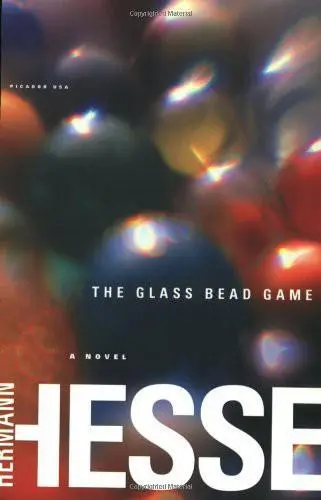
- Название:The Glass Bead Game
- Автор:
- Жанр:
- Год:1969
- ISBN:нет данных
- Рейтинг книги:4 / 5. Голосов: 2
-
Избранное:Добавить в избранное
- Отзывы:
-
Ваша оценка:
The Glass Bead Game: краткое содержание, описание и аннотация
Предлагаем к чтению аннотацию, описание, краткое содержание или предисловие (зависит от того, что написал сам автор книги «The Glass Bead Game»). Если вы не нашли необходимую информацию о книге — напишите в комментариях, мы постараемся отыскать её.
Something like chess but far more intricate, the game of Magister Ludi known as the Glass Bead Game is thought in its purest form, a synthesis through which philosophy, art, music and scientific law are appreciated simultaneously. The scholar-players are isolated within Castalia, an autonomous elite institution devoted wholly to the mind and the imagination…
The Glass Bead Game — читать онлайн бесплатно полную книгу (весь текст) целиком
Ниже представлен текст книги, разбитый по страницам. Система сохранения места последней прочитанной страницы, позволяет с удобством читать онлайн бесплатно книгу «The Glass Bead Game», без необходимости каждый раз заново искать на чём Вы остановились. Поставьте закладку, и сможете в любой момент перейти на страницу, на которой закончили чтение.
Интервал:
Закладка:
Knecht nodded. “Running amok though I am, I pause to express my gladness. I have no indictments to make. What I wish to say — if only it were not so hard, so incredibly hard to put into words — seems to me a justification; to you it may be a confession.”
He leaned back in his chair and looked up, where traces of Hirsland’s former days as a monastery showed in the vault of the ceiling, in sparse, dreamlike lines and colors, patterns of flowers and ornamentation.
“The idea that even a Magister could tire of his post and resign it first came to me only a few months after my appointment as Magister Ludi. One day I was sitting reading a little book by my once famous predecessor Ludwig Wassermaler, a journal of the official year, in which he offers guidance to his successors. There I read his admonition to give timely thought to the public Glass Bead Game for the coming year. If you felt no eagerness for it and lacked ideas, he wrote, you should try to put yourself into the right mood by concentration. With my strong awareness of being the youngest Magister, I smiled when I read this. With the brashness of youth I was a bit amused at the anxieties of the old man who had written it. But still I also heard in it a note of gravity and dread, of something menacing and oppressive. Reflecting on this, I decided that if ever the day came when the thought of the next festival game caused me anxiety instead of gladness, fear instead of pride, I would not struggle to work out a new festival game, but would at once resign and return the emblems of my office to the Board. This was the first time that such a thought presented itself to me. At the time I had just come through the great exertions of mastering my office, and had all my sails spread to the wind, so to speak. In my heart I did not really believe in the possibility that I too might some day be an old man, tired of the work and of life, that I might some day be unequal to the task of tossing off ideas for new Glass Bead Games. Nevertheless, I made the decision at that time. You knew me well in those days, your Reverence, better perhaps than I knew myself. You were my adviser and father confessor during that first difficult period in office, and had taken your departure from Waldzell only a short while before.”
Alexander gave him a searching look. “I have scarcely ever had a finer assignment,” he said, “and was then content, in a way that one rarely is, with you and myself. If it is true that we must pay for everything pleasant in life, then I must now atone for my elation at that time. I was truly proud of you then. I cannot be so today. If you cause the Order disappointment, if you shock all of Castalia, I know that I share the responsibility. Perhaps at that time, when I was your companion and adviser, I should have stayed in your Players’ Village a few weeks longer, or handled you somewhat more roughly, subjected you to stricter examination.”
Knecht cheerfully returned his look. “You must not have such misgivings, Domine , or I should have to remind you of various admonishments you felt called upon to give me at the time when I, as the youngest Magister, took the duties of my office too seriously. At one such moment you told me — I have just remembered this — that if I, the Magister Ludi, were a scoundrel or an incompetent and did everything a Magister is forbidden to do, in fact if I deliberately set out to use my high position to do as much harm as possible, all this would no more disturb our dear Castalia or affect it any more profoundly than a pebble that is thrown into a lake. A few ripples and circles and all trace is gone. That is how firm, how secure our Castalian Order is, how inviolable its spirit, you said. Do you recall? No, you are certainly not to blame for any efforts of mine to be as bad a Castalian as possible and to do the greatest possible harm to the Order. Moreover, you also know that what I do cannot shake your own tranquility. But I want to go on with my story. The fact that I could make such a decision at the very beginning of my magistracy, and that I did not forget it, but am now about to carry it out — that fact is related to a kind of spiritual experience I have from time to time, which I call awakening. But you already know about that; I once spoke to you about it, when you were my mentor and guru. In fact I complained to you at the time that since my accession to office that experience had not come to me, and seemed to be vanishing more and more into the distance.”
“I remember,” the President agreed. “I was somewhat taken aback at the time by your capacity for this kind of experience; it is rather rare among us, whereas in the world outside it occurs in so many varied forms: sometimes in the genius, especially in statesmen and generals, but also in feeble, semi-pathological, and on the whole rather meagerly gifted persons such as clairvoyants, telepaths, and mediums. You seemed to me to have no kinship at all with these two types, the aggressive heroes or the clairvoyants and diviners. Rather you seemed to me then, and until yesterday, to be a good Castalian, prudent, clearheaded, obedient. I thought it completely out of the question that you should ever be the victim of mysterious voices, whether of divine or diabolic origin, or even voices from within your own self. Therefore I interpreted the states of ‘awakening’ which you described to me simply as your becoming aware occasionally of personal growth. Given that interpretation, it followed that these spiritual insights would not be coming your way for a considerable time. After all, you had just entered office and had assumed a task which still hung loosely around you like an overcoat too big for you — you would still have to grow into it. But tell me this: have you ever believed that these awakenings are anything like revelations from higher powers, communications or summons from the realm of an objective, eternal, or divine truth?”
“In saying this,” Knecht replied, “you bring me to my present difficulty: to express in words something that refuses to be put into words; to make rational what is obviously extrarational. No, I never thought of those awakenings as manifestations of a god or daimon or of some absolute truth. What gives these experiences their weight and persuasiveness is not their truth, their sublime origin, their divinity or anything of the sort, but their reality. They are tremendously real, somewhat the way a violent physical pain or a surprising natural event, a storm or earthquake, seem to us charged with an entirely different sort of reality, presence, inexorability, from ordinary times and conditions. The gust of wind that precedes a thunderstorm, sending us into the house and almost wrenching the front door away from our hand — or a bad toothache which seems to concentrate all the tensions, sufferings, and conflicts of the world in our jaw — these are such realities. Later on we may start to question them or examine their significance, if that is our bent; but at the moment they happen they admit no doubts and are brimful of reality. My ‘awakening’ has a similar kind of intensified reality for me. That is why I have given it this name; at such times I really feel as if I had lain asleep or half asleep for a long time, but am now awake and clearheaded and receptive in a way I never am ordinarily. In history, too, moments of tribulation or great upheavals have their element of convincing necessity; they create a sense of irresistible immediacy and tension. Whatever the consequence of such upheavals, be it beauty and clarity or savagery and darkness, whatever happens will bear the semblance of grandeur, necessity, and importance and will stand out as utterly different from everyday events.”
He paused to catch his breath, then continued: “But let me try to examine this matter from another angle. Do you recall the legend of St. Christopher? Yes? Well now, Christopher was a man of great strength and courage, but he wanted to serve rather than to be a master and govern. Service was his strength and his art; he had a faculty for it. But whom he served was not a matter of indifference to him. He felt that he had to serve the greatest, the most powerful master. And when he heard of a mightier master, he promptly offered his services. I have always been fond of this great servant, and I must in some way resemble him. At any rate, during the one period in my life when I had command over myself, during my student years, I searched and vacillated for a long time before deciding what master to serve. For years I remained mistrustful of the Glass Bead Game and fended it off, although I had long ago recognized it as the most precious and characteristic fruit of our Province. I had tasted the bait and knew that there was nothing more attractive and more subtle on earth than the Game. I had also observed fairly early that this enchanting Game demanded more than naive amateur players, that it took total possession of the man who had succumbed to its magic. And an instinct within me rebelled against my throwing all my energies and interests into this magic forever. Some naive feeling for simplicity, for wholeness and soundness, warned me against the spirit of the Waldzell Vicus Lusorum. I sensed in it a spirit of specialism and virtuosity, certainly highly cultivated, certainly richly elaborated, but nevertheless isolated from humanity and the whole of life — a spirit that had soared too high into haughty solitariness. For years I doubted and probed, until the decision had matured within me and in spite of everything I decided in favor of the Game. I did so because I had within me that urge to seek the supreme fulfillment and serve only the greatest master.”
Читать дальшеИнтервал:
Закладка:
Похожие книги на «The Glass Bead Game»
Представляем Вашему вниманию похожие книги на «The Glass Bead Game» списком для выбора. Мы отобрали схожую по названию и смыслу литературу в надежде предоставить читателям больше вариантов отыскать новые, интересные, ещё непрочитанные произведения.










Обсуждение, отзывы о книге «The Glass Bead Game» и просто собственные мнения читателей. Оставьте ваши комментарии, напишите, что Вы думаете о произведении, его смысле или главных героях. Укажите что конкретно понравилось, а что нет, и почему Вы так считаете.